There’s a moment after your first 5K when you catch yourself thinking, what if I went further? Maybe it was the finish line high. Maybe a friend signed up for a half and asked you to join. Maybe you just want to prove to yourself that you can.
Whatever got you here, welcome. The half marathon, 13.1 miles or 21.1 kilometers, is one of the most rewarding goals a newer runner can chase. It’s long enough to feel like a real accomplishment and short enough that you can train for it without running your life into the ground.
This guide picks up where our 5K walk-to-run plan leaves off. You’ll find a 12-week training plan, the research on avoiding injury, simple fueling rules, what to do on race day and plenty of permission to walk, rest and go at your own pace. Because the goal is to cross that finish line feeling strong, not broken.
Why the half marathon is having a moment
If you feel like every woman you know is training for a half, you’re not imagining it. Running USA reported that in 2013, nearly two million people finished a U.S. half marathon, and 61% of them were women. The half has been one of the most popular race distances in the country for years, and it’s the distance where women make up the biggest share of finishers.
There’s a reason. The half is a sweet spot:
- 📅DoableFits a real life
Most beginner plans take about 12 weeks with 3 or 4 runs a week. That’s a season, not a lifestyle overhaul.
- 🏅MeaningfulA real milestone
13.1 miles is far enough that finishing feels huge, whether you run every step or mix in walking.
- 👭SocialBetter with friends
Many half marathons have a festive, supportive vibe, and training partners make long runs fly by.
- 💚RecoveryKinder than a full
Training load and recovery are much more manageable than marathon prep, especially if you’re juggling work and family.
Are you ready to start?
You don’t need to be fast. You do need a little base. Before starting the 12-week plan below, it helps if you can:
- Run (or run-walk) about 3 miles without needing to stop for a long break.
- Run 3 times a week fairly consistently for at least a month or two.
- Feel pain-free when you run, with no nagging injury you’re trying to push through.
Not there yet? That’s completely fine. Start with our 10-week walk-to-run 5K plan, then come back. Every half marathoner started with a first short run.
Check in with your doctor first if you have a heart condition, high blood pressure, diabetes, are pregnant or recently postpartum, or have any health concern. If you’re a newer mom, our post on postpartum exercise covers getting cleared and rebuilding gently.
Five training rules that actually matter
Before the plan, the principles. These are the things that separate a fun training season from an injured one.
1. Build slowly. Your body needs time.
Your heart and lungs adapt to running faster than your bones, tendons and muscles do. That gap is where injuries happen. You may feel ready to run farther before your body actually is.
Research backs this up. A study in the Journal of Orthopaedic & Sports Physical Therapy followed 261 runners preparing for a half marathon over 14 weeks. About 21.5% got a running-related injury during the study. Three weeks in, significantly more runners were injured when they increased their weekly distance by 20% to 60% compared with those who increased it by less than 20%.
An earlier study of 873 new runners found that those who increased their weekly distance by more than 30% over two weeks seemed more vulnerable to certain overuse injuries than those who increased it by less than 10%. You may have heard of the “10% rule.” The research is less precise than that, and a systematic review called the overall evidence limited. But the message is consistent: avoid big jumps.
2. Most of your running should feel easy
This surprises a lot of new runners. Sports scientist Stephen Seiler’s research found that elite endurance athletes do the large majority of their training at a low intensity, an idea popularized as “80/20” training. About 80% easy, about 20% harder.
For you, that means most runs should be at a conversational pace, where you could chat with a friend in full sentences. If you’re huffing, slow down or take a walk break. Easy running builds your aerobic engine, and it’s much easier on your body.
3. Walking is allowed
Run-walk intervals are a legitimate strategy, not cheating. Plenty of women finish half marathons running 4 minutes and walking 1, or running 2 and walking 1. Walking breaks can reduce fatigue and help you finish strong. If it gets you to the finish line happy and healthy, it’s the right method.
4. Rest is part of training
Your body gets stronger during recovery, not during the run. Rest days, sleep and lighter “cutback” weeks are built into the plan for a reason. Skip them and you’re more likely to get hurt or burn out.
5. Consistency beats heroics
One amazing long run won’t make your race. Twelve weeks of showing up, mostly at an easy pace, will. Missing a run here and there is normal. Don’t try to make it up by doubling the next one.
You don’t have to be fast. You just have to keep showing up, a little at a time.
The 12-week first half marathon plan
This plan is built for women who can comfortably cover 3 miles. It has three runs a week, two short strength sessions and plenty of rest. Run-walking is welcome on every single run.
How a typical week looks
- MondayRest or gentle walk
- TuesdayEasy run
- WednesdayStrength training (20 to 30 minutes)
- ThursdayWorkout run: easy miles with a few short pickups
- FridayRest or strength training
- SaturdayLong run
- SundayRest, walk, yoga or easy bike ride
Move the days around to fit your life. Just try not to put two hard days back to back, and keep at least one full rest day each week.
The plan, week by week
| Week | Easy run | Workout run | Long run |
|---|---|---|---|
| 1 | 2 miles | 2 miles easy | 3 miles |
| 2 | 2 miles | 2.5 miles with 4 strides | 4 miles |
| 3 | 3 miles | 2.5 miles with 4 strides | 4 miles |
| 4 (easier) | 2 miles | 2 miles easy | 3 miles |
| 5 | 3 miles | 3 miles with 6 strides | 5 miles |
| 6 | 3 miles | 3 miles with 10 minutes steady | 6 miles |
| 7 (easier) | 2 miles | 3 miles easy | 5 miles |
| 8 | 3 miles | 3.5 miles with 15 minutes steady | 7 miles |
| 9 | 3 miles | 4 miles with 15 minutes steady | 8 miles |
| 10 | 3 miles | 4 miles with 6 strides | 9 to 10 miles |
| 11 (taper) | 3 miles | 3 miles with 10 minutes at goal effort | 6 miles |
| 12 (race week) | 2 miles | 2 miles with 4 strides | Race day, 13.1 miles |
Weekly totals start around 7 miles and peak around 16 to 17, rising only about 10% to 15% from one regular week to the next. The bump after each easier week is just a return to where you were. Prefer minutes to miles? Swap each mile for about 10 to 13 minutes of easy running or run-walking, depending on your pace.
What the workout words mean
- Easy: Conversational pace. You could talk in full sentences. Walk breaks welcome.
- Strides: After your easy run, do short 15 to 20 second pickups where you run quicker and smoother, almost fast but relaxed. Walk or jog slowly for a minute between each one.
- Steady: A comfortably hard effort where you could speak a few words, not full sentences. Warm up with at least a mile easy first.
- Goal effort: The effort you hope to hold on race day. It should feel controlled, not hard.
- Easier weeks: Weeks 4 and 7 cut back on purpose so your body can absorb the training. Don’t skip them.
If life happens
Got sick? Kid had a bad week? Work exploded? Here’s the rule of thumb most coaches use: if you missed a few days, just pick up where you are. If you missed a week or more, repeat the last week you completed before moving on. If you’re feeling run down, it’s always okay to shorten a run or swap it for a walk.
The long run, your weekly anchor
The long run is the heart of half marathon training. It builds endurance, teaches your body to burn fuel efficiently and, maybe most importantly, gives you the confidence that you can keep going.
- Go slow. Your long run should be your easiest pace of the week. Many coaches suggest 1 to 2 minutes per mile slower than your goal race pace.
- You don’t need to run 13.1 before race day. Most beginner plans peak around 9 to 10 miles. Race-day adrenaline, a taper and the crowd will carry you the rest.
- Practice everything. Wear your race-day shoes and outfit. Try your fuel. Eat your planned breakfast. Nothing new on race day.
- Plan your route. Loops near home or your car make water and bathroom stops easy.
- Bring a friend or a podcast. Time flies with company. Our podcast list has plenty of walk and run-friendly shows.
Strength training, your injury insurance
If you only add one thing to your running, make it strength training. A 2014 meta-analysis of 25 trials and 26,610 participants found that strength training reduced sports injuries to less than one-third, and overuse injuries could be almost halved. Stretching, in the same analysis, showed no protective effect. A 2018 follow-up found that more strength training volume meant more protection.
You don’t need a gym. Two 20 to 30 minute sessions a week with a pair of dumbbells is plenty. Focus on:
- 🦵LegsSquats and lunges
Goblet squats, split squats, reverse lunges and step-ups build the muscles that absorb every stride.
- 🍑HipsGlutes
Glute bridges, hip thrusts and side-lying leg raises help keep your knees and hips stable.
- 🦶Lower legsCalves and ankles
Calf raises (straight and bent knee) and single-leg balance work help protect your Achilles and shins.
- 💪CoreTrunk strength
Dead bugs, side planks and bird dogs keep your posture strong when you get tired late in a run.
Want a ready-made routine? Our 20-minute dumbbell workout works well on your strength days, and our home gym under $100 post covers the gear.
A note on your pelvic floor
Leaking a little when you run is common, especially after having babies, but it isn’t something you just have to live with. Research has found urinary leakage during high-impact activities like running in a large share of active women. A pelvic floor physical therapist can assess you and give you exercises that actually help. If you’re having leaking, heaviness or pain, it’s worth a visit.
Fueling and water
Training for a half marathon means you need more fuel, not less. This isn’t the time to cut back on food. Running on empty makes training feel harder and raises your risk of injury.
Everyday eating
- Carbohydrates are your friend. Oats, rice, potatoes, bread, pasta, fruit. They fuel your running.
- Protein helps you recover. Spread it through the day: eggs, yogurt, beans, chicken, fish, tofu. Our protein powder guide can help if you need an easy boost.
- Eat after your runs. A snack or meal with carbs and protein within an hour or two helps you recover.
Fueling during long runs
For runs under about an hour, you generally don’t need to eat during the run. Once you get past that, fueling helps. The American College of Sports Medicine has long recommended about 30 to 60 grams of carbohydrate per hour during longer endurance exercise to help maintain blood sugar.
For most newer half marathoners, that might look like one energy gel or a handful of chews every 30 to 45 minutes after the first 45 minutes or so. Some women prefer real food like dates, pretzels or banana pieces. Practice on your long runs so your stomach is ready on race day.
Water: enough, not too much
Drinking to thirst works well for most people. But it’s worth knowing that drinking too much can be dangerous, too. A study of the 2002 Boston Marathon found that 13% of finishers tested had low blood sodium (hyponatremia), and among women, the figure was 22%. Longer finishing times and drinking frequently were risk factors.
Half marathons carry less risk than full marathons, but the lesson holds: sip when you’re thirsty, don’t force water at every station and consider a sports drink with electrolytes on longer or hotter runs. Want to keep water interesting on regular days? Try our infused water ideas.
Listen to your body
Training should make you tired in a good way. Here’s how to tell the difference between normal training soreness and signs to take seriously.
- Usually fineWhat you feel
General muscle soreness a day or two after a long run, especially in your thighs or calves.
What to doNormal. Keep moving gently, sleep well, eat enough and it should ease within a couple of days.
- Back offWhat you feel
Pain that changes how you run, gets worse as you go, or is still there the next morning.
What to doTake a few days off running. If it doesn’t improve, see a doctor or physical therapist.
- Get checkedWhat you feel
Pinpoint pain on a bone (like your shin or foot) that hurts to touch or when you hop.
What to doStop running and see a doctor. This can be a sign of a stress fracture.
- Pay attentionWhat you feel
Missed or irregular periods, constant exhaustion, frequent injuries or feeling cold all the time.
What to doTalk to your doctor. These can be signs you’re not eating enough to support your training.
Losing your period isn’t a badge of honor
Some runners have been told that missing periods is just part of training hard. It isn’t. When your body doesn’t get enough energy to cover training and everyday functions, it can lead to a condition called relative energy deficiency in sport, or REDs. Signs include missed or irregular periods, fatigue, mood changes and a higher risk of injuries like stress fractures. If this sounds familiar, please talk to your doctor or a registered sports dietitian.
And if food or exercise ever starts to feel like it’s controlling you, you deserve support. The National Alliance for Eating Disorders helpline is 1-866-662-1235. You can also check our guide to who does what when it comes to coaches, dietitians and therapists.
Gear you actually need
Running is wonderfully simple, but a few things make 13.1 miles much more comfortable. These links go to general Amazon searches or brand stores so you can compare, and we don’t earn anything from them.
-
Good running shoes
The most important purchase
Comfort is the best guide. Get fitted at a local running store if you can, and consider replacing shoes every 300 to 500 miles.
Read first: Our full guide to the best running shoes for women.
-
A supportive sports bra
Non-negotiable
Look for high-impact support that fits snugly without digging. Test it on a long run before race day.
Look for: High-impact support, adjustable straps and moisture-wicking fabric.
-
Moisture-wicking socks
Blister prevention
Cotton socks hold sweat and cause blisters. Synthetic or merino wool running socks keep feet drier.
Look for: Cushioned running socks with a seamless toe.
-
A running belt or vest
For long runs
Holds your phone, keys and gels without bouncing. A small handheld bottle or hydration vest helps on longer runs.
Look for: A no-bounce belt with room for your phone and two or three gels.
-
Energy gels or chews
Practice on long runs
Try a few kinds during training to find what your stomach likes. Check what the race offers on course, too.
Look for: Variety packs, so you can try a few flavors and textures.
-
Anti-chafe balm
Thank us later
Long runs mean friction. A little balm on your bra line, thighs and underarms saves a lot of stinging in the shower.
Look for: A stick-style balm that goes on clean and lasts.
A GPS watch is nice to have, but not required. A free running app on your phone works fine for tracking distance.
Taper week: trust the plan
In the last two weeks, you’ll run less. This is called the taper, and it lets your body recover fully so you show up on race day fresh. A well-known 2007 meta-analysis of tapering research found that cutting training volume by about 41% to 60% while keeping some intensity was linked to the biggest performance gains, with a taper of about two weeks.
Tapering can feel strange. You might feel restless, sluggish or worried you’re losing fitness. You’re not. Your fitness is built. Now you’re letting it shine.
- Keep running, just less. Short runs with a few strides keep your legs feeling peppy.
- Sleep more if you can. The nights before race week matter more than the night before the race.
- Eat normally, with a little extra carbohydrate in the last day or two.
- Don’t try anything new. No new shoes, new foods or new workouts.
- Plan logistics. Packet pickup, parking, start time and where you’ll meet your people after.
Race day
The night before
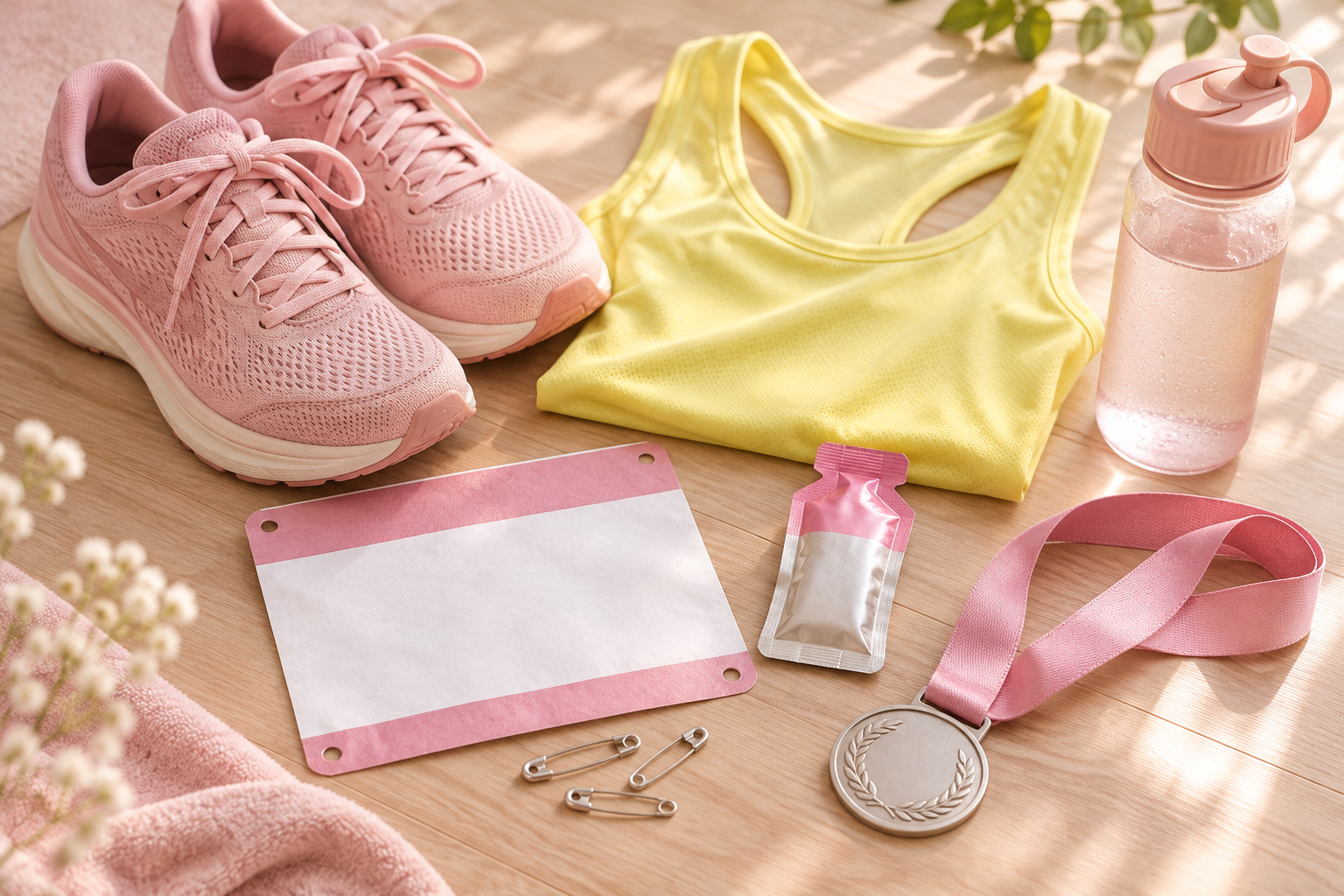
- Lay out everything: outfit, bib with pins, shoes, socks, watch, fuel, anti-chafe balm, a throwaway layer for the start.
- Eat a familiar dinner. Nothing too heavy, spicy or new.
- Set two alarms. Then try to rest, even if you don’t sleep much. Pre-race nerves are normal.
Race morning
- Eat the breakfast you practiced, about 2 to 3 hours before the start. Toast with peanut butter, oatmeal or a bagel with banana are popular choices.
- Arrive early. Bathroom lines get long.
- Do a gentle warm-up walk or a few minutes of easy jogging.
During the race
- Start slower than you think. The crowd and adrenaline make it easy to go out too fast. Hold back for the first few miles.
- Follow your plan. Run-walk if you trained that way. Fuel when you practiced fueling.
- Break it into pieces. Think in chunks: get to mile 3, then mile 6, then the 10K mark, then just a 5K left.
- Use the water stations wisely. Sip when you’re thirsty. Walking through water stations is completely fine.
- Expect a tough stretch. Many runners hit a low point around miles 9 to 11. It passes. Smile at a spectator, read the signs, think about who you’re running for.
- Soak in the finish. Look up when you cross the line. You’ll want to remember this.
After the finish
You did it. Grab your medal, a banana, some water and a photo. Then:
- Keep walking for a few minutes to help your legs ease out.
- Eat a real meal within a couple of hours, with carbs and protein.
- Expect soreness for a few days, especially going down stairs. It’s normal.
- Rest. Take at least a few days off running, then ease back in with short, easy runs for a week or two.
- Celebrate. Seriously. You trained for months and ran 13.1 miles. That’s huge. It belongs on your list of non-scale wins.
Half marathon myths
- Myth #1What you’ve heard
“You have to run the whole thing for it to count.”
The truthRun-walking is a proven strategy, and every finisher gets the same medal. Finishing is finishing.
- Myth #2What you’ve heard
“You need to run 13 miles in training first.”
The truthMost beginner plans peak around 9 to 10 miles. The taper and race-day energy carry you the rest.
- Myth #3What you’ve heard
“Every run should be hard to make progress.”
The truthMost of your training should feel easy. That’s how endurance athletes at every level train.
- Myth #4What you’ve heard
“Stretching prevents running injuries.”
The truthA large meta-analysis found strength training reduced injuries far more than stretching, which showed no protective effect.
- Myth #5What you’ve heard
“I’m too slow to run a half.”
The truthMany races allow 3.5 to 4 hours or more. Check the time limit, and know that plenty of people finish at a walk-run pace.
Your turn
This week, pick your race. Look for a half marathon about 12 to 16 weeks away, ideally with a generous time limit and a course you’re excited about. Sign up, tell a friend and put the plan on your calendar. A date makes it real.
Training for your first half marathon will teach you a lot about yourself. That you can do hard things. That slow and steady really does work. That 6 a.m. long runs with a friend can become your favorite part of the week.
And you don’t have to do it alone. If you want women around you cheering every mile, from the first easy 2-miler to the finish line, that’s exactly what our walk clubs and coaching circles are for. Come run with us.
Sources
- Active.com: The state of running (Running USA data)
- Smithsonian Magazine: Almost 2 million people ran a U.S. half marathon, and most were women
- JOSPT (2019): Damsted et al.: Changes in weekly running distance and injury, preparing for a half marathon
- JOSPT (2014): Nielsen et al.: Excessive progression in weekly running distance and risk of running-related injuries
- International Journal of Sports Physical Therapy (2018): Damsted et al.: Systematic review on training load and running injuries
- Outside: Seiler’s research and 80/20 training distribution
- British Journal of Sports Medicine (2014): Lauersen et al.: Exercise interventions to prevent sports injuries
- British Journal of Sports Medicine (2018): Lauersen et al.: Strength training as dose-dependent injury prevention
- Sports Medicine (2025): Review of carbohydrate fueling recommendations, including ACSM guidance
- New England Journal of Medicine (2005): Almond et al.: Hyponatremia among runners in the Boston Marathon (summary)
- American Academy of Orthopaedic Surgeons: Relative energy deficiency in sport (REDs)
- International Continence Society (2023): Pelvic floor function in female runners with stress urinary incontinence
- Bosquet et al. (2007): Effects of tapering on performance, a meta-analysis
Product links are general Amazon searches, and we don’t earn anything from them. This article is for general information and isn’t medical advice. Talk with your doctor before starting a new training program, especially if you have a health condition, are pregnant or are postpartum.
- Running
- Half marathon
- Training plans
- Strength training
- Beginners
Find your strength. Find your girls.
Tell us a little about where you are right now. We’ll reply within two business days with walk clubs, circles and coaching to help you train for your first half, one easy mile at a time.
Questions
Good questions.
How long does it take to train for a half marathon?
Most beginner plans take about 12 weeks, assuming you can already run or run-walk about 3 miles. If you’re starting from scratch, build up with a 5K plan first, which adds about 8 to 10 weeks.
Can I walk during a half marathon?
Yes. Run-walk intervals are a popular, proven strategy, and many finishers use them. Just check the race’s time limit, which is often around 3.5 to 4 hours or more.
How many miles a week should I run for a half marathon?
Many beginner plans start around 7 miles a week and peak around 15 to 17. The most important thing is to build gradually, since big jumps in weekly distance are linked with more injuries.
Do I need to run 13 miles before the race?
No. Most first-timer plans peak with a long run of about 9 to 10 miles. With a good taper and race-day energy, you’ll be ready for the full 13.1.
What should I eat during a half marathon?
For efforts longer than about an hour, guidelines suggest about 30 to 60 grams of carbohydrate per hour. For many runners that’s a gel or chews every 30 to 45 minutes. Practice during long runs so race day holds no surprises.
What’s a good finish time for a first half marathon?
The one where you finish feeling proud. Running USA reported a median women’s half marathon time of about 2 hours and 21 minutes in 2014, but plenty of first-timers take 2.5 to 3.5 hours, and that’s a huge accomplishment.
Keep reading
 Fitness
 Fitness