The baby is asleep. The monitor is glowing. You have maybe thirty minutes, maybe twelve, and a list of things you could be doing that’s longer than your arm. What if twenty of those minutes were just for you?
This is Strong in 20: a full-body dumbbell workout designed for exactly that window. It needs one or two pairs of dumbbells, a bit of floor and no gym. It’s built in short blocks, so if your baby wakes up at minute eleven, you’ve still done something real. And it’s made to grow with you, from your first week back to the day you’re reaching for heavier weights.
Below you’ll find the full workout, how to choose your weights, form tips that actually matter, ways to make it easier or harder, a simple weekly schedule and how to keep progressing. Set a timer, put the monitor where you can see it, and let’s go.
Why 20 minutes is enough
It’s easy to believe a workout only counts if it’s an hour long. It isn’t true. The CDC recommends that adults do muscle-strengthening activity that works all the major muscle groups at least two days a week. Twenty focused minutes, two or three times a week, gets you there.
Short workouts also have a big advantage for new moms: you’re far more likely to actually do them. A plan that fits inside a nap is a plan that survives sleep regressions, growth spurts and days when everything takes twice as long. Consistency beats intensity, every time.
Strength training is especially useful right now. Motherhood is surprisingly physical. You lift a car seat, carry a growing baby on one hip, bend over a crib a dozen times a day and push a stroller up hills. Getting stronger makes all of that easier, and many women find it helps their back, posture and energy too.
What strength can do for you
- Everyday ease. Lifting, carrying and bending feel less like a strain.
- Better posture. Rows, carries and presses help counter the rounded shoulders that come with feeding and holding.
- A confidence boost. There’s something powerful about watching the numbers on your dumbbells go up.
- Time that’s yours. Twenty minutes where nobody needs anything from you. That counts too.
Before you start
If you’ve had a baby recently, check with your doctor or midwife before starting a new workout. ACOG says you can begin exercising gradually once it’s medically safe, which depends on your birth and recovery. After a C-section or a complicated birth, it usually takes longer.
If you’re brand new to exercise after birth, start with the foundations in our post on postpartum exercise and where to start: breathing, gentle core work, walking and bodyweight moves. Strong in 20 is a great next step once those feel easy.
And as you go, keep an eye out for signals to ease off: leaking, heaviness or pressure in your pelvis, a bulge or dome down the middle of your belly, pain that doesn’t settle, or bleeding that increases after exercise. Any of those means it’s time to scale back and check in with your provider.
What you need
- Dumbbells. One lighter pair and one heavier pair is ideal. If you only have one pair, that works too.
- A mat or rug. For bridges and stretches.
- Something sturdy to lean on. A wall, counter, couch arm or sturdy table.
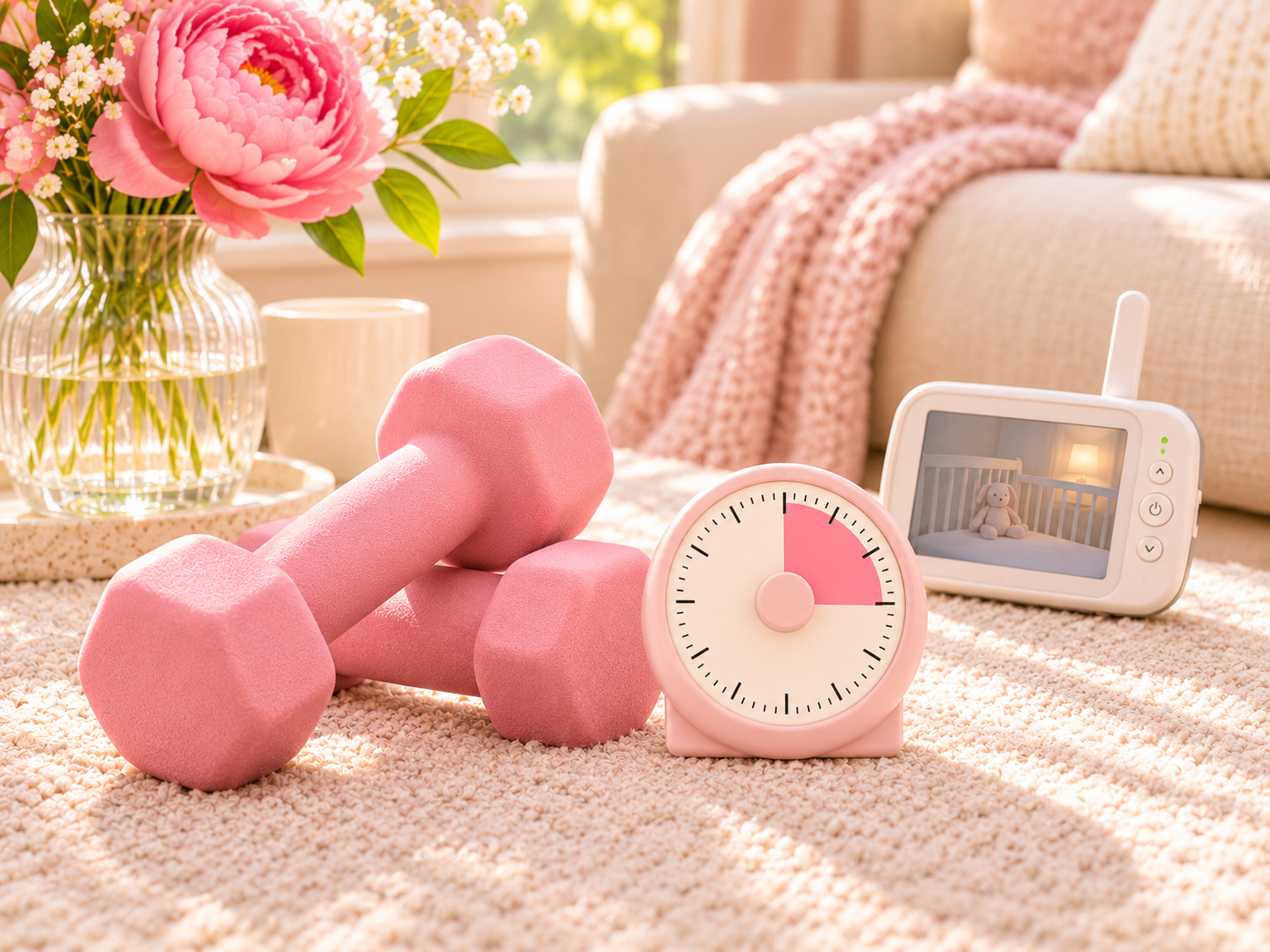
- A timer. Your phone works, or a simple kitchen timer.
- Water and the baby monitor. Within sight.
No dumbbells yet? Filled water bottles, a backpack with books or even laundry detergent jugs can stand in while you get started.
Choosing your weights
The right weight is one where the last two or three reps of each set feel challenging, but you can still do them with good form and steady breathing. If you could do ten more, it’s too light. If your form falls apart or you’re holding your breath, it’s too heavy.
As a rough starting point, many women begin with something like:
- Lighter pair (3 to 8 pounds) for shoulder presses and early rows.
- Heavier pair (8 to 15 pounds) for goblet squats, deadlifts and carries.
Everyone is different, so start lighter than you think and adjust. Your legs and back are usually much stronger than your shoulders, so it’s normal to use different weights for different moves.
The 20-minute plan
The workout has four short blocks. Do the moves in each circuit back to back with good form, rest for 30 to 60 seconds, then repeat the circuit a second time.
- Warm-upBreathe, march, circle3 min
- Circuit ALower body, 2 rounds7 min
- Circuit BUpper body and core, 2 rounds7 min
- Cool-downStretch and breathe3 min
If your baby wakes up early, stop wherever you are. Even the warm-up and one circuit is a workout.
Warm-up (3 minutes)
A short warm-up gets your blood moving, wakes up your core and pelvic floor and helps you feel steady before you pick up the weights.
- 🌬️1 minuteConnection breaths
Stand tall, breathe into your ribs and belly, then exhale and gently lift your pelvic floor and draw your lower belly in. Five slow breaths.
- 🚶♀️1 minuteMarch in place
Easy marching with arms swinging. Lift your knees a little higher as you warm up.
- 🔄1 minuteHip circles and arm circles
Big, slow circles each way. Then a few gentle bodyweight squats to a comfortable depth.
Circuit A: lower body (7 minutes)
Your legs and glutes are some of the biggest, strongest muscles you have, and they do a lot of the work of carrying a baby. Do each move, rest briefly, then repeat the whole circuit.
- 🦵10 repsGoblet squat
Hold one dumbbell at your chest. Sit your hips back and down as if to a chair, then press through your heels to stand. Breathe out as you rise.
- 🌱10 repsRomanian deadlift
A dumbbell in each hand, soft knees. Hinge at the hips and slide the weights down your thighs with a flat back, then squeeze your glutes to stand.
- 🌈12 repsGlute bridge
On your back, knees bent, dumbbell resting across your hips if you like. Exhale and lift your hips, pause, lower slowly.
- 🦶8 each sideSplit squat
One foot forward, one back, hand on a wall or couch for balance. Lower straight down a few inches and rise.
Circuit B: upper body and core (7 minutes)
This circuit strengthens your back, chest and shoulders and trains your core the way you actually use it: holding things steady while you move.
- 💪10 repsBent-over row
Hinge forward with a flat back, dumbbells hanging. Pull them toward your hips, squeeze your shoulder blades, lower with control.
- 🙌8 to 10 repsIncline push-up
Hands on a counter, couch arm or sturdy table. Lower your chest toward it and press away, body in one long line.
- 🦷10 repsShoulder press
Seated or standing, dumbbells at shoulder height. Exhale as you press up, keep your ribs down, lower slowly.
- 👜40 secondsFarmer’s carry
A heavier dumbbell in each hand. Stand tall and walk slowly around the room, shoulders relaxed, belly gently braced.
Cool-down (3 minutes)
Don’t skip this part. A few minutes of stretching and slow breathing helps your body settle, and it’s often the calmest three minutes of the day.
- 🧘45 secondsChild’s pose
Knees wide, sit back toward your heels and reach forward. Breathe into your back.
- 🐱45 secondsCat-cow
On hands and knees, round and then gently arch your spine with your breath.
- 🌟90 secondsChest and hip opener
Hands clasped behind you for a chest stretch, then a gentle kneeling hip flexor stretch on each side.
Short on time? The 10-minute version
Some naps are short. On those days, do the warm-up, then one round each of Circuit A and Circuit B, and finish with one stretch. It takes about ten minutes and still works every major muscle group. Two ten-minute workouts in a week are far better than none.
Rest between rounds
Rest 30 to 60 seconds between rounds, longer if you need it. Use that time to sip water, shake out your arms and check the monitor. If you’re breathing so hard you can’t talk in short sentences, take a little more rest before the next round. Strength work is about quality, not racing the clock.
Form tips that matter
You don’t need perfect form to benefit from strength training, but a few habits make every move safer and more effective, especially after a baby.
Exhale on the effort
Breathe out as you do the hardest part of each move: standing up from a squat, lifting your hips in a bridge, pushing away from the counter. Holding your breath and bearing down puts extra pressure on your core and pelvic floor. Exhaling helps manage it.
Keep your ribs over your hips
When you press or lift, it’s easy to arch your back and flare your ribs. Imagine your ribs stacked over your pelvis, like a can, and keep them there.
Hinge, don’t round
In deadlifts and rows, bend at your hips with a long, flat back rather than rounding your spine. Think about pushing your hips back toward a wall behind you.
Watch for doming
If you see a ridge, bulge or dome down the middle of your belly during a move, that’s a sign your core is under more pressure than it can handle right now. The Cleveland Clinic notes that movements that make your belly bulge can worsen abdominal separation. Make the move easier, slow down and focus on your exhale. If it keeps happening, ask your provider or a physical therapist.
Slow is strong
Take two to three seconds to lower each weight. Controlled reps build more strength than fast ones and are kinder to your joints.
Make it easier or harder
Every move can be scaled. Pick the version that feels challenging but doable today. It’s completely normal to use different levels on different days.
Your weekly schedule
Aim for two or three Strong in 20 sessions a week, with at least a day between them so your muscles can recover. Fill other days with walking, which counts toward the 150 minutes of moderate activity a week recommended during the postpartum period.
- MondayStrong in 20
- TuesdayStroller walk, 20 to 30 minutes
- WednesdayRest, or a gentle stretch and breathing
- ThursdayStrong in 20
- FridayWalk with friends or a walk club
- SaturdayStrong in 20 (optional third session)
- SundayRest and a family walk
This is a template, not a rule. If the baby had a rough night, swap a workout for a walk or a nap. The schedule bends so you don’t break.
How to progress
Your body adapts quickly to strength training, which means the workout should slowly get harder over time. Here are four simple ways to do that, roughly in this order:
- Add reps. When you can do all the reps in both rounds with good form, add two more reps per set.
- Add a round. Do each circuit three times instead of two. The workout becomes about 27 minutes.
- Add weight. Move up to the next pair of dumbbells and drop back to the original reps.
- Try the harder versions. Use the “Harder” column above for a move or two at a time.
Change one thing at a time, and only when the current level feels easy for a week or two. If anything starts to leak, bulge or hurt, step back a level. Progress isn’t a straight line, especially in the first year, and that’s okay.
Track it
Jot down the date, the weights you used and how it felt in your phone’s notes app. In a month, you’ll be able to look back and see exactly how much stronger you’ve gotten. That record is incredibly motivating on the days you feel like nothing is changing.
A sample eight-week path
If you like a roadmap, here’s one way the first two months might look. Move faster or slower depending on how you feel.
- Weeks 1–2Two sessions a week, lighter weights, two rounds of each circuit. Focus on breathing and form.
- Weeks 3–4Two or three sessions. Add two reps to each move when the last set feels easy.
- Weeks 5–6Try a third round of each circuit on one or two days, or move up a weight on squats and deadlifts.
- Weeks 7–8Swap in one or two “Harder” versions. Re-test your weights and write down how far you’ve come.
At the end of eight weeks, many women find they’re lifting noticeably heavier than when they started and that everyday tasks feel easier. That’s the goal: a body that feels capable in the life you’re actually living.
Lifting after baby: common worries
“Won’t I get bulky?”
It’s very unlikely with a routine like this. Two or three twenty-minute sessions a week with light to moderate dumbbells builds strength and tone, not bodybuilder muscle. Most women simply feel stronger and more capable.
“Doesn’t carrying my baby count?”
It definitely counts as activity, and you’re probably stronger than you think because of it. But carrying a baby mostly loads one side and one position. A balanced workout trains both sides, your back and your legs in ways that make all that carrying easier and more comfortable.
“I’m so sore the next day.”
Some muscle soreness a day or two after a new workout is normal, especially at first. It usually fades as your body adapts. If you’re very sore, use lighter weights next time. Sharp pain, pain in a joint or pain that doesn’t improve is different and worth checking with your provider.
“Is lifting okay while breastfeeding?”
For most moms, yes. Feeding or pumping before your workout can make it more comfortable, a supportive bra helps and drinking water before and after is a good habit. If you have specific concerns, ask your provider or a lactation consultant.
“I’m too tired to work out.”
Some days you are, and rest is the right choice. On other days, a short workout can actually leave you feeling a little more awake. Try just the warm-up and one circuit. If you feel better, keep going. If not, you still did ten minutes.
Recovery between sessions
Muscles get stronger while you rest, not while you lift. A day off between strength sessions gives them time to recover. Eating enough, especially some protein at meals and snacks, and drinking enough water both help. Our post on one-handed snacks for tired new moms has easy ideas.
Sleep matters too, though we know it isn’t always yours to control right now. On nights when sleep falls apart, it’s smart to skip or shorten the next day’s workout. Training on empty rarely feels good, and the plan will still be there tomorrow.
Nap-time survival tips
- Set up before the nap. Leave your dumbbells, mat and water out so you can start the second the baby’s down.
- Start with the warm-up, not your phone. Five minutes of scrolling becomes twenty very easily.
- Use a visual timer. Seeing the minutes tick by keeps you moving.
- Keep the monitor in view. You’ll relax more if you can see the baby.
- Work out with your baby awake, too. Bridges with a baby on your hips, squats while they watch from a bouncer and carries with a baby in a carrier (once you’re cleared and comfortable) all count.
- Don’t use every nap. Some naps are for resting, eating or doing absolutely nothing. That’s part of the plan.
Twenty minutes, twice a week. That’s how strong gets built.
When you want more support
If you like having a plan handed to you, our Strong in 20 guide takes this workout and builds it over eight weeks, with new moves, timing and progressions every couple of weeks. Our 1:1 coaching goes further, building your workouts around your birth, your body and your baby’s schedule, with a coach who checks in every week. And if leaking, pain or abdominal separation are getting in your way, a pelvic floor physical therapist can be a great teammate alongside us.
And if you have a friend with a new baby, invite her to do it with you over video during a shared nap window. Two moms, two sets of dumbbells, twenty minutes. It’s amazing how much easier it is to show up when someone is waiting for you.
For now, the next step is simple. The next time your baby goes down for a nap, set the timer for twenty minutes and see how it feels. You might be surprised how strong you already are.
Sources
- Centers for Disease Control and Prevention: Adult Activity: An Overview
- Centers for Disease Control and Prevention: Physical Activity for Pregnant or Postpartum Women
- American College of Obstetricians and Gynecologists: Exercise After Pregnancy
- Cleveland Clinic: Diastasis Recti
- Massachusetts General Hospital: Physical Therapy Helps Reduce Pelvic Floor Issues
This article is for general information and isn’t medical advice. Talk with your doctor or midwife about what’s right for you.
- Strength training
- Home workouts
- New moms
- Postpartum fitness
- Dumbbell workouts
Ready to get strong in 20?
Tell us where you are and what you’re working toward. We’ll reply within two business days about the Strong in 20 guide, coaching and our community.
Questions
Good questions.
Is a 20-minute workout really enough?
Yes. The CDC recommends muscle-strengthening activity at least two days a week. Two or three focused 20-minute sessions, plus walking on other days, is a strong, realistic routine for busy moms.
What weight dumbbells should I start with?
Choose a weight where the last two or three reps feel challenging but your form stays solid. Many women start with roughly 3 to 8 pounds for upper body and 8 to 15 pounds for lower body, but start lighter if you’re unsure.
Can I do this workout postpartum?
Once your doctor or midwife has cleared you to exercise. If you’re just starting back, build a base with breathing, walking and bodyweight moves first, then add dumbbells when those feel easy.
What if my baby wakes up halfway through?
Stop and pick it up later, or call it a day. The workout is built in short blocks, so even the warm-up and one circuit counts.
How many times a week should I do it?
Two or three times a week, with a rest day between sessions. Walking, stretching or rest fill the other days.
What should I do if I leak or see my belly dome?
Make the move easier, focus on breathing out during the effort and slow down. If it keeps happening, talk to your provider or a pelvic floor physical therapist before progressing.
 New moms
 Nutrition