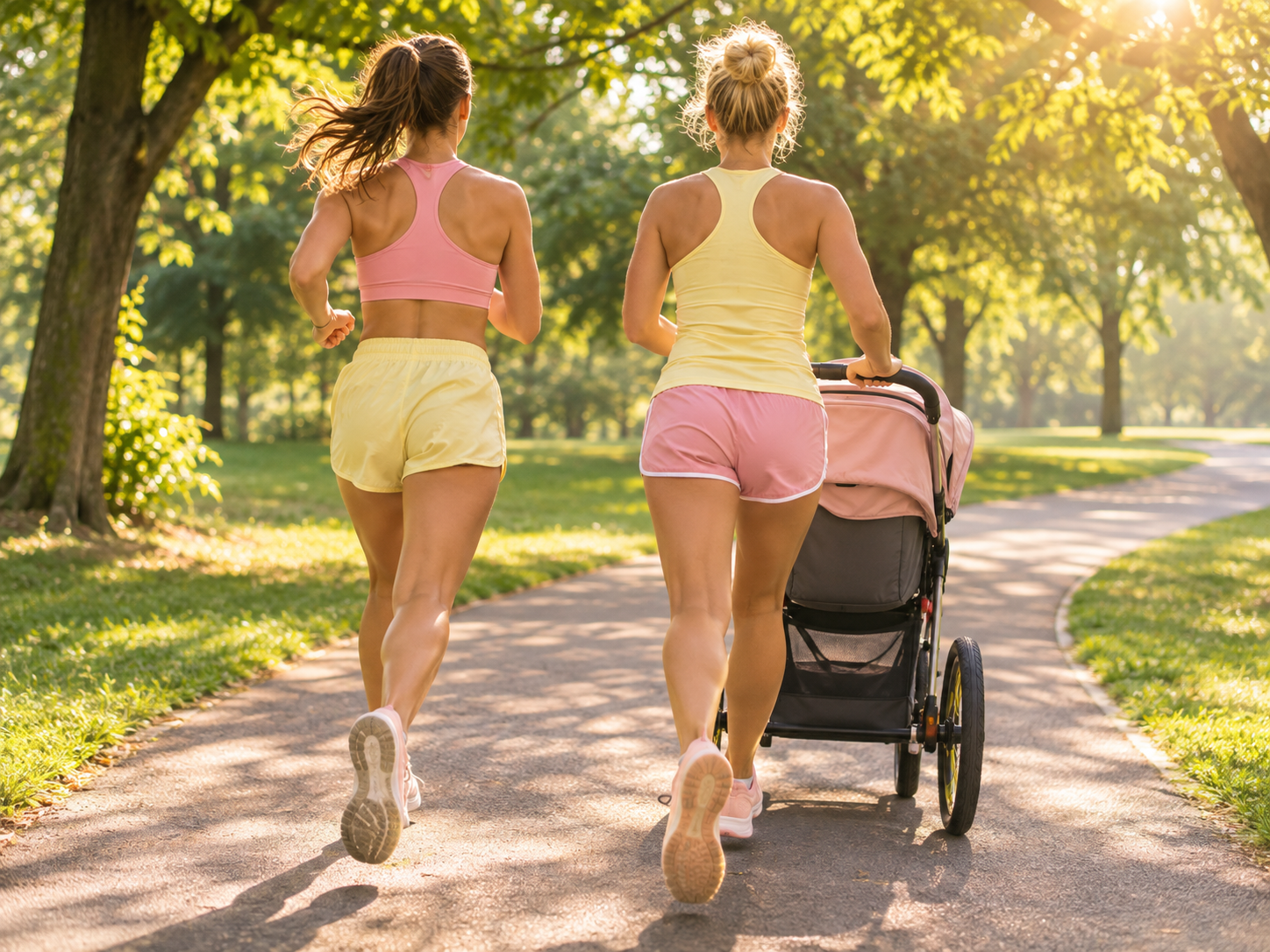
Maybe you used to run before kids. Maybe you’ve never run a step in your life. Either way, there’s something about crossing a 5K finish line, with your kids cheering or your stroller in front of you, that just feels like getting a piece of yourself back.
This is our walk-to-run plan for moms: ten weeks, three short sessions a week, starting with mostly walking and finishing with 30 minutes of running or your first 5K. It’s built for real life, with naps, night wakings, strollers and weeks that go sideways. And it starts with an honest look at whether your body is ready, especially if you’ve had a baby recently.
A quick note before we start: this is general fitness information, not medical advice. If you’re pregnant, postpartum or managing a health condition, check with your provider before starting a running program.
Why a 5K is the perfect goal
A 5K is 5 kilometers, or about 3.1 miles. It’s the most popular race distance in the country for a reason: it’s challenging enough to feel like a real accomplishment and short enough that almost anyone can train for it in a couple of months.
- 🎯The goalBig enough to be proud of
3.1 miles is a real accomplishment, and almost anyone can get there with a gradual plan.
- ⏰The timeSmall enough to fit your life
Three sessions a week of about 30 to 40 minutes, including warm-up and cool-down.
- 💰The costAlmost free
Supportive shoes, a good sports bra and a route. That’s it.
- 🚶♀️The methodWalking counts
You start with mostly walking. Walk breaks aren’t cheating; they’re the method.
- 🎉The payoffA finish line to celebrate
Signing up for a local 5K gives your training a date, a reason and a party at the end.
- 🤝The communityBetter with friends
A training buddy or walk club makes the early weeks much easier to stick with.
It also fits neatly into the activity guidelines. The CDC recommends at least 150 minutes of moderate activity a week, like brisk walking, plus two days of muscle-strengthening. Three walk-run sessions and two short strength sessions get you there.
Are you ready to run?
If you’re postpartum
This is the most important section of this post. Your six-week checkup is not automatically a green light to run. Running is high-impact, and your body, especially your pelvic floor and abdominal wall, needs time to heal after pregnancy and birth, whether you delivered vaginally or by C-section.
The most widely used guidance on this comes from a 2019 guideline written by physiotherapists Tom Goom, Gráinne Donnelly and Emma Brockwell. It recommends:
- Waiting at least 12 weeks after birth before starting to run, with walking and gentle strength work before that.
- A pelvic health assessment with a pelvic floor physical therapist for all postnatal women, however they gave birth, before returning to high-impact exercise.
- Passing a few simple tests first, like walking for 30 minutes, jogging on the spot and hopping, without symptoms.
The authors are clear that 12 weeks is a starting point, not a deadline. Many women need longer, and that’s completely normal. Our guide to postpartum exercise once you’re cleared covers what to do in the meantime.
Leaking urine or stool, a feeling of heaviness or bulging in your vagina, pelvic or low back pain, a bulge or doming along the middle of your belly, or bleeding that returns or increases. These are common after birth, but they’re not something to push through. A pelvic floor physical therapist or your provider can help.
If you’re pregnant
Many people can keep exercising during pregnancy, and some keep running, especially if they ran before. But starting a brand-new running plan while pregnant is a conversation to have with your provider first. Brisk walking is a wonderful option in the meantime.
If it’s been a while (or forever)
If your kids are older and you’re just out of practice, you’re probably ready to start. A good test: can you walk briskly for 30 minutes without feeling wiped out? If yes, start with week 1. If not, spend two to three weeks building up to 30-minute walks first. That’s still training.
How the plan works
- Walk-run sessionsNon-consecutive days30–40 min
- Strength daysHips, legs, core15–20 min
- Warm-up and cool-downBrisk walk before and afterEvery time
- Repeat when neededTen weeks is a guideNo rush
A sample week
- MondayWalk-run session
- TuesdayStrength day (15 to 20 minutes)
- WednesdayWalk-run session
- ThursdayRest, or an easy stroller walk
- FridayStrength day
- SaturdayWalk-run session, ideally with a friend or walk club
- SundayRest, family walk or stretch
Shift the days around whatever your week looks like. The only rule: try not to do walk-run sessions two days in a row, so your body has time to recover from the impact.
Like the popular couch-to-5K plans, ours alternates short runs with walking breaks and slowly shifts the balance until you’re running continuously. We stretch it to ten weeks with gentler jumps, because moms are often starting with less sleep, less time and a body that’s been through a lot.
The 10-week walk-to-run plan
Do each week’s session three times. Every session starts with a 5-minute brisk walk and ends with a 5-minute easy walk.
- Week 1Run 1 minute, walk 2 minutes. Repeat 8 times.Run slowly enough to talk. That’s the whole goal.8min running
- Week 2Run 90 seconds, walk 2 minutes. Repeat 8 times.Same easy pace, a little longer.12min running
- Week 3Run 2 minutes, walk 2 minutes. Repeat 6 times.Your body is learning to handle impact. Be patient.12min running
- Week 4Run 3 minutes, walk 2 minutes. Repeat 5 times.If this feels like a big jump, repeat week 3.15min running
- Week 5Run 4 minutes, walk 90 seconds. Repeat 4 times.Halfway. Celebrate it.16min running
- Week 6Run 6 minutes, walk 90 seconds. Repeat 3 times.Slow down if you need to. Slower is still running.18min running
- Week 7Run 10 minutes, walk 2 minutes. Repeat 2 times.Your first 10-minute runs. Big week.20min running
- Week 8Run 12 minutes, walk 1 minute. Repeat 2 times.Walk breaks are shrinking. You’ve got this.24min running
- Week 9Run 20 minutes, walk 2 minutes, run 8 minutes.Almost there. Keep the pace easy.28min running
- Week 10Run 30 minutes, or your full 5K with walk breaks as needed.Race week, or your own personal 5K.30min running
Screenshot it. Save this plan to your phone, or write the week on a sticky note on the fridge. Set your phone’s interval timer or use a free run-walk app so you don’t have to watch the clock.
A quick reality check: by week 10 you’ll be able to run for about 30 minutes, which may or may not equal exactly 5K depending on your pace. That’s okay. Lots of people walk part of their first 5K and still finish strong.
Your two strength days
Strength training is the secret ingredient most beginner running plans leave out. Stronger hips, legs and core help your body handle impact and lower your risk of aches and injuries. Two short sessions a week are plenty.
- Squats3 sets of 10. Hold a dumbbell, a kettlebell or your baby (if they love it).
- Glute bridges3 sets of 12. Squeeze at the top and lower slowly.
- Step-ups3 sets of 8 per leg on a sturdy step or bench.
- Calf raises3 sets of 15. Your calves do a lot of work when you run.
- Side-lying leg raises2 sets of 12 per side for your hips.
- Dead bugs or bird dogs2 sets of 8 per side, moving slowly with steady breathing.
- Pelvic floor exercisesAs guided by your pelvic floor physical therapist, if you’re postpartum.
Short on time? Our 20-minute dumbbell workout works perfectly as a strength day.
How fast to go (slower than you think)
The number one beginner mistake is running too fast. Use the talk test: you should be able to speak in short sentences while you run. If you can’t, slow down until you can, even if that feels like a shuffle.
- Easy is the goal. Almost every session in this plan should feel comfortable, not hard.
- Walk breaks are part of the plan, not a sign you’re failing.
- Pace comes later. Speed improves on its own once you’re running regularly.
- Hills count extra. Slow down or walk the uphills in the early weeks.
A better warm-up and cool-down
Your 5-minute walks before and after each session do a lot of quiet work. Make them count:
- Start slow and build. Begin at a stroll and finish your warm-up at a brisk, purposeful walk.
- Add a few drills once you’re warm: 10 marching steps, 10 gentle leg swings per side and 10 easy heel raises.
- Cool down gradually. Walk until your breathing settles, then stretch your calves, the fronts of your hips and your glutes for 20 to 30 seconds each.
- Check in with your body. Notice anything that felt off during the run. If it’s still there tomorrow, take note before your next session.
On days when you’re short on time, never skip the warm-up. Cut the running intervals instead. A shorter session done well beats a full one that leaves you sore.
Running with a stroller
Running with your baby in a jogging stroller can be one of the best parts of this whole journey, and it’s a great way to fit training into your day. A few things to know first:
- Wait until your baby is old enough. Many jogging stroller makers and pediatricians suggest waiting until babies are around six months old or more, with good head and neck control. Check your stroller’s manual and ask your pediatrician.
- Use a stroller made for running. Regular strollers aren’t designed for running speeds. Jogging strollers usually have a fixed or lockable front wheel, a hand brake and a wrist strap.
- Always wear the wrist strap. It keeps the stroller from rolling away if you trip.
- Expect to be slower. Pushing a stroller is harder, especially uphill. That’s extra training, not a problem.
- Keep your posture tall and swing your free arm when you can. Alternate hands so one side doesn’t do all the work.
- Pick smooth, flat routes. Our city walk guides, like the Hudson River Greenway, list stroller-friendly paths.
Not ready to run with the stroller yet? Do your run-walk sessions solo when your partner or a friend can watch the baby, and do your brisk warm-up and cool-down walks with the stroller.
Real-life tips for moms
- 🍼BreastfeedingFeed or pump first
Running is more comfortable with emptier breasts. Wear a supportive sports bra and drink extra water.
- 😴SleepBad night? Walk it
On a rough night, swap your run-walk for a brisk walk. Rest is part of training.
- 📅ScheduleBook it like an appointment
Put your three sessions on the family calendar so everyone knows that’s your time.
- 🏠WeatherHave a plan B
A treadmill, a walking video or laps around a mall all count on bad-weather days.
- 👧KidsBring them in
Older kids can ride bikes alongside you, time your intervals or cheer at the finish.
- 📝ProgressTrack every session
A simple checkmark on the calendar after each session is incredibly motivating.
Fueling your training
You don’t need a special diet to train for a 5K, but a little planning makes your sessions feel a lot better, especially on broken sleep.
- Eat something small first if it’s been a few hours since a meal: a banana, toast with peanut butter or a yogurt about 30 to 60 minutes before.
- Hydrate through the day, not just right before. Breastfeeding moms need extra fluids.
- Refuel after with a snack or meal that has protein and carbs, like eggs on toast, a smoothie or leftovers.
- Don’t try to eat less while you’re building up to running. Your body needs fuel to adapt, recover and, if you’re nursing, make milk.
Need quick ideas? Our one-handed snacks and 10-minute dinner rotation were made for exactly this kind of week.
What you need (and what you don’t)
- Running shoes that fit. If you can, get fitted at a local running store. Your feet may have changed size during pregnancy.
- A truly supportive sports bra. Especially important if you’re breastfeeding.
- A water bottle and a phone or watch with a timer.
- Weather layers. Dress like it’s about 15 degrees warmer than it is, since you’ll heat up fast.
- A jogging stroller, only if you plan to run with your baby.
What you don’t need: expensive watches, special supplements, compression everything or a perfect running outfit. Start with what you have.
When a week goes sideways
It will happen. A sick kid, a teething week, a work trip, a period that knocks you flat. Here’s how to handle it:
- Missed one session? Just keep going with the next one.
- Missed a week? Repeat the last week you finished.
- Missed two weeks or more? Go back two weeks and build up again. You’ll move faster the second time.
- Something hurts? Pain that changes how you move, gets worse as you run or lingers the next day is a reason to stop and check in with a professional.
These are the doubts we hear most often:
- Doubt #1What you’re thinking
“I’m not a runner.”
The truthYou don’t have to be one yet. This plan starts with one-minute runs and lots of walking. If you can walk briskly for 30 minutes, you can start.
- Doubt #2What you’re thinking
“I’m too slow.”
The truthThere’s no such thing on this plan. The right pace is one where you can still talk in short sentences. Plenty of people finish a 5K in 40 minutes or more.
- Doubt #3What you’re thinking
“I don’t have time.”
The truthEach session is about 30 to 40 minutes, three times a week. You can do them with a stroller, on a treadmill during nap time or before anyone else wakes up.
- Doubt #4What you’re thinking
“What if I can’t finish a week?”
The truthRepeat it. Most beginner plans, including this one, expect you to repeat weeks. Ten weeks is a guide, not a deadline.
- Doubt #5What you’re thinking
“Running will hurt my body.”
The truthBuilding up gradually, adding strength work and listening to warning signs is how you protect it. If something hurts or feels wrong, pause and check with a professional.
Your 5K day
Signing up for a real 5K, a few weeks out, is one of the best ways to stay motivated. Look for local fun runs, charity 5Ks and turkey trots. Many welcome walkers and strollers; check each event’s rules first. In many U.S. cities you can also find free, weekly, timed 5Ks on Saturday mornings.
- The week before: keep your sessions easy and shorter. No new shoes or gear.
- The night before: lay out your clothes and pin your bib to your shirt. Plan a familiar dinner.
- The morning of: eat a light breakfast you’ve tried before a run, feed or pump if needed and get there early.
- At the start: line up near the back. Start slower than you think you should.
- During: take walk breaks whenever you need them. Smile at every water station.
- At the finish: celebrate. You did something many people never try.
After your 5K: what’s next?
Crossing the finish line isn’t the end. It’s proof of what you can do. A few ways to keep going:
- Keep three easy runs a week to hold on to your fitness. Many women find this becomes their favorite part of the week.
- Pick a new 5K and try to run more of it, or just enjoy it with friends.
- Build toward a 10K by slowly lengthening one run a week.
- Keep your strength days. They’re what keep running feeling good for years.
- Or don’t run at all for a while. If walking, lifting or yoga feel better in this season, that’s a win too.
Do it together
Here’s the truth about training plans: the plan is the easy part. Showing up three times a week for ten weeks is the hard part. And it’s so much easier when someone is expecting you.
- Find a buddy who’s training for the same race.
- Join a walk club. Many of our members turn walk club mornings into run-walk sessions. See what’s forming in your city.
- Share your progress in a group chat or community. Accountability is powerful.
- Work with a coach who can adapt this plan to your body and schedule. See how 1:1 coaching works.
We’d love to host Pink in Progress community 5Ks someday, with strollers, cheering kids and a lot of pink. If you’d run one in your city, tell us when you sign up. That’s exactly how we’ll decide where to start.
Your turn
You don’t have to be a runner to start. You become one by starting. Pick your three days, lace up and do week 1.
And when you finish, whether it’s in ten weeks or sixteen, with walk breaks or without, we want to hear about it. That finish line belongs to you.
Sources
- Goom, Donnelly & Brockwell (2019): Returning to running postnatal: guidelines for medical, health and fitness professionals
- British Journal of Sports Medicine blog: Ready, steady…GO! Ensuring postnatal women are run-ready
- CDC: Adult activity: an overview
- NHS: Get running with Couch to 5K
This article is for general information and isn’t medical advice. Talk with your doctor or midwife about what’s right for you.
- Running
- 5K
- Postpartum fitness
- Walking
- Beginner workouts
Find your strength. Find your girls.
Training for your first 5K? Tell us where you are. We’ll reply within two business days with coaching, walk clubs and a community to cheer you on.
Questions
Good questions.
How long does it take to train for a 5K as a beginner?
Most beginner plans take 8 to 10 weeks with three sessions a week. Our walk-to-run plan is 10 weeks, and you can repeat any week, so it’s fine to take longer.
When can I start running after having a baby?
A widely used 2019 guideline recommends waiting at least 12 weeks after birth, getting a pelvic health assessment and passing simple readiness tests before running. Many women need longer. Always check with your provider first.
Is it okay to walk during a 5K?
Yes. Many people walk part or all of a 5K. Walk breaks are a smart strategy, not a failure, and most local 5Ks welcome walkers.
How fast should a beginner run?
Slowly enough to talk in short sentences. Easy pace builds your fitness safely, and speed comes naturally later.
When can I run with my baby in a jogging stroller?
Many jogging stroller makers and pediatricians suggest waiting until babies are around six months old or more, with good head and neck control. Check your stroller’s manual and ask your pediatrician.
Do I need strength training if I’m running?
It’s highly recommended. Two short strength sessions a week help protect your joints and pelvic floor, and the CDC recommends muscle-strengthening at least two days a week for all adults.
 New moms
 Fitness