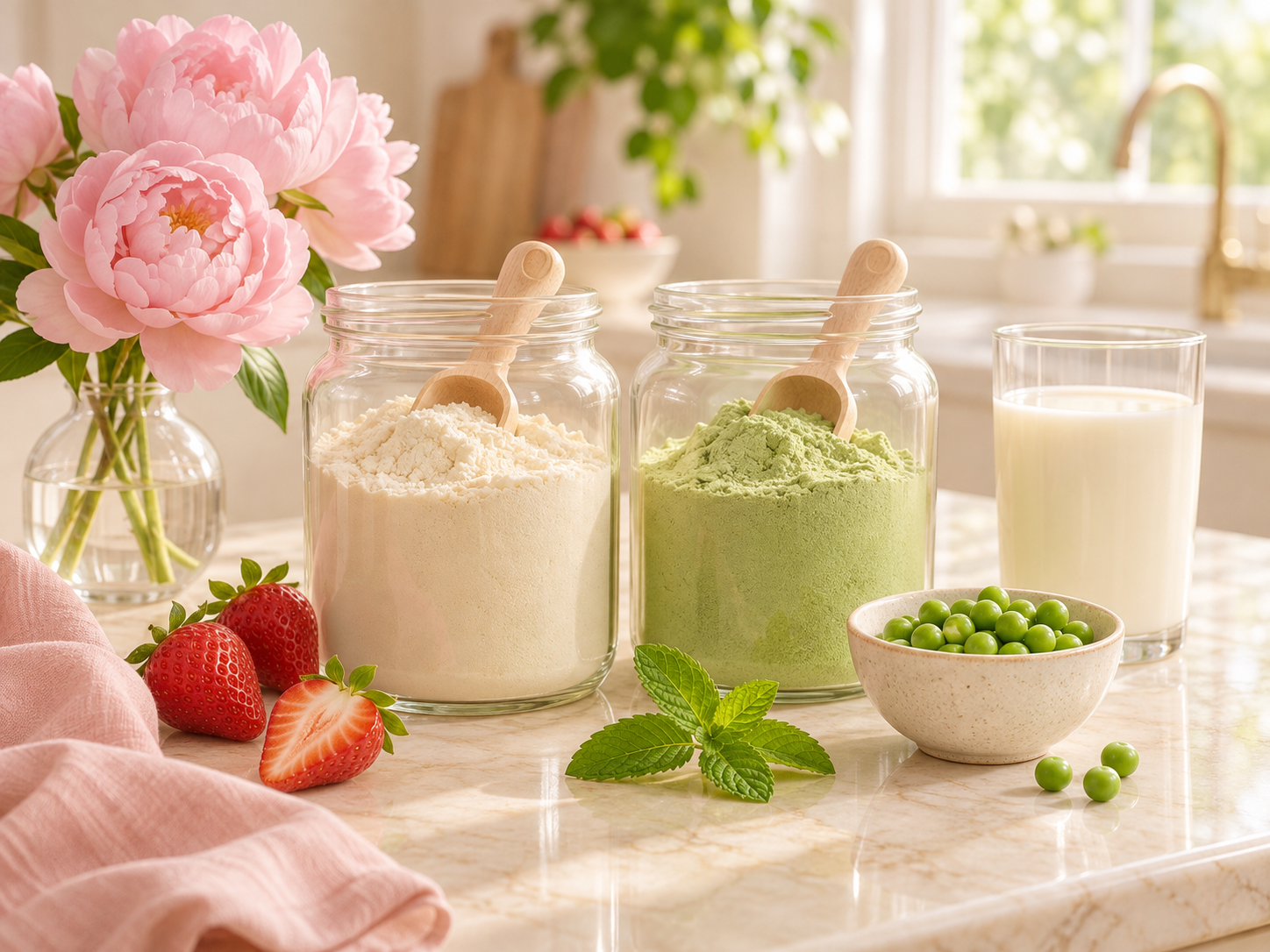
You’ve decided a protein powder might make busy mornings easier. Great. Then you get to the store and there are two walls: the whey side, with tubs promising muscle, and the plant side, with bags promising clean, green everything. Which one is actually better?
The internet will give you strong opinions in both directions. Whey people say plant protein is weaker. Plant people say whey is hard on your stomach. Both sides have a point, and both sides oversell.
Here’s the honest, research-backed comparison: what each one is, how they compare for muscle, digestion and safety, what to know about soy, and a simple way to decide which fits your body, your budget and your values. (If you’re still deciding whether you need a protein powder at all, or wondering where collagen fits in, start with our post on collagen vs. protein powder.)
We’re coaches, not dietitians or doctors. This is general information, not medical or nutrition advice. If you have allergies, digestive issues or a health condition, or you’re pregnant or breastfeeding, talk to your provider or a registered dietitian before adding supplements.
The short answer
For most women, both work. When you eat enough total protein and do some strength training, research suggests whey and well-chosen plant proteins lead to similar gains in strength and muscle.
Choose whey if you tolerate dairy, want the most protein per scoop and like a smooth, mild taste. Look for whey isolate if lactose bothers you a little.
Choose plant protein if you’re dairy-free, vegan or vegetarian, or prefer plant foods for other reasons. Pick soy or a blend of plant proteins, and be extra picky about third-party testing for heavy metals.
Either way, the best protein powder is the one you actually like, tolerate and use, alongside plenty of protein from food.
At a glance
| Whey protein | Plant protein | |
|---|---|---|
| Source | Milk (the liquid left after making cheese) | Pea, soy, rice, hemp, pumpkin seed and blends |
| Complete protein? | Yes | Soy is. Others usually need blending to be complete |
| Leucine | High | Lower, so servings may need to be a bit bigger |
| Muscle research | Strong | Similar long-term results when total protein is enough |
| Digestion | Can bother people sensitive to lactose. Isolate is gentler | Dairy-free. Some people find pea or blends gassy at first |
| Lead in 2025 testing | Lower on average | Higher on average. Testing matters more |
| Taste and texture | Smooth, creamy, mild | Earthier and thicker. Blends taste best |
| Good for | Most people who tolerate dairy | Dairy-free, vegan and plant-forward eaters |
What whey is
Whey is one of the two main proteins in milk (the other is casein). When milk is turned into cheese, the liquid that’s left behind is whey. It’s filtered, dried and turned into powder.
You’ll usually see three types:
- 🥛Most commonWhey concentrate
Less filtered. Usually cheaper and creamier, with a bit more lactose and fat.
- ✨GentlerWhey isolate
Filtered more, so it’s higher in protein and usually very low in lactose. Often easier on sensitive stomachs.
- ⚡Pre-digestedWhey hydrolysate
Partly broken down. Pricier and slightly bitter. Most people don’t need it.
- 🍴CousinCasein
The other milk protein. Digests slowly and makes thick, pudding-like shakes.
Whey is digested quickly and is naturally rich in leucine, an amino acid that helps switch on muscle building. That’s a big reason it became the default in sports nutrition.
What plant protein is
Plant protein powders are made by pulling the protein out of beans, seeds and grains. The most common sources:
- 🌱CompleteSoy
The most studied plant protein. A complete protein with a protein quality score on par with whey.
- 🫛PopularPea
Mild, affordable and allergy-friendly. Lower in one essential amino acid (methionine), so it’s often blended.
- 🍚Blending partnerBrown rice
Low in lysine but higher in methionine, so it pairs nicely with pea to round things out.
- 🌿Whole food-ishHemp and pumpkin seed
Earthy and often higher in fiber and healthy fats, but lower in protein per scoop.
Many of the best plant powders are blends, like pea and rice, or pea, pumpkin seed and quinoa, which fill in each other’s gaps and usually taste better too.
Protein quality, explained
Nutrition scientists rate protein quality with scores that look at how many essential amino acids a protein provides and how well your body digests them. The older score is called PDCAAS, and a newer, stricter one is called DIAAS.
Here’s what you need to know: a review in Today’s Dietitian notes that whey, casein, soy and egg all have a top PDCAAS score of 1. Most other plant proteins score lower on their own, though blending them helps. A 2020 review in Nutrients on plant protein quality concluded that while plant proteins can be inferior in some respects, there are real health benefits to diets higher in plant protein, and smart combining helps meet amino acid needs.
The other key number is leucine. A review led by McMaster University’s Stuart Phillips, partly funded by the whey industry, concluded that leucine content is the strongest determinant of how well a protein stimulates muscle building. Whey has more leucine per gram than most plant proteins. That’s why plant protein servings sometimes need to be a little bigger to match.
Scores aren’t the whole story, though. If you eat a variety of protein foods throughout the day, your body pools amino acids from everything you eat. A plant powder doesn’t need to be perfect on its own.
Which builds more muscle?
This is the big question, and the answer is reassuring.
In short-term lab studies, whey often produces a bigger, faster spike in muscle building right after you drink it. But what matters for most of us is the long-term result: are you actually getting stronger over weeks and months?
- 📊Meta-analysis, 2018Soy matched whey
A meta-analysis of nine trials with 266 people found soy protein produced similar gains in strength and lean mass as whey protein during resistance training.
- 🏋️♀️Trial, 2021Vegans gained just as much
In a 12-week study, vegans eating plant foods plus soy protein gained the same muscle and strength as omnivores eating mixed foods plus whey, when both ate about 1.6 g of protein per kg per day.
- 🫛Trial, 2015Pea kept up with whey
In a 12-week study of 161 young men, pea protein and whey led to similar gains in biceps muscle thickness, both better than placebo.
- ⚖️Meta-analysis, 2021Small edge in some measures
A broader review found protein source didn’t change gains in absolute lean mass or strength, though animal protein had a small advantage in percent lean mass.
Two honest caveats. First, most of these studies were done mostly in young men, and some were funded by protein ingredient companies, so we need more research in women. Second, the plant groups often ate enough total protein. That’s the key: if you get enough protein overall and lift something heavy-ish a couple of times a week, the source matters much less than people think.
Total protein and showing up to strength train matter far more than which tub it came from.
Need a place to start lifting? Our Strong in 20 dumbbell workout fits into a nap.
Digestion and dairy
For many women, this is the deciding factor.
According to the National Institutes of Health, experts estimate that about 68 percent of the world’s population has lactose malabsorption, and in the U.S. it’s about 36 percent. It’s more common in people with African American, American Indian, Asian American and Hispanic or Latino heritage. Not everyone with malabsorption has symptoms, and most people with lactose intolerance can handle some lactose.
What that means for you:
- If regular dairy is fine, any whey should work.
- If milk sometimes bothers you, try whey isolate, which is usually very low in lactose.
- If you have a milk allergy, that’s an immune reaction, not lactose intolerance. Skip whey entirely and choose plant protein.
- If plant protein makes you gassy, try a different source (soy instead of pea, for example), a smaller serving or one without added gums and sugar alcohols.
Bloating can also come from sweeteners like sugar alcohols, added fibers and gums, not just the protein itself. A shorter ingredient list is often easier on your stomach.
Heavy metals and safety
In October 2025, Consumer Reports tested 23 popular protein powders and shakes for heavy metals. The biggest gap was between whey and plants: plant-based powders averaged about nine times more lead than dairy-based ones, and twice as much as beef-based powders. Consumer Reports said most products were fine occasionally, but advised against a protein shake every day.
Why plants? Plants absorb heavy metals naturally present in soil and water. That doesn’t make plant protein “bad,” but it does make choosing a tested brand especially important.
Whey isn’t automatically in the clear either. Half of the dairy-based products CR tested were still above its level of concern. And in the U.S., there are no federal limits on heavy metals in supplements, and the FDA doesn’t approve supplements before they’re sold.
Our rule: whichever you choose, look for an independent seal like NSF Certified for Sport or Informed Choice, check for published heavy metal testing and get most of your protein from food.
What about soy?
Soy gets a lot of side-eye, mostly because of its isoflavones, plant compounds that can act a bit like estrogen. So is soy protein safe for women?
The American Cancer Society says a large body of evidence supports the safety of soy foods as part of a healthy diet. Its experts note that human studies have found soy’s estrogen-like effects either have no effect at all or may reduce breast cancer risk, and that the early worries came largely from animal studies.
If you’ve had a hormone-sensitive cancer or have a thyroid condition, talk to your doctor about soy specifically. For most women, a soy protein shake is a perfectly reasonable choice, and soy is one of the most complete and best-studied plant proteins available.
Values and the planet
For many women, the choice isn’t just about nutrition. It’s about values, and that’s valid.
- Environment. The 2020 Nutrients review notes that producing 1 kilogram of high-quality animal protein requires feeding about 6 kilograms of plant protein to livestock, which puts more strain on land and water. Choosing more plant protein can lower that footprint. (Whey is a byproduct of cheese, so its story is a bit more complicated.)
- Animal welfare. If you avoid animal products, plant protein is the clear choice.
- Health patterns. Diets higher in plant protein are linked with several health benefits, often because they also bring more fiber and fewer saturated fats.
There’s no wrong answer here. Plenty of women use both: whey in a post-workout shake and plant protein in a smoothie bowl.
Taste, texture and cost
- 😋TasteWhey wins on smooth
Whey mixes easily with just water or milk and tastes mild. Plant powders can be earthier or grittier, though blends have improved a lot.
- 🥤TexturePlant makes it thick
Plant powders thicken smoothies and baked goods nicely. Great in oats and smoothie bowls, less great in a quick shaker.
- 💰CostIt depends
Whey concentrate is often the cheapest per gram of protein. Isolates and tested plant blends usually cost more.
- 🎂CookingBoth bake well
Swap a few tablespoons of flour for powder in pancakes or muffins. Whey can dry baked goods out, so add a little extra liquid.
Tip: Buy a small bag or single-serve samples before committing to a giant tub. Taste is personal, and the best powder is one you’ll actually use.
How to choose
Answer these five questions, in order:
- Do you have a milk allergy or follow a vegan diet? Choose plant protein, ideally soy or a pea-rice blend.
- Does dairy upset your stomach? Try whey isolate first. If that still bothers you, go plant.
- Is your main goal strength and muscle? Either works. Whey gets you there with slightly smaller servings; with plant, aim for a serving with about 20 to 30 grams of protein.
- Do you care about environmental impact? Lean plant, or mix the two.
- Is it third-party tested? Whatever you choose, this is the non-negotiable.
What to look for
Because quality and testing change from batch to batch, we don’t name specific brands. These links go to Amazon searches so you can compare options, plus NSF’s certified product finder. We don’t earn anything from these links.
-
Third-party tested whey isolate
Dairy · Complete protein
The easy, smooth-mixing choice for most people who tolerate dairy. Isolate is usually lower in lactose than concentrate.
Look for: NSF Certified for Sport or Informed Choice, about 20 to 25 grams of protein per scoop and a short ingredient list.
-
Soy protein isolate
Plant · Complete protein
The most complete and best-studied plant protein, with a protein quality score on par with whey. Usually budget-friendly, too.
Look for: Third-party testing, published heavy metal results and minimal additives.
-
Pea and rice protein blend
Plant · Soy-free
A soy-free, dairy-free option where the two proteins fill in each other’s amino acid gaps. Great in smoothies and oats.
Look for: Independent heavy metal testing (this matters most for plant powders), about 20 grams of protein or more per serving and no proprietary blends.
-
An unflavored option for cooking
Whey or plant
Unflavored powder disappears into soups, sauces, oats and baking without making everything taste like vanilla cake.
Look for: The same testing seals, and a single ingredient if you can find it.
Label red flags
- “Proprietary blend” that hides how much of each ingredient is inside.
- Added stimulants or herbs you didn’t ask for, especially in “fat-burning” or “beauty” formulas.
- Big promises like “melts fat” or “detox.” Protein powder is food, not medicine.
- Collagen listed first in a “protein” powder meant for muscle. It’s not a complete protein.
Getting the most from either
- Pair it with strength training. Protein supports muscle. Lifting tells your body to build it.
- Spread protein across the day. Many women eat very little at breakfast. A smoothie or protein oats is an easy fix.
- Go a little bigger with plant protein if strength is your focus, to make up for the lower leucine.
- Don’t rely on one shake every single day. Rotate with food sources like Greek yogurt, eggs, tofu, beans, fish and chicken.
- Make it taste good. Frozen fruit, cinnamon, cocoa, peanut butter and a splash of milk go a long way.
For easy, protein-friendly meals that don’t need powder at all, see our 10-minute dinner rotation and one-handed snacks.
Pregnancy and breastfeeding
Protein needs rise during pregnancy and breastfeeding, and a shake can be a lifesaver when you’re feeding a baby with one arm. Before you add one:
- Check with your provider, since supplements aren’t approved by the FDA before they’re sold.
- Choose third-party tested products to lower the risk of heavy metals.
- Skip powders with herbs, stimulants or “lactation blends” unless your provider says they’re okay.
- Lean on food when you can. Greek yogurt, eggs, cheese, milk or soy milk and leftovers are all great.
Myths
- Myth #1What you’ve heard
“Plant protein can’t build muscle.”
The truthLong-term studies found soy and pea led to similar gains as whey when people ate enough total protein and strength trained.
- Myth #2What you’ve heard
“Whey is bad for everyone’s stomach.”
The truthMany people tolerate whey just fine, and whey isolate is usually very low in lactose. A true milk allergy is different and means skipping whey.
- Myth #3What you’ve heard
“Soy messes with your hormones.”
The truthThe American Cancer Society says a large body of evidence supports the safety of soy foods. Talk to your doctor if you’ve had a hormone-sensitive cancer.
- Myth #4What you’ve heard
“Plant-based means cleaner and safer.”
The truthIn Consumer Reports’ 2025 testing, plant powders averaged the highest lead levels. Third-party testing matters more than the word “plant.”
- Myth #5What you’ve heard
“You have to drink it within 30 minutes of a workout.”
The truthTotal protein across the day matters much more than a tight timing window. Have it whenever it fits your life.
Your turn
Pick the one that fits your body and your values, buy the smallest, third-party tested size you can find and try it in a breakfast smoothie for two weeks. If you like it and it agrees with you, you’ve found your protein.
Whey and plant protein aren’t enemies. They’re two good tools. Whey is smooth, efficient and well studied. Plant protein works just as well for most people when you get enough, and it can fit better with how you eat and what you care about. What matters most is that you eat enough protein overall, move your body and choose products you can trust.
If you want help building protein habits that feel easy and doable, our coaches would love to help. And if you want to swap smoothie recipes with women who get it, come find your circle.
Sources
- International Journal of Sport Nutrition and Exercise Metabolism (2018): Messina et al.: No difference between soy and animal protein on gains in muscle mass and strength
- Sports Medicine (2021): Hevia-Larraín et al.: High-protein plant-based diet versus a protein-matched omnivorous diet
- Journal of the International Society of Sports Nutrition (2015): Babault et al.: Pea proteins vs. whey protein during resistance training
- Nutrients (2021): Animal protein versus plant protein in supporting lean mass and muscle strength: a meta-analysis
- Nutrients (2020): Plant proteins: assessing their nutritional quality and effects on health and physical function
- Today’s Dietitian: Powering up with plant proteins
- NutraIngredients-USA: Protein quality matters for muscle building, says review
- NIDDK (NIH): Definition and facts for lactose intolerance
- NPR: A study found lead in popular protein powders. Here’s why you shouldn’t panic
- Nutraceuticals World: Consumer Reports protein powder testing
- American Cancer Society: Soy and cancer risk: our expert’s advice
- U.S. Food and Drug Administration: Dietary supplements
- NSF Certified for Sport
Product links are general Amazon searches, and we don’t earn anything from them. This article is for general information and isn’t medical or nutrition advice. Talk with your doctor or a registered dietitian about what’s right for you.
- Nutrition
- Protein
- Whey
- Plant-based
- Supplements
Find your strength. Find your girls.
Tell us how you like to eat and move. We’ll reply within two business days with coaching and community that make healthy habits feel simple.
Questions
Good questions.
Is whey or plant protein better?
Neither is better for everyone. Whey is complete, rich in leucine and smooth. Soy and blended plant proteins lead to similar strength and muscle gains when total protein is adequate. Choose based on digestion, diet, taste, values and third-party testing.
Can you build muscle with plant protein?
Yes. Studies found soy and pea protein produced similar gains in strength and muscle as whey during resistance training, as long as people ate enough total protein.
Is whey okay if I’m lactose intolerant?
Often, yes. Whey isolate is filtered to remove most lactose and is usually better tolerated than concentrate. If you have a milk allergy, though, avoid whey completely.
Do plant protein powders have more heavy metals?
On average, yes. In Consumer Reports’ 2025 testing, plant-based powders contained about nine times more lead than dairy-based ones. Choose products with independent heavy metal testing.
Is soy protein safe for women?
For most women, yes. The American Cancer Society says a large body of evidence supports the safety of soy foods as part of a healthy diet. If you’ve had a hormone-sensitive cancer or have a thyroid condition, ask your doctor.
Which plant protein is best?
Soy is the most complete and best studied. If you avoid soy, a pea and rice blend is a great choice because the two proteins fill in each other’s amino acid gaps.
 Nutrition
 Nutrition