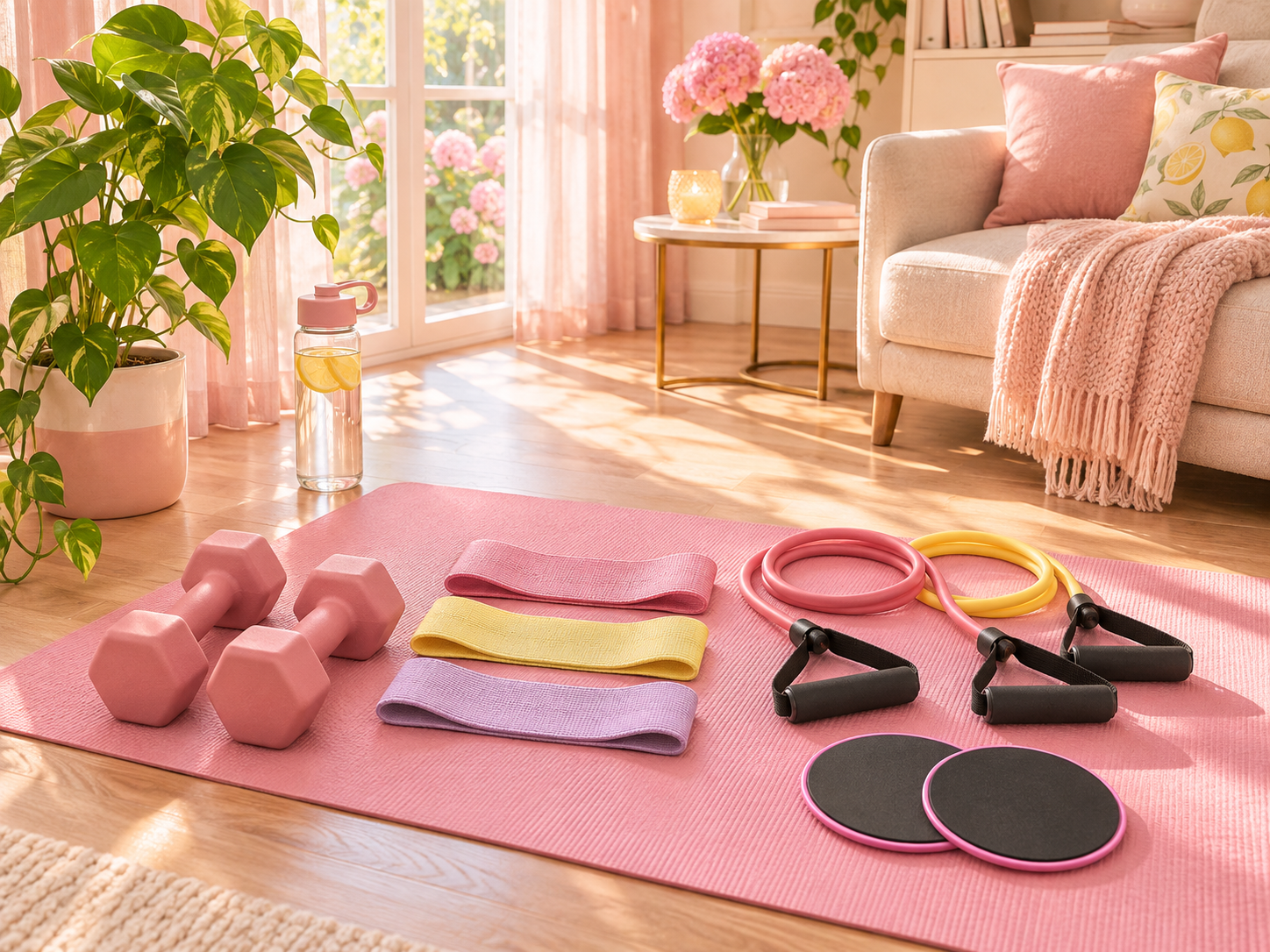
You don’t need a gym membership, a garage full of equipment or a $2,000 bike to get strong. With a mat, one pair of dumbbells and a few bands, you can do almost everything a beginner needs, in your living room, during nap time, for about $100.
This is our honest list of the only equipment we think most women need to start strength training at home, what to look for in each piece, how to choose your weights, three workouts to do with it and what’s worth adding later. Every item links to an Amazon search so you can compare options and prices.
A quick note: we don’t earn anything from these links. Prices are rough ranges we’ve seen and will change, so check current prices before you buy.
Why a home gym works for busy women
The CDC recommends muscle-strengthening activity at least two days a week for adults, working all the major muscle groups. That can sound like a lot when you’re juggling work, kids and everything else. A small home setup removes the biggest barriers:
- ⏰TimeNo commute
A 20-minute workout takes 20 minutes, not an hour with driving and parking.
- 👶KidsNo childcare needed
Work out during nap time, after bedtime or with your toddler “helping.”
- 💰CostPays for itself
About $100 once, compared with a monthly gym membership.
- 😊ComfortNo audience
No mirrors full of strangers, no waiting for equipment, no worrying about what to wear.
And strength training matters at every stage, from rebuilding after birth to protecting bones and muscle in your 40s and beyond. Stronger legs make carrying a car seat easier. A stronger back makes lifting a toddler out of the crib less of a strain. Stronger hips and glutes help protect your knees on long walks. This is strength for real life, not for a mirror.
Who this kit is for
- Beginners who want to start strength training without the gym.
- Moms who can only work out at home, during naps or after bedtime.
- Women returning to exercise after a break, an injury or a baby (once cleared).
- Walkers and new runners who want two short strength days to protect their joints.
- Travelers, since the bands and sliders fit easily in a suitcase.
If you’re already lifting heavy at a gym, this kit makes a great backup for busy weeks and travel. If you’re brand new, it’s everything you need for your first several months.
The under-$100 home gym kit
-
Exercise mat
About $15–30
Your home base for floor work, stretching and core. It protects your back, knees and floors, and it marks off “workout time” in a busy house.
Look for: Around 6mm thick for comfort, non-slip on both sides and easy to wipe clean.
Tip: Roll it out the night before. Seeing it is half the motivation.
Shop on Amazon -
A pair of dumbbells
About $20–40
The most versatile thing you can own. Squats, rows, presses, deadlifts and lunges all get better with a little weight. One pair is enough to start.
Look for: Hex-shaped (so they don’t roll), with a comfortable grip. Most beginners do well with a pair between 8 and 15 pounds.
Tip: If you can only buy one pair, choose the heavier option you can lift with good form for 10 squats.
Shop on Amazon -
Mini loop bands
About $10–15
Small loops that go around your thighs or ankles. They wake up your glutes and hips, which matter for walking, running, carrying kids and protecting your knees.
Look for: A set of three to five resistance levels. Fabric bands roll up less than thin latex ones.
Tip: Use them as a warm-up before walks: 10 side steps each way and 10 glute bridges.
Shop on Amazon -
Long resistance bands with handles
About $20–30
Long tube bands with handles and a door anchor turn any door into a cable machine for rows, chest presses and overhead work. Great for travel too.
Look for: A set with several resistance levels, padded handles and a door anchor.
Tip: Always check that the door is closed and locked toward you before you anchor a band in it.
Shop on Amazon -
Sliders
About $8–12
Small discs that slide on carpet or hard floors. They make lunges, mountain climbers and hamstring curls harder without adding weight.
Look for: Double-sided (one side for carpet, one for hard floors).
Tip: No sliders yet? Paper plates on carpet or a hand towel on hardwood work in a pinch.
Shop on Amazon
What it adds up to
- Exercise matAbout $15–30
- One pair of dumbbellsAbout $20–40
- Mini loop bandsAbout $10–15
- Long bands with handlesAbout $20–30
- SlidersAbout $8–12
- TotalRoughly $75–125, depending on what you choose
ThatThat’s less than many monthly gym memberships, and it’s yours for years.rsquo;s about what a few months of many gym memberships cost, and itThat’s less than many monthly gym memberships, and it’s yours for years.rsquo;s yours for years. To stay closer to $75, choose a basic mat and skip the long bands until later. Already have a yoga mat or a pair of weights? Even better: your kit might cost under $50.
How to choose your dumbbell weight
This is the question we get most. There’s no perfect number, but here’s a simple way to decide:
- Test with a squat. Hold something you already own, like a water jug or a bag of rice, and do 10 slow squats.
- Notice how the last few reps feel. The right weight feels challenging by rep 8 to 10, but you can keep good form.
- Choose for your legs and back. These are your strongest muscles. A weight that’s right for squats and rows will usually work for most exercises.
- Use lighter options for shoulders and arms. Bands, slower reps or one dumbbell instead of two work well until you add a lighter pair.
As a rough starting point, many beginners do well with a pair between 8 and 15 pounds. If you used to lift, you may want heavier. If you’re newly postpartum, start lighter and focus on form and breathing.
When to go heavier
When you can do 15 reps of an exercise with good form and it feels easy, it’s time to progress. First, slow down and add pauses. When that’s easy too, it’s time for a heavier pair or a kettlebell.
How much space you need
Less than you think. Here’s the full footprint:
- Your mat, plus about an arm’s length of space on each side.
- A door for the band anchor, or a sturdy post or railing.
- A sturdy chair, couch or counter for rows and incline push-ups.
- A basket or bin to store it all. Under the bed, in a closet or tucked behind the couch.
Keep your kit somewhere you’ll see it. Out of sight really does mean out of mind.
Small-space storage ideas
- A pretty basket by the couch holds bands, sliders and a rolled-up mat, and doubles as living room decor.
- An over-the-door hook keeps long bands and the door anchor tangle-free.
- A low shelf or closet floor is the safest place for dumbbells, especially with toddlers around.
- Your mat can stand upright behind a door or in a tall umbrella-style bin.
Safety basics
- Store weights low and out of reach of small children, and never leave them where someone could trip.
- Check bands before each use for nicks or tears, and replace them if you find any. A snapping band can hurt.
- Wear shoes for standing exercises with weights, or work out on your mat for grip.
- Clear the space of toys, pets and corners before you start.
Caring for your equipment
Wipe your mat with a damp cloth and mild soap after sweaty sessions and let it dry flat. Keep bands out of direct sunlight, which can make latex brittle. Wipe dumbbell handles now and then. Good gear, cared for, should last you years.
Five moves to master first
Almost every strength workout is built from a handful of basic movement patterns. Get comfortable with these, and you can do hundreds of exercises:
- Squat. Feet about hip-width, sit your hips back and down like you’re reaching for a chair, keep your chest proud and press through your whole foot to stand.
- Hinge. The deadlift pattern. Soften your knees, push your hips back and lower the weights along your legs with a long, flat back. You should feel it in your hamstrings and glutes.
- Row. With one hand on a chair, pull the dumbbell toward your hip, keeping your shoulder away from your ear. Think “elbow to back pocket.”
- Push. Incline push-ups and overhead presses. Keep your ribs down and your core gently braced so your back doesn’t arch.
- Carry. Walk around holding your dumbbells at your sides, standing tall. It’s exactly what you do with groceries and car seats, just on purpose.
Film yourself on your phone, or work with a coach, to check your form when you’re starting out. Small fixes early make a big difference later.
Three workouts to do with your kit
Start each workout with 3 to 5 minutes of marching, arm circles and a few bodyweight squats. Move slowly, breathe out on the hard part and stop if anything hurts. Finish with a minute or two of easy stretching for your hips, chest and calves. Each workout takes about 20 minutes, so they fit neatly into a nap.
💪 Full body in 20
- Goblet squat10 reps, holding one dumbbell at your chest
- Dumbbell row10 per side, one hand on a chair
- Glute bridge with a mini band15 reps
- Incline push-up8 to 10 reps, hands on a counter or couch
- Dead bug8 per side, slow and controlled
Do 3 to 4 rounds, resting about a minute between rounds.
🍑 Lower body and glutes
- Banded side steps10 each direction
- Romanian deadlift with dumbbells10 reps
- Reverse lunge (add sliders for a challenge)8 per side
- Banded clamshells12 per side
- Calf raises holding dumbbells15 reps
Do 3 rounds. Great before or after a walk.
🎈 Upper body and core with bands
- Band row from a door anchor12 reps
- Band chest press12 reps
- Dumbbell overhead press10 reps
- Band pull-apart15 reps
- Slider plank reach6 per side
Do 3 rounds. Perfect for travel with just the bands.
Want more? Our 20-minute dumbbell workout was made for exactly this kit.
A simple weekly plan
- MondayFull body in 20
- TuesdayWalk, ideally with a friend or your stroller
- WednesdayLower body and glutes
- ThursdayRest or gentle stretching
- FridayUpper body and core with bands
- SaturdayA longer walk or a walk club
- SundayRest
Two strength days a week is a great start. Three is even better once it feels routine. Training for a race? The strength days in our 5K walk-to-run plan work with this kit too.
If you’re postpartum
Check with your provider before starting strength training after birth, and consider a visit with a pelvic floor physical therapist. Start with lighter weights and focus on breathing and posture, and stop if you notice leaking, heaviness, pain or doming along your belly. Our guide to postpartum exercise once you’re cleared covers where to begin.
Progress over 8 weeks
- Weeks 1–2Learn the moves. Do 2 rounds of each workout, slowly, focusing on form and breathing.
- Weeks 3–4Add a third round. Slow down the lowering part of each rep to about three seconds.
- Weeks 5–6Add 2 to 3 reps per exercise, or a stronger band. Try a fourth round of your favorite workout.
- Weeks 7–8If 15 reps feels easy, it’s time for a heavier pair of dumbbells or a kettlebell. You’ve earned your first upgrade.
Make it a habit
- Same time, most days. Right after drop-off, during the first nap or after bedtime. Pick a slot and protect it.
- Stack it. Do your workout right after something you already do every day, like your morning coffee.
- Make a playlist that you only use for workouts. It becomes a cue to start.
- Track it. A checkmark on the calendar after every session is surprisingly motivating.
- Lower the bar on hard days. One round counts. Five minutes counts. Showing up matters more than finishing.
Working out with kids around
Home workouts with little ones are rarely quiet, and that’s okay. Give toddlers their own “equipment” (a small ball or a stuffed animal to lift), let older kids count your reps or set the timer, and keep dumbbells stored up high when you’re done. If the baby wakes up, pause, and finish later. Two short sessions add up just like one long one.
Free alternatives (use what you have)
Not ready to spend anything? Start with what’s in your house:
- Water jugs or laundry detergent bottles make great dumbbells.
- A backpack filled with books works for squats and lunges.
- Stairs are perfect for step-ups and incline push-ups.
- A towel on hardwood works as a slider.
- A folded blanket can stand in for a mat on carpet.
- Your own bodyweight is plenty for squats, lunges, bridges, push-ups and planks.
When you find yourself wanting more challenge, that’s the perfect moment to buy your first real piece of equipment.
Free alternatives have limits, though. Jugs and backpacks get awkward to hold as the weight goes up, and they don’t grip as well, which can throw off your form. That’s why a real pair of dumbbells is the first thing we’d buy. If your budget only stretches to one item right now, make it the dumbbells, and use a blanket and a towel for everything else until you can add more.
Worth it later
Once you’ve been consistent for a couple of months, these are the upgrades we think are worth it:
-
A kettlebell
About $25–50
Great for swings, goblet squats and carries once you have the basics down. Many women start with 15 to 20 pounds.
Shop on Amazon -
A second pair of dumbbells
About $25–45
A lighter pair for shoulders and arms and a heavier pair for legs and back lets you progress much further.
Shop on Amazon -
A sturdy step
About $30–60
For step-ups, incline push-ups and elevated bridges. A sturdy bottom stair works for free.
Shop on Amazon -
A foam roller
About $15–30
Feels great on tight calves and upper backs, especially once you’re walking or running more.
Shop on Amazon -
A jump rope
About $10–15
Quick, fun cardio for days you can’t get outside. Skip it if you’re postpartum and not yet cleared for impact.
Shop on Amazon -
Adjustable dumbbells
Often $100+
Many weights in one compact pair. Pricier, but they save space and grow with you. Worth it once you know you’ll stick with it.
Shop on Amazon
What to skip
Some fitness products promise a lot and deliver very little. We’d save your money on:
- Waist trainers and sauna suits. They don’t build strength or change your body in any meaningful way, and some can be uncomfortable or unsafe.
- Ab gadgets that promise a flat stomach. Core strength comes from simple, consistent exercises, not a special device.
- Vibration belts and “effortless” toning gear. If it promises results without effort, be skeptical.
- Huge all-in-one machines before you know you’ll use them. Start small and upgrade based on what you actually do.
Smart buying tips
- Read recent reviews and look at customer photos, not just star ratings.
- Check the return policy, especially for weights, which are heavy to ship back.
- Compare price per pound for dumbbells and kettlebells.
- Look locally too. Secondhand marketplaces and sporting goods stores often have great deals on weights.
- Buy the basics first and add pieces as you need them.
Common doubts
- Doubt #1What you’re thinking
“Will I actually use it?”
The truthStart with the kit, not a full gym. If it’s still being used in two months, upgrade. Keeping it visible and having a plan, like the three workouts below, makes a huge difference.
- Doubt #2What you’re thinking
“Are light weights even worth it?”
The truthYes, especially if you’re starting out. Slow tempo, pauses and more reps make light weights surprisingly challenging. When 15 reps feels easy, it’s time to go heavier.
- Doubt #3What you’re thinking
“I don’t have space.”
The truthYou need about the size of your mat plus a little arm room. Everything in the kit fits in a basket under the bed.
- Doubt #4What you’re thinking
“Can I build strength without a gym?”
The truthAbsolutely. For most beginners, dumbbells, bands and bodyweight provide plenty of challenge for months, especially when you progress gradually.
Your turn
Pick one item from the kit, or one free alternative from your kitchen, and do the “Full body in 20” workout this week. That’s your home gym, officially open.
Remember: the best home gym isn’t the fanciest one. It’s the one you actually use, a little bit, most weeks, for a long time.
And if you’d like help turning your kit into a real plan, with workouts matched to your equipment, your schedule and your season of life, that’s exactly what our coaches do.
Sources
- CDC: Adult activity: an overview
- U.S. Department of Health and Human Services: Physical Activity Guidelines for Americans, 2nd edition
- ACOG: Exercise after pregnancy
Product links are Amazon searches, and we don’t earn anything from them. Prices are rough ranges and will change. This article is for general information and isn’t medical advice. Talk with your doctor or midwife about what’s right for you.
- Home workouts
- Strength training
- Equipment
- Budget fitness
- Beginner workouts
Find your strength. Find your girls.
Tell us what equipment you have and how much time you’ve got. We’ll reply within two business days with coaching and community that fit your season.
Questions
Good questions.
What equipment do I need for a home gym on a budget?
Most beginners can start with an exercise mat, one pair of dumbbells, a set of mini loop bands, long resistance bands with handles and sliders. Together they cost roughly $75 to $125 depending on what you choose.
What weight dumbbells should a beginner woman buy?
Many beginners do well with a pair between 8 and 15 pounds. Choose a weight that feels challenging by rep 8 to 10 of a squat while you keep good form.
Can you build strength at home without a gym?
Yes. Dumbbells, bands and bodyweight exercises provide plenty of challenge for most beginners for months, as long as you progress gradually.
How often should I strength train at home?
The CDC recommends muscle-strengthening activity at least two days a week for adults. Two 20-minute sessions is a great place to start.
Are resistance bands as good as weights?
Bands and weights work well together. Bands are great for rows, presses and hip exercises and are easy to travel with, while dumbbells make it easier to add load for squats and deadlifts.
Keep reading
 Fitness
 Fitness