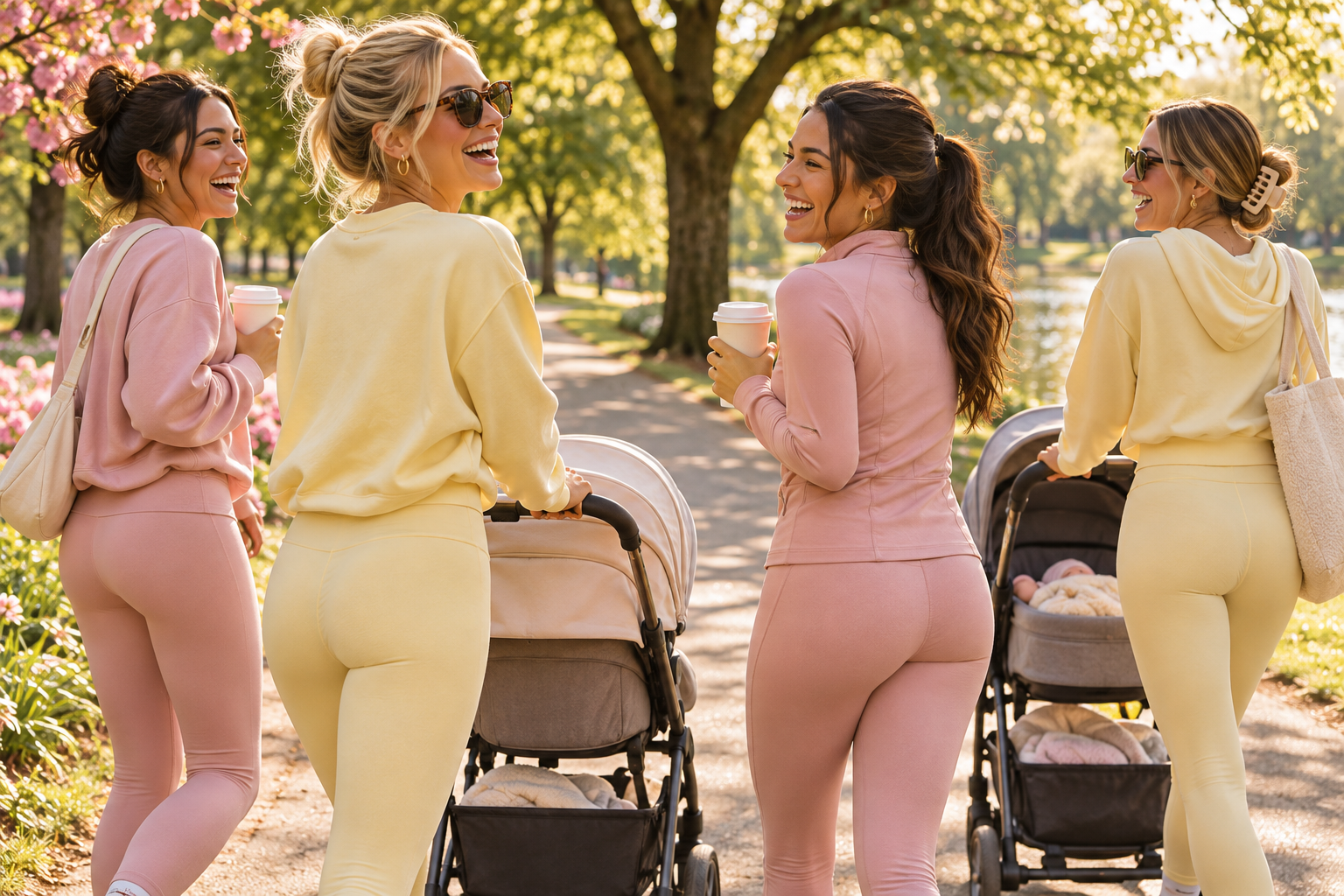
You know the feeling. Your alarm goes off, it’s cold, the baby was up twice, and every part of you wants to skip the walk. Then you remember your friend is meeting you at the corner in 15 minutes. So you go. And it’s the best part of your day.
That’s not just willpower. There’s real research behind why moving with other people makes it easier to start, more fun to keep doing and more likely to stick. It’s also the whole idea behind our walk clubs and The Flock.
Here’s what the science says, why it works, the honest downsides and simple ways to start working out with friends, even if you don’t have a workout buddy yet.
The short answer
Working out with other people tends to make you more consistent, helps you push a little harder and makes exercise more enjoyable. And for many women, especially moms, the connection is just as good for you as the movement.
The best part? You don’t need a gym, a fancy class or a group of marathon runners to get these benefits. A neighbor, a stroller and a sidewalk are plenty.
That doesn’t mean you have to work out with others. Solo movement is wonderful too. But if you’ve struggled to stay consistent on your own, adding people might be the missing piece.
What the research says
Researchers have studied social support and exercise for decades. A few studies stand out:
- 👥Wing & Jeffery, 1999Joining with friends helped people stick with it
In a study of 166 adults in a weight-loss program, 95% of those who joined with friends and got extra support finished the program, compared with 76% of those who joined alone and got the standard program. Two-thirds of the friend group kept their results six months later, versus about a quarter of the solo group.
- 🏃♀️Aral & Nicolaides, 2017Exercise is contagious
MIT researchers tracked about 1.1 million runners over five years. When friends ran more, people ran more too. One surprising detail: women were influenced by other women, but not by men.
- 🧘Yorks et al., 2017Group workouts eased stress
Medical students who took a weekly group fitness class for 12 weeks reported about 26% less stress and better quality of life. Students who worked out alone exercised longer but saw much smaller changes. It was a small study of students who chose their own group, so we take it as a hint, not proof.
- 💪The Köhler effectA partner can help you go longer
In a series of lab studies, people held exercises longer when they had a partner who was a little stronger than them, even a virtual one, than when they exercised alone.
What about walking groups specifically?
Good news for walk club fans. A 2015 review in the British Journal of Sports Medicine pulled together 42 studies of outdoor walking groups involving more than 1,800 adults, about three-quarters of them women. People in walking groups saw improvements in blood pressure, resting heart rate, body fat, cholesterol and depression scores, and about 75% of participants stuck with their programs.
The researchers suggested that the social side of walking groups, the companionship and shared experience, may be part of why people kept showing up. That matches what we see: the walk gets people out the door, but the friendships keep them coming back.
A quick honest note: like most research on behavior, these studies have limits. Some are small, some involve specific groups like medical students, and people who choose to join groups may already be different from people who don’t. But the overall picture is consistent: for many people, other people help.
Six reasons working out with friends works
- 📅AccountabilitySomeone is expecting you
It’s easy to cancel on yourself. It’s much harder to text a friend who’s already standing at the park with her stroller.
- 💪The Köhler effectYou push a little harder
Exercising next to someone slightly fitter nudges you to keep going, without anyone saying a word.
- 🙌EnjoymentIt’s more fun
Conversation makes a walk fly by. And we’re all more likely to keep doing things we enjoy.
- 🦋Social contagionHabits spread
When the people around you move more, you tend to move more too. Healthy habits travel through friendships.
- 💖WellbeingConnection lowers stress
Moving with people you like does double duty: exercise for your body, connection for your heart.
- 🌱IdentityYou start to see yourself differently
Showing up with a group helps you become “someone who walks on Saturdays.” Identity is a powerful habit-keeper.
The power of the “weak link”
The Köhler effect is one of the most interesting ideas here. Named after a German psychologist who first noticed it, it describes how people try harder when they’re the “weak link” on a team and their effort matters to the group. In exercise studies, people who were paired with a slightly more capable partner kept going longer than people working out alone.
The key word is slightly. A partner who’s a bit ahead of you is motivating. A partner who’s miles ahead can feel discouraging. That’s one reason walk clubs with mixed paces, where everyone can find someone at about their level, work so well.
Women influence women
One finding from the big MIT running study made us smile. Men were influenced by both men and women, but women were influenced only by other women. We can’t say exactly why from one study, but it’s a nice reminder that finding your girls isn’t just a tagline. It might genuinely help.
Moving together feels good
There’s also something special about moving in sync with other people. In a well-known 2010 study from Oxford, rowers who trained together in a synchronized team showed a higher pain threshold afterward, a rough sign of endorphin release, than when they rowed the same workout alone. Researchers think that shared rhythm, like walking in step or moving to the same music, may boost the feel-good effects of exercise.
You don’t need a rowing crew to feel it. Anyone who’s laughed through a hard workout class or fallen into step with a friend on a long walk knows the feeling.
The four kinds of support
Researchers often describe social support in four flavors. A good workout crew usually gives you a little of each:
- Emotional support: encouragement, empathy and someone who gets it on the hard days.
- Practical support: a friend who watches your kids while you run, or swaps babysitting so you both get a workout in.
- Information: tips on routes, gear, strollers or workouts from people who’ve been there.
- Companionship: simply having someone to do it with.
If one kind is missing, look for it elsewhere. Your partner might be great at practical support, while your walk club handles companionship and your coach handles information.
Why it matters even more for moms
For new moms especially, working out with friends isn’t only about fitness. It can be a lifeline.
- Loneliness is common after a baby. Many new moms go days without a real adult conversation. Our post on new mom loneliness goes deeper on why.
- Social connection matters for health. In 2023, the U.S. Surgeon General issued an advisory calling loneliness and isolation a public health concern and urging people to invest in social connection.
- It saves time. When your week is packed, a walk with a friend covers exercise and friendship in one hour instead of two.
- Babies are welcome. A stroller walk is one of the few workouts where bringing your baby is the whole point.
- You get perspective. Hearing that another mom is also exhausted, also struggling with feeding, also missing her old life, is incredibly reassuring.
If you’re feeling persistently low, anxious or disconnected after having a baby, please talk to your provider too. Walks with friends can help, but they’re not a substitute for care. You can also call or text the National Maternal Mental Health Hotline at 1-833-852-6262.
When it doesn’t work (and how to fix it)
Working out with others isn’t magic. Here are the most common snags and how to get around them:
- Common snag #1The problem
You compare yourself to everyone.
The fixPick a group with a range of fitness levels and a no-pressure culture. Remember that the research shows a slightly stronger partner helps; a much stronger one can just feel discouraging.
- Common snag #2The problem
Your buddy keeps canceling.
The fixHave a backup: a group with a set time, so the plan doesn’t depend on one person. Walk clubs are great for this.
- Common snag #3The problem
It turns into a competition.
The fixAgree on the vibe up front. “We’re here to move and talk, not to race” is a perfectly good ground rule.
- Common snag #4The problem
You feel pressure to keep up.
The fixYou never have to. A good group adjusts the pace or lets people go at their own speed and meet back up.
- Common snag #5The problem
You’d honestly rather be alone.
The fixThat’s okay too. Some people recharge through solo movement. A weekly check-in text with a friend can give you the accountability without the company.
How to find your people
Don’t have a workout buddy? Most women don’t, at first. Here’s how to find one:
- Start with who you already know. Text two friends: “Want to walk Saturday at 9?” Keep it specific and low-pressure.
- Look for existing groups. Walk clubs, stroller fitness classes, running clubs and community center classes all have regulars who love new faces.
- Use what you’re already doing. The moms at daycare drop-off, the parents at the playground and the coworker who mentions her step count are all potential buddies.
- Go more than once. Friendships form through repetition. Go to the same group three or four times before deciding if it’s for you.
- Start your own. Our guide to starting a stroller walk club walks you through it. Many of the best groups started with one mom and one text.
- Join a community. We’re forming walk clubs in seven cities, plus virtual circles that work anywhere.
What to text (copy and paste)
The hardest part is often just asking. Here are a few low-pressure invitations:
- The simple one: “I’m trying to walk more. Want to come with me Saturday at 9? Stroller welcome, coffee after.”
- The new-mom one: “I’m going a little stir-crazy at home. Want to do a stroller loop at the park this week? Totally fine if the baby melts down.”
- The accountability one: “Would you be my accountability buddy? I’ll text you when I work out and you text me. No judgment if we miss.”
- The group one: “Thinking of starting a Tuesday morning walk with a few of us. Interested? Even once a month counts.”
Make it stick
One great walk is easy. Making it a habit takes a little structure:
- Same time, same place. “Tuesdays at 9 by the fountain” is easier to keep than “let’s walk sometime.”
- Pick a plan B for rain or sick kids, like a video workout or a mall walk.
- Anchor it to something you love, like coffee or a favorite bakery at the end.
- Keep the bar low. A 20-minute walk counts. Showing up matters more than the workout.
- Track your streak. A shared note or calendar of walks you’ve done together becomes its own motivation.
How to choose the right group
Not every group will be your group, and that’s okay. Before you commit, ask yourself (or the organizer) a few questions:
- Is everyone welcome at any fitness level? Look for groups that say so out loud, and that actually wait for the slowest person or split into paces.
- Are kids and strollers welcome? If you need to bring your baby, find out first so you’re not the only one.
- What’s the vibe? Some groups are chatty and social, others are focused on training. Neither is wrong, but one will suit you better.
- Is the time realistic for your life? A 6 a.m. group sounds great until you try it after a night of feeds.
- How do they talk about bodies? Groups that focus on strength, energy and fun feel very different from groups centered on weight loss or “bouncing back.”
- Do you leave feeling better? That’s the real test. If you walk away lighter and more connected, you’ve found your people.
If the first group isn’t a fit, try another. Finding your people sometimes takes a few tries, and every try still counts as a workout.
How to be a great workout buddy
- Show up when you say you will, and give notice when you can’t.
- Match the pace of the slower person, or agree to split up and meet at the end.
- Celebrate wins, big and small. “You didn’t stop on the hill today!” goes a long way.
- Skip the diet talk. Keep the focus on how you feel, not what you weigh or ate.
- Be flexible. Babies nap at random. Plans change. Grace makes friendships last.
- Check in when someone disappears. A simple “Missed you this week, everything okay?” can mean a lot.
8 ways to work out with friends
- 🚶♀️Easiest startJoin a walk club
A set time and place, strollers welcome, coffee after. See what’s forming in your city.
- 🍼With babiesDo a stroller session
Meet a friend at the park for a walk with a few squats, lunges and push-ups on the bench along the way.
- 💻From homeWork out on video
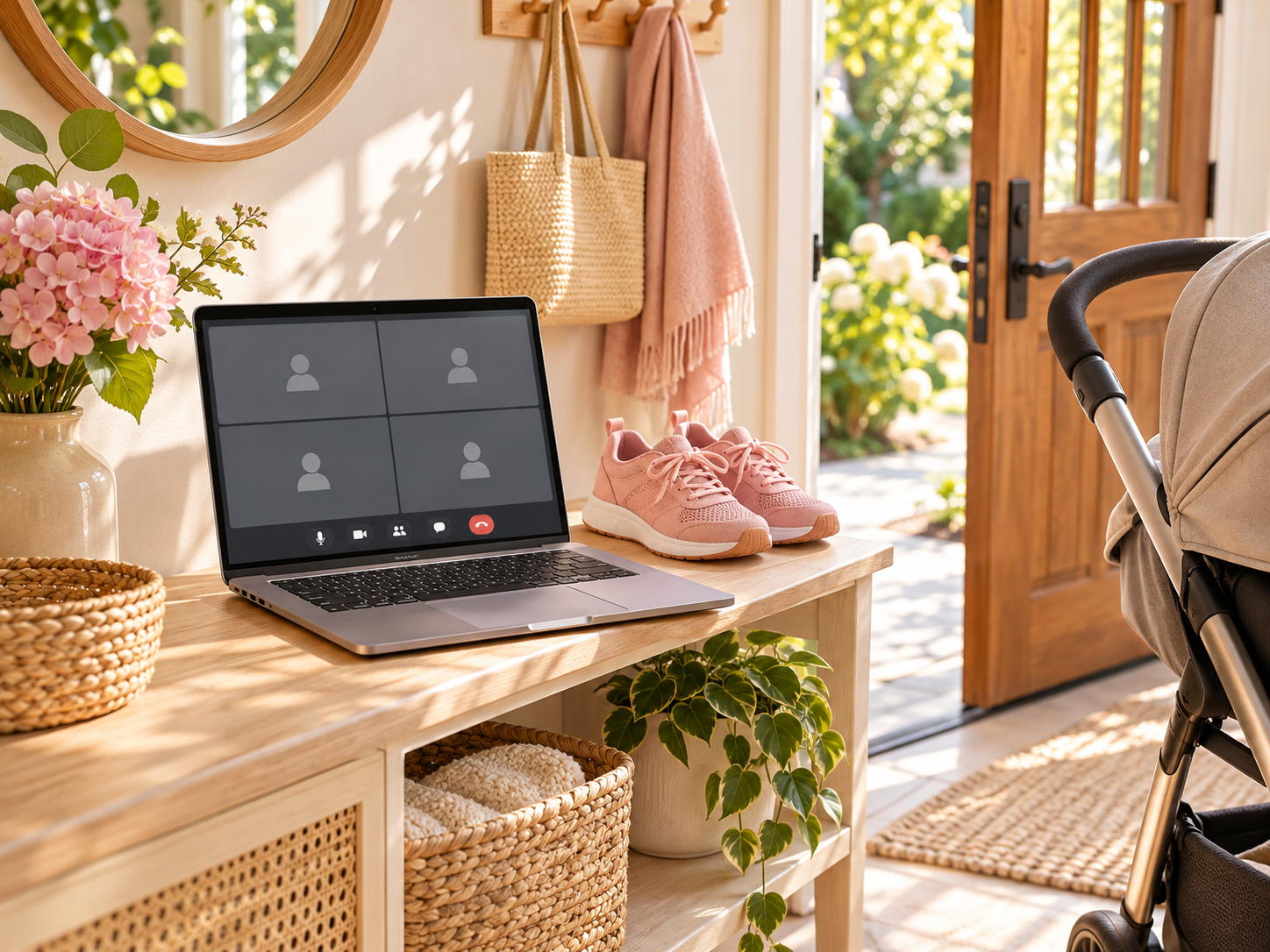
Pick a free workout video and do it at the same time on a call. Cameras optional.
- 💬Low pressureStart a group-chat challenge
Everyone posts a thumbs-up after moving for 20 minutes. Simple, and surprisingly motivating.
- 🏅A shared goalTrain for a 5K together
Follow the same plan, check in after each session and cross the finish line together.
- 🎠With kidsTurn playdates into workouts
While the kids play, take turns doing laps of the playground or a quick bodyweight circuit.
- ☕A standing dateClass plus coffee
Take the same class every week and get coffee after. The coffee is often what keeps people coming back.
- 📱For busy weeksBe accountability texters
Send each other your plan for the week on Sunday and a quick check-in on Friday.
Want a goal to train for together? Our 10-week walk-to-run 5K plan is perfect for doing with a friend or a group.
Online counts too
Can’t get out of the house? Virtual workouts and check-ins still give you a lot of the benefits: accountability, encouragement and connection. Many moms in our community start with virtual circles and move to in-person walks when they’re ready.
Ideas for every season
- SpringStart a walk club as the weather warms. Blossom walks make the best first meetups.
- SummerEarly-morning walks before the heat, playground workouts and splash-pad meetups for the kids.
- FallPeak walking season. Train together for a turkey trot or a local 5K.
- WinterIndoor video workouts on a group call, mall walks and short, bundled-up strolls followed by hot chocolate.
Bring the kids into it
Working out with friends doesn’t have to mean finding childcare. Some of the most fun group workouts include the kids:
- Playground circuits: step-ups on the bench, incline push-ups on the slide ladder and walking lunges around the sandbox while the kids play.
- Family walks: older kids on scooters or bikes, babies in strollers and adults catching up as they go.
- Dance parties: a few families, one playlist and 20 minutes of silliness in someone’s living room.
- Scavenger-hunt walks: give the kids a list of things to spot (a red door, a dog, a yellow leaf) and walk until they find them all.
Kids who see their parents moving with friends learn that exercise can be fun and social, not just something you squeeze in alone. That might be the best long-term benefit of all.
Solo time still counts
We love group workouts, but we’d never say they’re the only way. For many moms, a solo walk or a quiet workout during nap time is the only alone time all week, and that’s valuable too.
The sweet spot for many women is a mix: one or two social sessions a week for accountability and connection, and solo sessions that fit wherever life allows. Our 20-minute dumbbell workout is a great solo option.
And if you want accountability without a group, that’s exactly what a coach provides. Read how coaching and community work together to see how the two fit.
Your turn
Here’s your tiny challenge for this week: text one person and invite her on a walk. Not a big commitment, just one walk. Pick a day and a time and send it before you can talk yourself out of it.
Worst case, you get some fresh air together. Best case, you’ve just found your Saturday-morning person.
Then notice how you feel afterward. Not just in your legs, but in your mood, your energy and your sense of not being alone in this. That feeling is the real reason so many women keep coming back to their walking crews, week after week, season after season. The exercise matters, but the people are what make it stick.
And if you don’t have anyone to text yet, that’s exactly why we’re here. Tell us where you are, and we’ll help you find your people.
Sources
- Journal of Consulting and Clinical Psychology (1999): Benefits of recruiting participants with friends and increasing social support for weight loss and maintenance
- MIT Sloan School of Management: New study shows exercise is contagious (Aral & Nicolaides, Nature Communications, 2017)
- American Osteopathic Association via ScienceDaily: Group exercise improves quality of life, reduces stress far more than individual workouts
- Journal of Medical Internet Research (2013): Exercising with an Internet partner and the Köhler effect
- Biology Letters (2010): Rowers’ high: behavioural synchrony is correlated with elevated pain thresholds
- British Journal of Sports Medicine (2015): Is there evidence that walking groups have health benefits? A systematic review and meta-analysis
- U.S. Surgeon General (2023): Our Epidemic of Loneliness and Isolation
- HRSA: National Maternal Mental Health Hotline
This article is for general information and isn’t medical advice. Talk with your doctor or midwife about what’s right for you.
- Community
- Motivation
- Walk clubs
- Accountability
- New moms
Find your strength. Find your girls.
Tell us where you are and what you’re looking for. We’ll reply within two business days with walk clubs, circles and coaching that fit your season.
Questions
Good questions.
Is it better to work out with a friend or alone?
Both are good. Research suggests working out with others can boost consistency, effort and enjoyment for many people, but solo exercise has real benefits too. Many women do best with a mix.
Why do I try harder when working out with someone?
Part of it is the Köhler effect: people tend to push harder when exercising with a slightly more capable partner, especially when their effort matters to the team. Accountability and enjoyment play a big role too.
Does working out in a group reduce stress?
Some research suggests it can. In one 2017 study, medical students who took a weekly group fitness class reported about 26% less stress after 12 weeks, while students who exercised alone saw smaller changes. It was a small study, so it’s a promising hint rather than proof.
How do I find a workout buddy as a mom?
Start by inviting a friend on one specific walk, look for local walk clubs or stroller classes, talk to parents you already see at daycare or the playground, or start your own small walk group.
What if my workout buddy is much fitter than me?
A partner who’s slightly ahead of you can be motivating, but a big gap can feel discouraging. Agree on an easy pace, or walk in a group where everyone can find someone at their level.
 Community
 Community