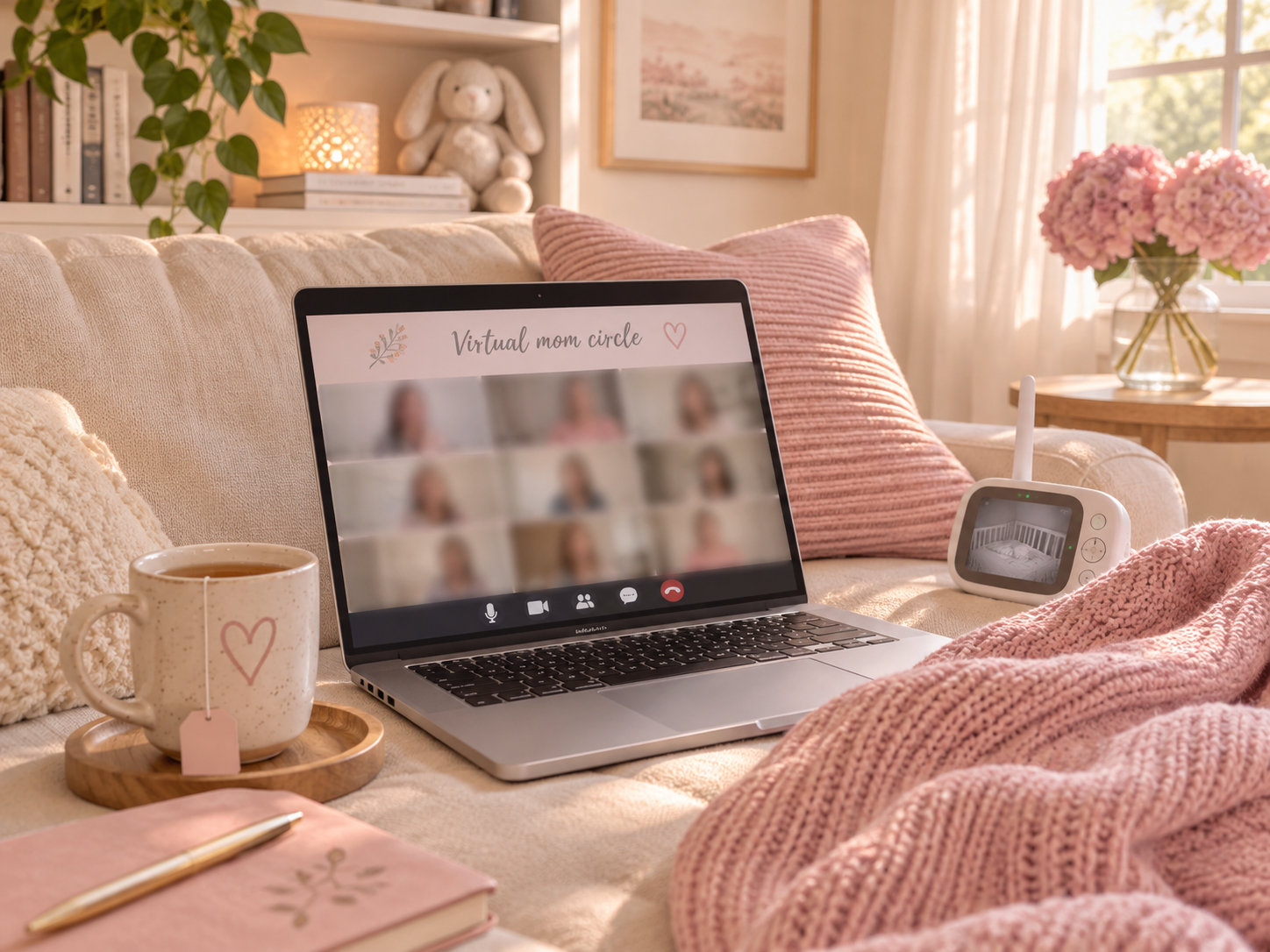
Picture this: it’s Tuesday at 1 p.m. The baby just went down. You pour a cup of tea, flop onto the couch and open your laptop. A few familiar faces pop up on the screen. Someone’s feeding, someone’s in pajamas, someone’s laughing about the diaper blowout from this morning. For forty-five minutes, you’re not doing this alone.
That’s a virtual mom circle. It’s one of the simplest ideas we’ve ever had, and one of the things our community loves most. If you’ve been feeling isolated, if getting out of the house with a baby feels impossible, or if your friends are busy with their own lives, a circle might be exactly what you’ve been missing.
This post explains what a virtual mom circle is, how ours work, what happens in a session, the different kinds of circles, what to expect your first time and how a circle is different from a group chat, a forum or therapy. By the end, you’ll know whether a circle is right for you, and how to try one.
What a virtual mom circle is
A virtual mom circle is a small group of moms who meet regularly over video at a set time. Think of it as a standing coffee date with the same group of women, except nobody has to find parking, and you can show up with spit-up on your shirt.
At Pink in Progress, our circles are designed around a few simple ideas:
- Small groups. Small enough that everyone can talk and you can get to know each other.
- A set time each week. Often during nap-time windows, with evening options for working moms.
- About 45 minutes. Long enough to connect, short enough to fit around a baby.
- A friendly host. Someone who welcomes everyone, offers a topic and keeps things warm and on track.
- Cameras optional. Feeding, rocking, lying on the floor or just listening are all welcome.
The magic isn’t any one session. It’s the rhythm. Showing up week after week with the same women is what turns a video call into a circle and a circle into friendships.
Why circles work
In 2023, the U.S. Surgeon General issued an advisory on loneliness and isolation, describing social connection as essential to our health. New motherhood is one of the seasons when connection can quietly slip away: your routines change, you’re home more and your friends may be on a different schedule. Circles are designed to bring connection back in a way that actually fits new-mom life.
- 📅ReliableSame time, every time
A circle meets on a set schedule, so it’s easy to plan around and easy to keep showing up.
- 👪FamiliarSame faces
Small groups mean you see the same women week after week. That’s how strangers become friends.
- 🛋️EasyFrom your couch
No car seat, no parking, no getting dressed. You can join with a baby on your lap or in the next room.
- 🎙️GuidedA host keeps it flowing
Nobody has to carry the conversation. A host welcomes people, offers a prompt and makes sure everyone gets a turn.
- 💬HonestReal talk
The hard parts and the funny parts, without the highlight reel. You’ll hear “me too” a lot.
- 🌱GentleA first step
For many moms, a circle is the easiest way back to connection, and a bridge to meeting up in person.
What a session looks like
Every circle has its own personality, but most of our sessions follow a similar, gentle flow:
- ArriveHellos and settle in5 min
- Check-inOne word or one win each10 min
- TopicA gentle prompt to talk through25 min
- CloseOne takeaway and see you next week5 min
Arrive and settle in
The host opens the call a few minutes early. People drift in, say hi, adjust their cameras or turn them off, and get the baby settled. There’s no pressure to be on time to the second.
Check-in
Everyone who wants to shares a quick check-in, like one word for how their week has been or one small win. “Exhausted.” “Proud: I showered.” “Hopeful.” It’s a fast way to see how everyone is doing, and it often gets the laughs started.
The topic
The host offers a gentle prompt, and the conversation goes from there. Topics might include:
- What nobody told you about the first month
- Sleep: what’s working, what isn’t
- How your relationship with your partner has changed
- Going back to work, or deciding not to
- Finding time to move your body
- Missing your old self, and meeting your new one
- Holidays, family visits and boundaries
Sometimes the group runs with the topic. Sometimes someone has a hard week and the circle gathers around her instead. Both are exactly what a circle is for.
Close
The session ends with everyone sharing one takeaway, a plan for the week or simply a “see you next Tuesday.” The host shares any reminders, like an upcoming walk club or meetup.
What our hosts do
Every circle has a host. She isn’t there to lecture or to be the expert in the room. Her job is to make the circle feel warm, safe and easy to be part of.
- Welcomes everyone by name, especially new faces, so nobody feels like the odd one out.
- Offers the topic and a couple of follow-up questions if the conversation needs a nudge.
- Makes room for quieter voices, gently inviting people in without putting anyone on the spot.
- Keeps the agreements, steering things back if a conversation turns judgmental or off track.
- Watches the clock, so circles start and end when they’re supposed to.
- Checks in privately if someone seems to be having a really hard time, and shares professional resources.
- Shares what’s coming up, like walk clubs, meetups and new circles.
Hosts are part of our community too. Many are moms who’ve been where you are and wanted to help other women feel less alone.
Why small groups matter
It might seem like a bigger group would mean more connection. In practice, it’s the opposite. In a big video call, most people stay muted, the same few voices do the talking and it’s easy to leave without anyone noticing you were there.
In a small circle, you’re missed when you don’t show up. People remember that your baby was teething last week and ask how it went. You get time to actually talk, not just wave. That’s the difference between being in a meeting and being in a circle, and it’s why we keep our groups intentionally small.
Who circles are for
Circles are for any mom who wants more connection in her week. They can be especially helpful if:
- You feel lonely or isolated, even with people around.
- You live far from family or moved recently.
- Getting out of the house with a baby feels like too much right now.
- You’re recovering from a hard birth or a C-section and can’t get around easily.
- Your existing friends love you but are busy with their own lives.
- You’re shy, and a small online group feels easier than a big in-person event.
- You want to meet local moms before you meet up in person.
- You just like having something to look forward to.
And you don’t have to be a brand-new mom. Circles welcome moms of toddlers, moms of several kids and moms going through all kinds of seasons.
Different kinds of circles
Not every season looks the same, so not every circle does either. Some circles are open to any mom, and some gather women going through something specific, so the conversation can go deeper. Here are the kinds of circles we offer and are building.
- 🍼Babies 0–12 monthsNew mom circles
For the fourth trimester and the first year: sleep, feeding, identity and everything in between.
- 🚼Little ones 1–3Toddler mom circles
Tantrums, transitions and getting a little of yourself back as your baby grows.
- 💼EveningsWorking mom circles
For moms juggling work and family, scheduled after bedtime so you can actually make it.
- 🌟GentleHard birth and recovery
For moms recovering from a difficult birth, a NICU stay or a complicated recovery. Lying-down friendly.
- 💌Coming soonStarting over after divorce
For women rebuilding after a divorce or separation, with or without kids.
- 🕯️Coming soonLife after loss
For widows and women grieving a partner, at whatever pace grief takes.
- 🍀Coming soonHealing after a hard relationship
For women moving forward after a toxic or abusive relationship, alongside professional support.
- 🌸Open to allReady for more
For any woman who wants to feel stronger and more connected, whatever season she’s in.
Specialized circles like divorce, loss and healing after a hard relationship need extra care, so we’re building them thoughtfully, with trained hosts and clear connections to professional support. We’ll be writing more about each of them soon. If one of them is what you need, let us know through the form and we’ll reach out when it opens.
Our circle agreements
A circle only works if everyone feels safe to be honest. So every Pink in Progress circle shares a few simple agreements. The host reminds everyone of them, especially when someone new joins.
- 🤐PrivacyWhat’s said here stays here
We don’t share each other’s stories, names or screenshots outside the circle.
- 👂RespectListen more than fix
We share experiences, not lectures. Advice only when someone asks for it.
- 🎈WelcomeCome as you are
Cameras optional. Babies, messy buns, pajamas and late arrivals are all welcome.
- 🚫SafeNo selling, no judging
No pitches, no recruiting and no comparing bodies, babies or choices.
- ✋ChoicePass is always okay
You never have to share. Listening counts.
- 🩹SupportCare first
If someone is struggling, the host will check in privately and share professional resources.
What a circle isn’t
Circles are wonderful, but it’s important to be clear about what they are and aren’t.
- Not therapy. Our hosts are friendly guides, not therapists. A circle is peer support, and it works best alongside professional care when you need it.
- Not medical advice. Moms share experiences, but questions about your health or your baby’s health belong with your provider or pediatrician.
- Not a crisis service. If you’re in crisis, please reach out to the resources below right away.
- Not a sales pitch. Nobody will try to sell you anything in a circle.
If you’re struggling with your mood, it’s worth talking to your provider. The National Institute of Mental Health notes that mood symptoms lasting longer than two weeks after birth may be signs of postpartum depression, which is common and treatable. Postpartum Support International also offers free online support groups led by trained facilitators, focused on perinatal mood.
Your first circle
Joining a group of strangers, even online, can feel nerve-racking. That’s completely normal. Here’s what to expect, so there are no surprises.
- You’ll get a link and a reminder. After you sign up, we’ll send the day, time and video link, plus a reminder before the circle.
- Join a minute or two early if you can. The host will greet you and help with any tech hiccups.
- Camera on or off, your choice. Plenty of moms start with the camera off and turn it on once they feel comfortable.
- You’ll be introduced. Just your first name, your baby’s age if you like and one thing about your week.
- Listen as much as you like. You never have to share. Many first-timers mostly listen, and that’s welcome.
- Leave whenever you need to. Babies wake up. Nobody will think twice if you drop off early.
- Come back next week. The second circle is always easier than the first, and the third feels like catching up with friends.
Feeling shy?
You’re in good company. Many moms who join circles describe themselves as introverts. A few things that help: have your check-in word ready, keep a drink in your hand, and remember that everyone else on the screen once had their first circle too.
The tech side
You don’t need anything fancy to join a circle.
- A phone, tablet or laptop with a camera and microphone. A phone propped up on a pillow works fine.
- Headphones, if you want privacy or there’s a sleeping baby nearby.
- A quiet-ish spot. A couch, a bed, the floor of the nursery. It doesn’t need to look nice.
- Mute when you’re not talking if there’s background noise. Nobody minds baby sounds, though.
- A private space when it matters. If you’re sharing something personal, headphones help keep it between you and the circle.
Getting the most out of it
Circles get better the more you put in, but “putting in” mostly means showing up.
- Make it a standing appointment. Put it in your calendar like any other commitment, and protect it.
- Tell your partner or helper. Ask them to take the baby for that hour when they can.
- Share a little more each week. You don’t have to open up all at once. Trust builds over time.
- Follow up with someone. If you click with another mom, swap numbers or suggest a walk.
- Join something in person. Many circle friendships become walk club or coffee friendships. Our stroller walk club guide shows you how.
Circles vs. group chats and forums
You might be thinking: I’m already in a mom group chat, or I post in an online forum. Why a circle? Group chats and forums can be lovely, but they’re different.
- Faces and voices, not just text. Hearing someone laugh or seeing her nod along feels closer than reading a message at 2 a.m.
- Small and familiar, not huge and anonymous. Big online groups can be overwhelming and sometimes judgmental. A circle is small, and you know who’s there.
- Set time, not endless scrolling. A circle has a start and an end. It’s connection, not another feed to keep up with.
- Guided, not chaotic. A host keeps the tone kind and makes sure the conversation includes everyone.
Circles also give you something forums can’t: people who notice when you’re missing and are genuinely glad when you come back.
Lots of moms use both. A group chat for quick questions and memes, and a circle for real conversation.
Starting a circle with your own friends
Love the idea but want to start something with women you already know? You can. The same principles work for any small group.
- Invite three to six moms. Small enough that everyone talks, big enough that it still happens when someone cancels.
- Pick one time and stick to it. The same day and time every week or every other week.
- Choose a free video tool everyone can use on their phone, and send one recurring link.
- Rotate the host. Each week, someone different brings a question to talk about.
- Agree on a few ground rules, like privacy, no judgment and passing is always okay.
- Keep it short. Forty-five minutes is plenty. Ending on time keeps people coming back.
A few easy prompts to start with: What was the best and hardest part of your week? What’s something you miss from before baby? What’s one thing that’s helped you lately? What do you wish someone had told you?
Questions moms ask before joining
“What if I don’t click with anyone?”
It happens, and it’s okay. Give it two or three sessions before deciding, since the first circle is always the most awkward. If it still doesn’t feel right, we can help you try a different circle or time.
“What if my baby cries the whole time?”
Then your baby cries the whole time, and everyone understands. Mute yourself if you’d like, bounce, feed, and stay as long as you can. Every mom on that call has been there.
“I’m not a new mom anymore. Is it too late?”
Not at all. Moms of toddlers, preschoolers and big kids feel lonely too, and some of our circles are made just for later seasons.
“Is it awkward to talk to strangers on camera?”
A little, the first time. That’s why cameras are optional and the host guides the conversation. Most moms say the awkwardness disappears within ten minutes, usually right around the first shared laugh.
How to join
Virtual circles are part of every Pink in Progress membership. You can join on their own through The Flock, our community membership, or get them as part of 1:1 coaching, along with walk clubs, meetups and a private group chat.
To get started, fill out the short form on our homepage and choose “Community” or “New mom support.” We’ll reply within two business days with the circle schedule and how to join your first one.
Already part of a circle and loving it? Invite a friend. Many of our moms first heard about circles from another mom who said, “Come with me next week.” Sometimes that’s all it takes.
And if you’re on the fence, try just one. Pour the tea, grab a blanket and log on. The worst case is a pleasant forty-five minutes. The best case is finding your girls.
Sources
- AHRQ: Surgeon General Advisory on the Epidemic of Loneliness and Isolation
- Postpartum Support International: Online Support Meetings
- National Institute of Mental Health: Perinatal Depression
- HRSA: National Maternal Mental Health Hotline
- 988 Suicide & Crisis Lifeline: 988lifeline.org
This article is for general information and isn’t medical advice. Talk with your doctor or midwife about what’s right for you.
- Virtual circles
- Community
- New moms
- Mom friends
- Support groups
Ready to try your first circle?
Tell us a little about you. We’ll reply within two business days with the circle schedule and a link to join.
Questions
Good questions.
What is a virtual mom circle?
A small group of moms who meet regularly over video at a set time, with a host who guides the conversation. It’s a way to build real connection and friendships from home.
Do I have to turn my camera on?
No. Cameras are always optional. Many moms start with the camera off and turn it on once they feel comfortable.
Can I bring my baby?
Yes. Babies are welcome, whether they’re feeding, sleeping on you or making noise in the background.
How long are circles?
About 45 minutes, usually at the same time each week, so it’s easy to plan around.
Is a virtual circle the same as therapy?
No. A circle is peer support with a friendly host, not therapy or medical care. If you’re struggling with your mood, please talk to your provider or a licensed therapist.
Do I have to talk?
Never. You can pass at any time, and listening is always welcome.
 Community
 Community