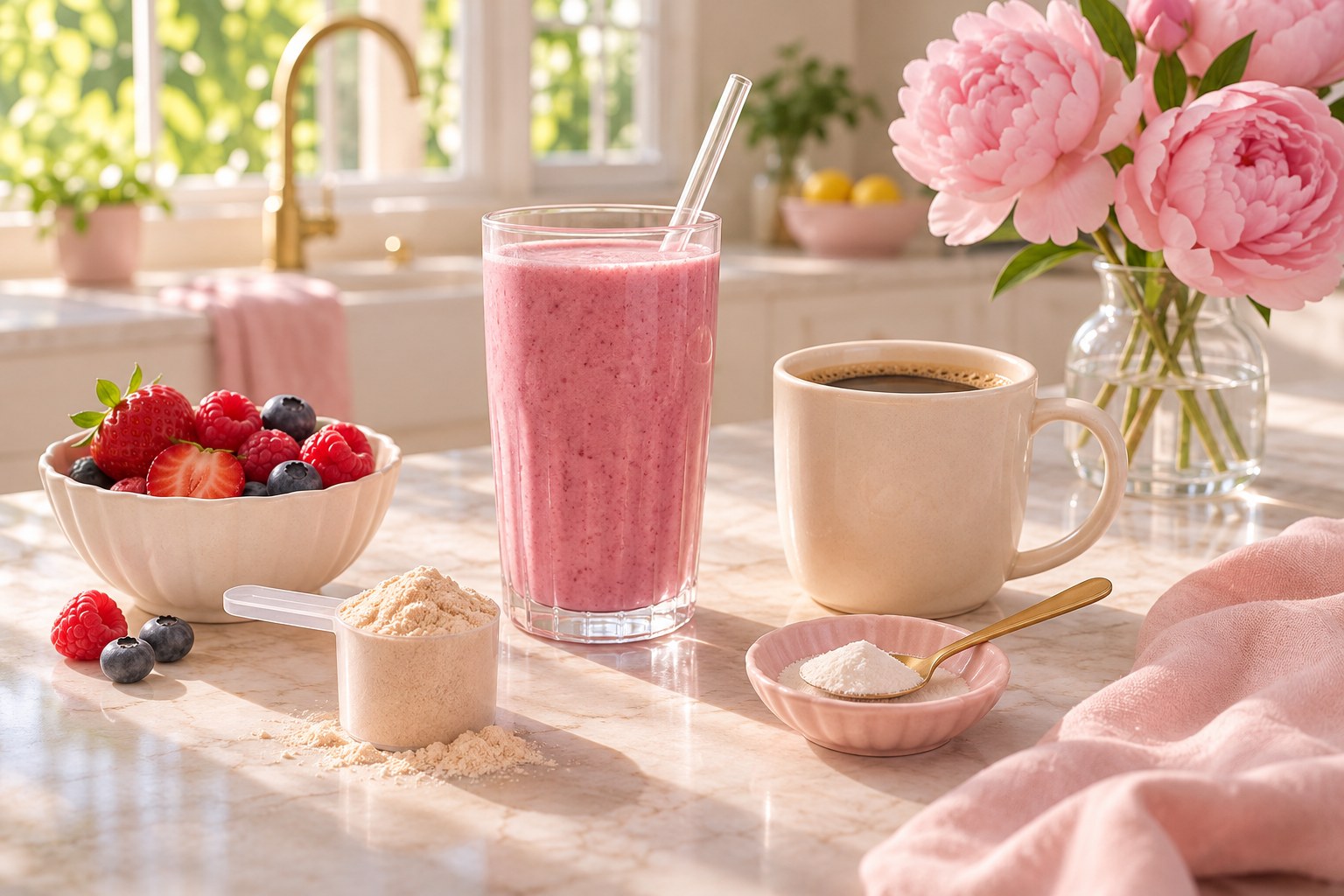
Walk down the supplement aisle, or scroll for about four seconds, and you’ll see two tubs promising to change your life. One says collagen and shows glowing skin. The other says protein and shows a very strong arm. Both have “grams of protein” on the label. So what’s the difference, and do you need either?
It’s one of the most common questions we hear from women in our community, and it makes sense. Collagen is marketed for beauty, protein powder for muscle, and a lot of us are quietly wondering whether a scoop of collagen in our coffee “counts” toward our protein for the day.
Here’s the honest version: what collagen and protein powder actually are, why they’re not interchangeable, what the research says about muscle, skin and joints, how much protein you really need and how to choose and shop safely, especially after recent testing found heavy metals in many popular powders.
We’re coaches, not dietitians or doctors. This is general information, not medical or nutrition advice. If you have a health condition, are pregnant or breastfeeding, or take medications, talk to your provider or a registered dietitian before adding supplements. Our post on coaches, dietitians and therapists explains who does what.
The short answer
Protein powder is a complete protein designed to help you meet your daily protein needs and support your muscles. Collagen is an incomplete protein made mostly of a few specific amino acids. It’s marketed for skin, hair, nails and joints, with research that’s mixed and still debated.
If you can only pick one and your goal is strength, recovery or simply eating enough protein, choose a protein powder. If you enjoy collagen and want to try it for skin or joints, that’s fine too, but don’t count it as a replacement for the protein in your meals.
And the most important part: neither one is required. Real food, like eggs, yogurt, fish, chicken, beans, tofu and cheese, can cover most women’s protein needs. Powders are a convenience, not a magic ingredient.
At a glance
| Collagen peptides | Protein powder | |
|---|---|---|
| What it is | Broken-down collagen from animal skin, bones or fish scales | Concentrated protein from milk (whey, casein), eggs, beef or plants (pea, soy, rice) |
| Complete protein? | No. It contains no tryptophan | Most are complete. Some plant powders blend sources to get there |
| Main amino acids | Glycine, proline and hydroxyproline | All nine essential amino acids, often rich in leucine |
| Marketed for | Skin, hair, nails and joints | Muscle, recovery and meeting daily protein needs |
| Muscle research | Weaker. Whey beat collagen in head-to-head studies | Strongest evidence, especially with strength training |
| Taste and texture | Usually unflavored, dissolves in hot or cold drinks | Often flavored, best in shakes, oats and smoothies |
| Typical serving | About 10 to 20 grams | About 20 to 30 grams of protein |
What collagen is
Collagen is the most abundant protein in your body. It’s the scaffolding of your skin, tendons, ligaments, cartilage and bones. Your body makes it on its own, from the protein you eat, and production naturally slows as we age.
Collagen supplements are usually made from cow hides, pig skin, chicken cartilage or fish skin and scales. The collagen is broken down into small pieces called peptides (or “hydrolyzed collagen”), so it dissolves easily into coffee, tea, water or smoothies.
Here’s the key thing to know: collagen has a very unusual amino acid profile. It’s packed with glycine, proline and hydroxyproline, which is exactly what makes it great at being collagen. But it’s missing tryptophan entirely, and it’s low in several other essential amino acids, including leucine, the one most closely tied to building muscle.
When you swallow collagen, your body doesn’t send it straight to your face. It breaks it down into amino acids and small peptides, then uses them wherever they’re needed. The theory behind collagen supplements is that some of those peptides may act as signals that encourage your body to make more of its own collagen. That’s an active area of research, and we’ll get to what it’s found.
What protein powder is
Protein powder is a concentrated source of protein made from food. The most common types:
- 🥛DairyWhey
From milk. Fast-digesting and naturally rich in leucine. Whey isolate is filtered more and often easier for people sensitive to lactose.
- 🧀DairyCasein
Also from milk. Digests more slowly and makes thicker shakes. Some people like it before bed.
- 🌱PlantPea, soy, rice and blends
Good for dairy-free or vegan diets. Soy is complete on its own; blends of pea and rice help round out the amino acids.
- 🥚AnimalEgg white and beef
Dairy-free animal options. Note that some “beef protein” powders are made largely from collagen, so check the label.
A scoop typically provides around 20 to 30 grams of protein, which is similar to a small chicken breast or a cup of Greek yogurt plus a little extra. That’s the main appeal: an easy way to add protein when you’re busy, not hungry, or eating on the go.
Complete vs. incomplete protein
This is where the confusion usually lives.
Your body needs nine essential amino acids from food, because it can’t make them on its own. A complete protein contains all nine in useful amounts. Meat, fish, eggs, dairy, soy and most protein powders are complete.
Collagen is not. It contains no tryptophan at all and very little of several other essential amino acids. In a common scoring system for protein quality, which looks at how well a protein meets your essential amino acid needs, collagen scores at the very bottom.
Does that make collagen “bad”? No. Lots of healthy foods are incomplete proteins, and if you eat a variety of protein foods through the day, you’ll get everything you need. It just means collagen shouldn’t be your main source of protein, and a 20-gram scoop of collagen isn’t the same as 20 grams of protein from a complete source.
Collagen is a protein. It’s just not a complete one. Enjoy it as an extra, not a replacement.
A note on labels
Collagen tubs list grams of protein on the label, and some protein bars and “beef protein” powders use collagen to boost their protein numbers. If muscle and recovery are your goal, flip the tub over and check the ingredients. If collagen or gelatin is the first ingredient in a “protein” product, it may not be doing what you think.
For muscle and strength
If your goal is getting stronger, recovering from workouts or holding on to muscle as you age, the research clearly favors complete protein.
Researchers at McMaster University in Canada, led by Sara Oikawa and Stuart Phillips, compared whey protein and collagen peptides head to head in a randomized controlled trial in healthy older women, published in the American Journal of Clinical Nutrition. Whey protein, but not collagen, stimulated muscle protein synthesis, both on its own and when combined with resistance exercise. Phillips has explained that leucine content is the key difference: whey is rich in it, collagen isn’t.
An earlier study from the same lab in older adults found that after a period of inactivity, whey helped participants rebuild muscle once they got moving again, while collagen did not.
That doesn’t mean collagen does nothing for active women. Some researchers are studying whether it supports tendons and connective tissue. But for muscle specifically, a complete protein like whey, soy, a well-blended plant protein or simply protein-rich food is the better tool.
Pair it with strength training. Protein supports muscle, but lifting is what tells your body to build it. Our 20-minute dumbbell workout and home gym for under $100 are easy places to start.
For skin
This is where collagen’s marketing is loudest, and where the research is the most debated.
Several meta-analyses, which pool results from many studies, have found that collagen supplements improved skin hydration and elasticity compared with a placebo. A large umbrella review from Anglia Ruskin University in 2025, looking at 113 randomized trials with nearly 8,000 participants, found consistent evidence for improved skin elasticity and hydration over time, but no improvement in skin roughness, a proxy for visible wrinkles. The authors noted their review received no industry funding.
But a 2025 meta-analysis in The American Journal of Medicine looked more closely. Across 23 randomized trials with 1,474 participants, collagen seemed to help skin overall. When the researchers looked only at high-quality studies, or studies without industry funding, those benefits disappeared. Industry groups pushed back on the analysis, and the debate continues.
Our honest take: collagen might modestly help skin hydration and elasticity for some people, but the evidence is shakier than the marketing suggests, and much of the research is funded by the industry selling it. Sunscreen, not smoking, sleep and a protein-rich diet have much stronger evidence for skin.
For joints
The joint research is a little more encouraging, though it’s still not settled.
A 2024 meta-analysis in Clinical and Experimental Rheumatology pooled 11 randomized trials with 870 people with knee osteoarthritis and found that oral collagen improved pain and function scores compared with placebo. The researchers noted that not every improvement was large enough to be clearly meaningful in daily life, and the studies varied a lot. An earlier 2019 meta-analysis found improvements in stiffness, but not in pain or function. The 2025 umbrella review also reported relief from osteoarthritis-related joint pain and stiffness.
So if you have achy knees, collagen may be worth discussing with your doctor, alongside the things with strong evidence: strength training, staying active, physical therapy and maintaining your mobility. If you don’t have joint pain, there’s little evidence collagen prevents it.
How much protein you actually need
Before you buy anything, it helps to know whether you even need a supplement.
- BaselineThe RDA for adults is 0.8 grams of protein per kilogram of body weight per day. That’s the minimum to meet basic needs, not necessarily the ideal.
- Active womenThe International Society of Sports Nutrition says 1.4 to 2.0 grams per kilogram per day is safe and may help active people adapt to training.
- Female athletesA 2023 ISSN position stand on female athletes suggests the mid to upper end of sports nutrition ranges for women at every stage, including peri- and post-menopause.
- Pregnant or nursingNeeds go up. Ask your provider or a dietitian what’s right for you.
Numbers can feel overwhelming, so here’s a simpler approach that works for most women: include a palm-sized portion of protein at each meal, and a protein-rich snack or two. Eggs or Greek yogurt at breakfast. Chicken, tuna, tofu or beans at lunch. Fish, meat or lentils at dinner. Cheese, edamame or a shake as a snack.
Many women undereat protein at breakfast and overeat it at dinner. Spreading it out across the day is an easy win. Our one-handed snacks and 10-minute dinner rotation posts are full of easy protein ideas.
And if you’re working on your relationship with food, or numbers make things harder, skip the counting. Focus on regular, satisfying meals that include protein. A registered dietitian can help you find what works for you.
Which one should you choose?
Here’s how we’d think about it for the most common goals.
- 💪GoalGetting stronger
Protein powder (or more protein foods), plus strength training. Collagen isn’t a substitute.
- ⏰GoalBusy mornings
Protein powder in a smoothie or oats makes breakfast easier. Collagen in coffee adds a little but won’t replace breakfast protein.
- 🌱GoalDairy-free or vegan
A soy or blended plant protein. Collagen is never vegan. Check for third-party testing (see below).
- ✨GoalSkin
Sunscreen first. If you want to try collagen, give it a few months and keep your expectations modest.
- 🦵GoalAchy joints
Talk to your doctor or a physical therapist. Collagen may help some people, alongside strength and movement.
- 🍴GoalYou already eat plenty of protein
You may not need either. Save your money for good sneakers.
Can you take both? Yes. Some women add a scoop of collagen to coffee and use a protein powder in a smoothie. Just count the protein powder (and your meals) toward your daily protein, and think of collagen as an extra.
Shopping safely: heavy metals and testing
Here’s something every woman who uses protein powder should know.
In October 2025, Consumer Reports tested 23 popular protein powders and ready-to-drink shakes. More than two-thirds had more lead in a single serving than its experts consider safe to consume in a whole day. Plant-based powders were the most concerning, averaging about nine times more lead than dairy-based products. Consumer Reports said most products were fine to have occasionally, but advised against having a protein shake every day.
Why does this happen? Heavy metals can get into plant crops from soil and water. And in the U.S., there are no federal limits on heavy metals in supplements. Manufacturers are responsible for testing their own products, and the FDA doesn’t approve supplements before they’re sold.
Collagen isn’t automatically safer. It’s also a supplement, and quality varies by brand.
How to shop smarter
- Look for third-party testing. Seals like NSF Certified for Sport or Informed Choice mean an independent lab has tested the product for contaminants and checked that the label is accurate. You can search certified products on NSF’s website.
- Check recent testing. Look up the brand in Consumer Reports’ results or the company’s own published testing.
- Keep it simple. Fewer ingredients usually means fewer surprises. Watch out for “proprietary blends,” herbs and stimulants.
- Don’t rely on one powder every single day. Use powders to fill gaps and get most of your protein from food.
- Be extra careful if you’re pregnant, breastfeeding or making shakes for kids. Talk to your provider first.
What to look for
We don’t recommend specific brands here, because quality and testing change. Instead, these links go to Amazon searches so you can compare options. Always check for third-party testing before you buy. We don’t earn anything from these links.
-
Whey protein isolate
Complete protein · Dairy
Mixes easily, digests quickly and is naturally rich in leucine. Isolate is usually lower in lactose than concentrate. In Consumer Reports’ testing, dairy-based powders averaged much lower lead than plant-based ones.
Look for: NSF Certified for Sport or Informed Choice, a short ingredient list and about 20 to 25 grams of protein per scoop.
-
Soy or blended plant protein
Complete protein · Dairy-free
Great for vegan or dairy-free diets. Soy is complete on its own, and pea-rice blends help round out the amino acids. Because plant powders tested highest for lead, third-party testing matters even more here.
Look for: Third-party heavy metal testing, published lab results and a blend of protein sources.
-
Unflavored collagen peptides
Incomplete protein · Animal-based
Dissolves into coffee, tea and soups with almost no taste. If you want to try collagen for skin or joints, a plain, unflavored version keeps things simple. Give it a few months before you judge it.
Look for: Third-party testing, a single ingredient (collagen peptides) and a clear source, like bovine or marine.
-
A good shaker bottle
About $10–20
The unsung hero of protein shakes. A shaker with a mixing ball or whisk means no clumps and no blender to wash.
Look for: Leak-proof lid, dishwasher safe and a size that fits your cup holder.
Easy ways to use them
No need to chug chalky shakes. A few easy ideas:
- 🍓Protein powderBerry smoothie
A scoop of vanilla protein, frozen berries, a banana, milk and a handful of spinach you won’t taste.
- 🥣Protein powderProtein oats
Stir a scoop into oatmeal after cooking, with a splash of milk so it stays creamy.
- 🥛Protein powderYogurt bowl
Mix a little powder into Greek yogurt and top with fruit and granola.
- 🥞Protein powderPancakes and muffins
Swap a few tablespoons of flour for protein powder in your usual batter.
- ☕CollagenCoffee or tea
Unflavored collagen dissolves right in, hot or iced.
- 🍲CollagenSoups and sauces
Stir into soups, stews or pasta sauce for a little extra protein.
Remember: if you add collagen to your coffee, your breakfast still deserves a complete protein. Eggs, yogurt, cottage cheese or a protein smoothie are great partners.
Pregnancy and breastfeeding
Protein needs go up during pregnancy and breastfeeding, and lots of new moms reach for shakes because they’re easy to have with one hand. That’s understandable. A few things to keep in mind:
- Talk to your provider first. Supplements aren’t approved by the FDA before they’re sold, and many haven’t been studied in pregnancy.
- Choose third-party tested products to lower the risk of heavy metals and hidden ingredients.
- Avoid powders with extra herbs, stimulants or “proprietary blends.” Some “lactation” and “beauty” blends include ingredients that haven’t been well studied.
- Lean on food when you can. Greek yogurt, eggs, cheese sticks, milk and leftover chicken are easy, safe and nutritious.
Myths
- Myth #1What you’ve heard
“Collagen counts toward my protein goal.”
The truthIt adds some protein, but it’s incomplete. It shouldn’t replace complete protein from food or protein powder, especially if you want to build muscle.
- Myth #2What you’ve heard
“Collagen goes straight to your skin.”
The truthYour body breaks it down and uses the pieces where it needs them. Some peptides may signal skin to make collagen, but the evidence is debated.
- Myth #3What you’ve heard
“Protein powder will make you bulky.”
The truthBuilding a lot of muscle takes years of heavy training. Protein helps you recover and get stronger. It doesn’t change your body on its own.
- Myth #4What you’ve heard
“Plant protein is always the healthiest choice.”
The truthPlant powders can be great, but in Consumer Reports’ 2025 testing they averaged the highest lead levels. Choose third-party tested products.
- Myth #5What you’ve heard
“You need a supplement to get enough protein.”
The truthMost women can meet their needs with food. Powders are a convenience for busy days, not a requirement.
Your turn
Before you buy anything, try this for one week: add a source of protein to your breakfast every day. Then decide whether a powder would actually make your life easier.
Collagen and protein powder aren’t rivals, and neither is a miracle. Protein powder is a practical tool for meeting your protein needs and supporting your muscles. Collagen is an optional extra with mixed but interesting research for skin and joints. Food does most of the heavy lifting either way.
If you’d like help building simple, sustainable protein habits that fit your life, without food rules or guilt, that’s exactly what our coaches do. And if you want women to swap smoothie recipes with, our circles are always happy to talk breakfast.
Sources
- American Journal of Clinical Nutrition (2020): Oikawa et al.: Whey protein but not collagen peptides stimulate muscle protein synthesis in healthy older women
- NZMP: Stuart Phillips on collagen peptides vs. whey protein
- McMaster University: Finding their whey back
- Athletech News: The American Journal of Medicine meta-analysis on collagen and skin aging
- CosmeticsDesign: Industry reacts to collagen skin meta-analysis
- Fox News Health: Anglia Ruskin University umbrella review of collagen supplements
- Clinical and Experimental Rheumatology (2025): Oral collagen supplementation and knee osteoarthritis (OrthoEvidence summary)
- International Orthopaedics (2019): Collagen supplementation and osteoarthritis symptoms: a meta-analysis
- International Society of Sports Nutrition position stand: Protein and exercise
- ISSN position stand (2023): Nutritional concerns of the female athlete
- NPR via OPB: A study found lead in popular protein powders. Here’s why you shouldn’t panic
- Nutraceuticals World: Consumer Reports protein powder testing
- U.S. Food and Drug Administration: Dietary supplements
- NSF Certified for Sport
Product links are general Amazon searches, and we don’t earn anything from them. This article is for general information and isn’t medical or nutrition advice. Talk with your doctor or a registered dietitian about what’s right for you, especially if you’re pregnant, breastfeeding or have a health condition.
- Nutrition
- Protein
- Collagen
- Supplements
- Strength training
Find your strength. Find your girls.
Tell us where you are and what you’re working on. We’ll reply within two business days with coaching and community that make healthy habits feel simple.
Questions
Good questions.
Is collagen the same as protein powder?
No. Collagen is a protein, but it’s incomplete: it contains no tryptophan and is low in leucine and other essential amino acids. Most protein powders are complete proteins designed to help you meet your daily protein needs and support muscle.
Does collagen count toward my daily protein?
It adds a little, but it shouldn’t replace complete protein from food or protein powder, especially if your goal is muscle or recovery. Think of collagen as an extra.
Is collagen or whey better for building muscle?
Whey. In a randomized trial in healthy older women, whey protein stimulated muscle protein synthesis while collagen peptides did not, likely because whey is much richer in leucine.
Does collagen really work for skin?
The evidence is mixed. Some reviews found modest improvements in skin hydration and elasticity, but a 2025 meta-analysis found the benefits disappeared when looking only at high-quality or non-industry-funded studies.
Are protein powders safe?
Many are fine occasionally, but Consumer Reports’ 2025 testing found that more than two-thirds of 23 products had more lead per serving than its experts consider safe daily, with plant-based powders highest. Choose third-party tested products and get most of your protein from food.
Can I take collagen or protein powder while pregnant or breastfeeding?
Talk to your provider first. Supplements aren’t approved by the FDA before they’re sold, and many haven’t been studied in pregnancy. If you use one, choose a simple, third-party tested product.
Keep reading
 Nutrition
 Fitness