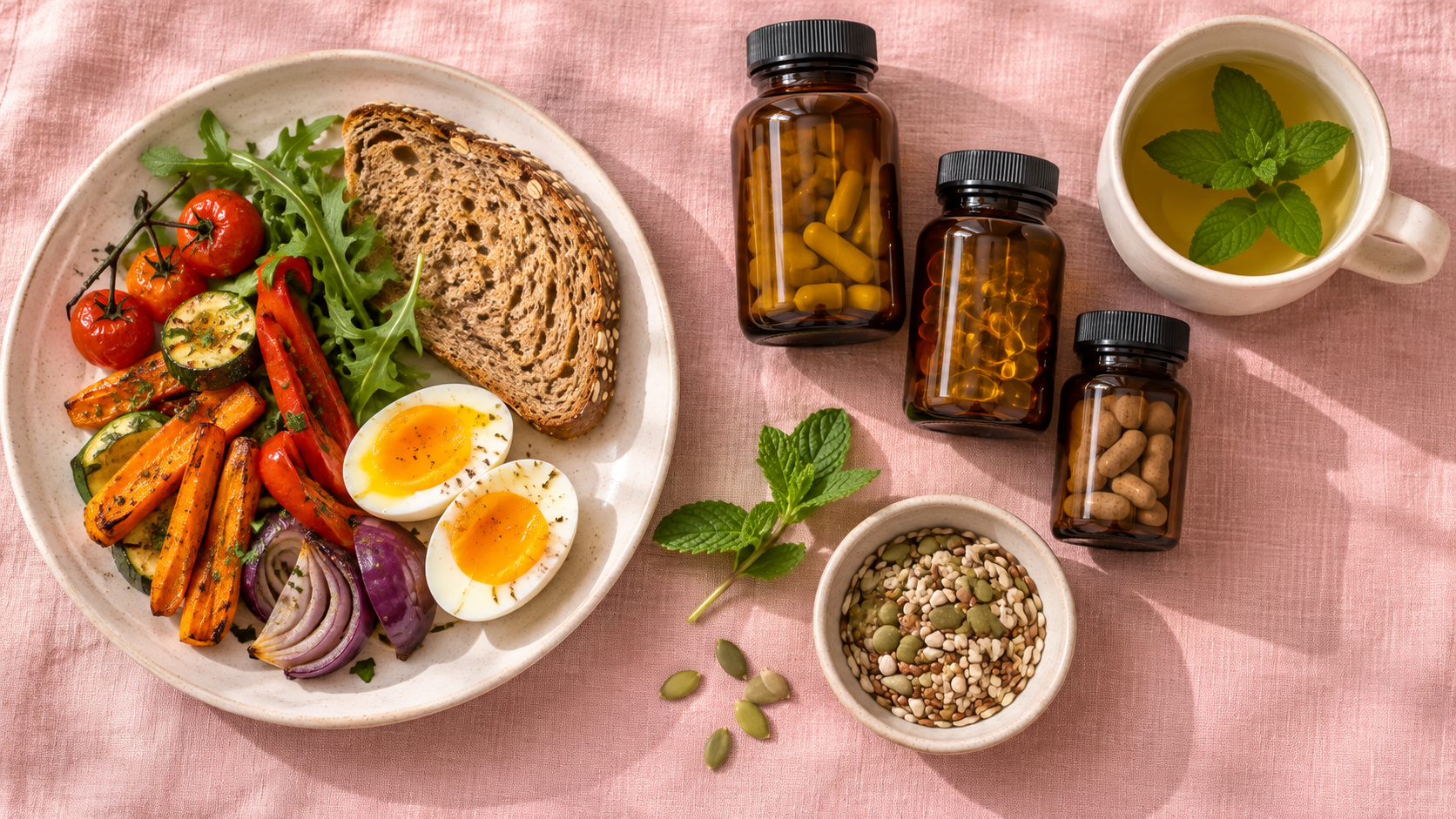
Spearmint tea for your testosterone. Seeds for your cycle. An “adrenal cocktail” for your cortisol. A raw carrot salad to clear out estrogen. If you’ve felt off lately, your feed has probably offered you a hormone-balancing fix. The honest answer is that food does affect your hormones, but not in the way most wellness marketing promises.
Feeling tired, bloated, moody or not like yourself is real, and it’s frustrating when nobody can explain why. That’s exactly why “hormone imbalance” is such an appealing answer. It names the feeling and offers a fix you can buy. This guide sorts out what the evidence actually says, where nutrition truly matters for hormone health and how to tell a real hormone problem from a sales pitch.
We’re health coaches, not doctors or dietitians, and this is general information. If you have symptoms that worry you, see your doctor. Real hormone conditions like thyroid disease, PCOS and diabetes are common and treatable, and they need a proper diagnosis.
The pitch vs. the science
Search “hormone balance” on social media and you’ll find hundreds of millions of views. The videos usually follow the same script: a list of very common symptoms, a claim that your hormones are “out of balance,” and a product, protocol or program to fix it.
Doctors who specialize in hormones see it differently. In an article for clinicians, one OB-GYN wrote that “hormone balancing” is a term that is practically meaningless in medicine. It isn’t a diagnosis, there’s no test for it, and no one agrees on what “balanced” would even look like.
That doesn’t mean your symptoms aren’t real. It means the label is too vague to be useful, and vague labels make it easy to sell vague solutions.
- Diets proven best for PCOSNo single type beat the othersTruth
- Hormone-balance books studiedAuthors often sold supplementsFollow the $
- “Adrenal fatigue” coinedIn a book, not a studyOrigin
- Hormones in your bodyNo diet targets them allReality
What hormones actually do
Hormones are chemical messengers. Glands like your thyroid, ovaries, adrenals and pancreas release them into your blood, and they tell other parts of your body what to do. Your body makes dozens of them, controlling everything from blood sugar and sleep to hunger, stress and your menstrual cycle.
Here’s the part the “balance” idea misses: hormones aren’t supposed to stay level. Estrogen and progesterone rise and fall across your cycle. Cortisol peaks in the morning and drops at night. Insulin rises after you eat. Over a lifetime, your hormones shift through puberty, pregnancy, postpartum, perimenopause and menopause. Change isn’t a malfunction. It’s how the system works.
Your body also controls its hormones with tight feedback loops. When a level drops, your brain signals a gland to make more. When it rises, production slows. That’s why a handful of seeds or a cup of tea is very unlikely to override the system. It’s also why taking hormones or hormone-like supplements you don’t need can backfire, since your body may respond by making less of its own.
When something really does go wrong, like your thyroid making too little hormone or your body not responding well to insulin, doctors can usually measure it. Those are real hormone conditions, with names, tests and treatments.
Where “hormone balancing” came from
The idea isn’t new. Sociologists Norah MacKendrick and Hannah Troxel studied self-help hormone balance books written by medical doctors and published between 2003 and 2021. They found the books tended to blame most health complaints on imbalanced hormones, especially for women, whose bodies were described as constantly at risk of falling out of balance. They called hormone balance a fantasy biological state.
MacKendrick told TIME she found almost no legitimate medical support for the concept, but the authors sold special supplements. There was never a clear clinical definition. Instead, how you feel became the measure of success, which makes any product easy to sell and hard to disprove.
Social media took that and sped it up. A 2024 report from the Association of Health Care Journalists described endocrinologists seeing real harm, often in young women, from “remedies” promoted online. One endocrinologist explained that taking something your body doesn’t need can disrupt its own hormone regulation.
It’s worth saying why this message lands. Women’s symptoms have a long history of being brushed off, and women have been underrepresented in medical research. When you feel dismissed, a confident creator who says “I believe you, and here’s the fix” is powerful. The answer isn’t to stop asking questions. It’s to ask them of people who can actually test and treat you.
Evidence scorecard
Here’s how common “hormone diet” ideas compare with the evidence. More dots mean stronger evidence that it makes a real difference to hormone health.
- Eating enough, consistentlyStrong evidence
Chronic undereating, especially with lots of exercise, can switch off ovulation. This one is real and well documented.
- A healthy eating pattern for PCOSStrong evidence
The 2023 international PCOS guideline backs healthy eating and activity. It found no single diet type beats another.
- Enough iodine for your thyroidStrong evidence
Your thyroid needs iodine to make hormones. Most people in the U.S. get enough from iodized salt, dairy and eggs.
- Drinking less alcoholStrong evidence
Alcohol raises estrogen levels and breast cancer risk. Cutting back is one of the few food changes with clear hormone effects.
- Gluten-free for Hashimoto’sOnly if celiac
Essential if you also have celiac disease. Without celiac, studies don’t show it improves symptoms.
- Soy or herbal supplements for hot flashesNot recommended
The Menopause Society’s 2023 statement doesn’t recommend soy, supplements or herbal remedies for hot flashes.
- DIM and “estrogen detox” pillsUnproven
DIM can shift estrogen breakdown products in urine, but that hasn’t been shown to improve how women feel.
- Seed cyclingNo evidence
Seeds are nutritious. Rotating them by cycle phase has no research showing it changes hormones.
- “Adrenal fatigue” diets and cocktailsMyth
The Endocrine Society says adrenal fatigue isn’t a real medical condition, so there’s nothing for a diet to fix.
What food really can do
So is there a hormone-balancing diet? Not in the way it’s sold. But food absolutely affects your hormones. The effects just come from boring, basic habits rather than special ingredients.
- 🍽FuelEat enough
Undereating, especially with hard training or high stress, can stop ovulation and periods. This is one of the clearest food–hormone links.
- 🥣InsulinSteady blood sugar
Meals with fiber, protein and healthy fats help keep insulin steadier, which matters most if you have insulin resistance or PCOS.
- 🧂ThyroidEnough iodine
Your thyroid needs iodine to make hormones. Iodized salt, dairy, eggs and seafood are common sources.
- 🍷EstrogenLess alcohol
Alcohol can raise estrogen levels and is linked to breast cancer. Drinking less is a real hormone-health change.
- 🌾GutMore fiber
Fiber helps your body clear hormones through digestion and supports a healthy gut. Most women don’t get enough.
- 🥛BonesCalcium and vitamin D
Estrogen helps protect bone. After menopause, food sources of calcium and vitamin D become more important.
Notice that none of these require a branded protocol. A regular, varied diet with enough food, plenty of plants and protein, and less alcohol supports hormone health for nearly everyone. Our guides to closing the fiber gap and how much protein women need are good places to start.
The undereating piece deserves extra attention. The Endocrine Society’s guideline on functional hypothalamic amenorrhea describes how stress, weight loss and too much exercise, alone or together, can cause the brain to stop signaling the ovaries. Periods stop, and over time that can lead to bone loss and fertility problems. Ironically, the restrictive “reset” diets sold for hormone balance can push some women toward exactly this. If you’ve missed periods for three months or more and you’re not pregnant, talk to your doctor.
PCOS: where diet matters most
Polycystic ovary syndrome is one of the most common hormone conditions in women. It can cause irregular periods, acne, extra hair growth and fertility challenges, and it’s linked to insulin resistance and a higher risk of type 2 diabetes. It’s also the condition with the most diet marketing aimed at it.
The good news is that PCOS has a large international, evidence-based guideline, updated in 2023 with input from experts and women with PCOS across 71 countries. It recommends healthy eating and regular physical activity for everyone with PCOS, as first-line care alongside any medical treatment.
What it doesn’t do is pick a winning diet. Reviews for the guideline found limited evidence that any specific diet, whether low-carb, high-protein or something else, works better than another for PCOS. Approaches that change carbs, protein or fat tended to have similar effects. The guideline also stresses that care should be respectful and free of weight stigma.
- Focus on overall quality. Whole grains, vegetables, fruit, beans, lean protein and healthy fats.
- Pick what you can keep doing. The best PCOS diet is the one that fits your life, culture and budget.
- Move in ways you enjoy. Any activity helps, and some is better than none.
- Be cautious with supplements. Evidence for inositol, herbal medicines and other supplements is still limited or inconsistent, so talk with your doctor first.
- Ask about medication. Treatments like metformin or hormonal birth control are evidence-based options for many people.
If you’ve been told you must cut out dairy, gluten or all sugar forever to manage PCOS, know that the international guideline doesn’t say that.
Perimenopause and menopause
The menopause transition is a real, major hormone shift, and the symptoms can be rough. Hot flashes, night sweats, poor sleep, brain fog and mood changes are common. It makes sense that “menopause support” supplements and diets are a booming market.
In 2023, The Menopause Society (then the North American Menopause Society) reviewed the research on non-hormone treatments for hot flashes. It recommended options like cognitive behavioral therapy, clinical hypnosis, some prescription medications and, for women with excess weight, weight loss. Hormone therapy remains the most effective treatment for most healthy women near menopause.
On the “not recommended” list: supplements and herbal remedies, soy foods and soy extracts, and dietary changes, because the evidence that they reduce hot flashes is weak or negative. That doesn’t make soy unhealthy. It just means a tofu stir-fry isn’t a hot-flash treatment.
Food still matters a lot in midlife, just for different reasons:
- Bone health: Falling estrogen speeds bone loss. Calcium, vitamin D, protein and strength training help.
- Heart health: Heart disease risk rises after menopause. Plenty of plants, fiber and healthy fats support your heart.
- Muscle: Getting enough protein and lifting weights help protect muscle as you age.
- Sleep: Cutting back on alcohol and late caffeine can help, even if it doesn’t stop hot flashes.
If symptoms are affecting your life, talk to a clinician who knows menopause care. You have more options than a supplement aisle.
Thyroid and Hashimoto’s
Hashimoto’s thyroiditis is an autoimmune condition and the most common cause of an underactive thyroid. It’s much more common in women. Online, it’s often paired with strict diets, especially gluten-free.
Here’s what the research shows. A 2023 evidence review in American Family Physician found no evidence that a gluten-free diet reduces the symptoms of autoimmune thyroid disease, though one small trial saw some changes in antibodies and lab values. A 2022 review in Nutrients found no basis for a gluten-free diet as standard care for Hashimoto’s.
The important exception: celiac disease is more common in people with autoimmune thyroid disease. If you have celiac, going strictly gluten-free is essential. So if you have Hashimoto’s and digestive symptoms, ask your doctor about a celiac blood test before you cut gluten, since going gluten-free first can make the test less accurate.
A few other thyroid-and-food facts worth knowing:
- Iodine matters, but more isn’t better. Too much iodine, often from kelp or seaweed supplements, can actually cause thyroid problems.
- Selenium has been studied in Hashimoto’s with mixed results. Don’t take high doses on your own, because too much can be toxic.
- Timing your medicine matters. If you take levothyroxine, coffee, calcium, iron and soy can affect how well it’s absorbed. Your pharmacist can help you plan around them.
- Medication works. If your thyroid is underactive, thyroid hormone replacement is the treatment. No diet replaces it.
Cortisol and “adrenal fatigue”
“Cortisol belly,” “cortisol face,” adrenal cocktails of orange juice, coconut water and salt. Cortisol has become one of the internet’s favorite villains. It’s usually tied to “adrenal fatigue,” the idea that chronic stress wears out your adrenal glands.
The term was popularized in a 1998 book by an alternative-medicine practitioner. The Endocrine Society says adrenal fatigue is not a real medical condition. There’s no test that can detect it, and a systematic review found no evidence that it exists. The Society also warns that some “adrenal support” supplements have contained real thyroid or steroid hormones. Stopping them can leave your own adrenal glands slow to restart, which in rare cases can lead to a dangerous adrenal crisis.
That said, the symptoms people describe, like exhaustion, poor sleep, brain fog and cravings, are real. Endocrine Society experts urge doctors to take them seriously and look for treatable causes, such as anemia, sleep apnea, thyroid problems, depression or other conditions. True adrenal problems do exist, like adrenal insufficiency (Addison’s disease) and Cushing’s syndrome, but they’re rare and diagnosed with specific tests.
Stress does affect your body, of course. But the evidence-based ways to manage it aren’t cocktails. They’re sleep, movement, connection, therapy when you need it and fewer demands where possible. Our post on being too exhausted to work on yourself covers what to do when you’re running on empty.
“Estrogen dominance,” DIM and seed cycling
“Estrogen dominance” is a popular term online, often blamed for bloating, weight gain, PMS and heavy periods. It isn’t a recognized medical diagnosis, and there’s no agreed test or threshold for it. Some conditions really do involve estrogen, like fibroids, endometriosis and certain cancers, and those need a doctor, not a detox.
DIM (diindolylmethane) is a compound your body makes when you digest cruciferous vegetables like broccoli and cabbage. As a supplement, it’s sold to “clear excess estrogen.” Studies show it can change the estrogen breakdown products in urine, but that hasn’t been shown to improve symptoms or health outcomes, and it can interact with medications like tamoxifen and birth control. Eating the broccoli is a great idea. The pill is unproven.
Seed cycling means eating flax and pumpkin seeds in the first half of your cycle, then sesame and sunflower seeds in the second half, to “balance” estrogen and progesterone. Seeds are nutritious, with fiber, healthy fats, zinc and vitamin E. But there’s no solid evidence that rotating them by cycle phase changes your hormones or relieves symptoms. If you enjoy seeds, eat them every day in any order.
Cycle-syncing diets, which change what you eat in each phase of your cycle, are similar. A 2025 study of TikTok content on cycle syncing found most of it was anecdotal rather than based on science. Paying attention to how you feel through your cycle is useful, and our post on your cycle and workouts covers what the evidence says. You just don’t need a different menu for each week.
Marketing decoder
Here’s how to translate common hormone-health claims into plain English.
On the label“Balances your hormones”→There’s no medical definition of “balanced.” Ask: which hormone, measured how, compared to what?On the label“Supports healthy estrogen levels”→A structure-function claim. Supplements can say this without proving it works.On the label“Detoxes excess estrogen”→Your liver and gut already clear estrogen. Nothing on a shelf has been shown to do it better.On the label“Adrenal support”→Some of these products have contained real thyroid or steroid hormones, which can be risky.On the label“Doctor formulated”→A credential isn’t evidence. Look for studies in people, not a famous name.In the video“Your labs are normal, but you’re still imbalanced”→A red flag. If a problem can’t be measured, it can’t be shown to improve.
One reason these phrases are everywhere: in the U.S., supplements don’t need FDA approval before they’re sold. Companies can say a product “supports” a body function without proving it works, as long as they add a small disclaimer. If a product promises to treat or fix a condition, that’s a bigger red flag.
When it really is your hormones
Real hormone conditions are common, especially in women, and they’re very treatable. If your symptoms are ongoing or getting in the way of your life, it’s worth seeing a doctor instead of guessing. Here are some common symptoms and what might be behind them.
- If you noticeTired all the time, cold, dry skin, heavier periodsWorth ruling out
Underactive thyroid (hypothyroidism) or Hashimoto’s
Ask aboutTSH, plus free T4 and thyroid antibodies if needed
- If you noticeExhausted, short of breath, heavy periodsWorth ruling out
Iron deficiency or anemia, which is very common and often blamed on “hormones”
Ask aboutComplete blood count and ferritin
- If you noticeIrregular or missing periods, acne, extra facial hairWorth ruling out
PCOS, thyroid problems, high prolactin or under-fueling
Ask aboutPregnancy test, testosterone, TSH, prolactin; your doctor decides which
- If you noticeHot flashes, night sweats, sleep changes in your 40s or 50sWorth ruling out
Perimenopause or menopause
Ask aboutUsually diagnosed by age and symptoms, not a blood test
- If you noticeVery thirsty, peeing often, cravings, tired after mealsWorth ruling out
Prediabetes or diabetes, which are true hormone problems with insulin
Ask aboutA1C or fasting glucose
- If you noticeLow mood, no motivation, poor sleep for weeksWorth ruling out
Depression or anxiety, which can look a lot like “imbalance”
Ask aboutA mental health screening with your doctor
Many of these conditions have overlapping symptoms, which is exactly why a proper workup beats a quiz or a TikTok checklist. And if your labs are normal and you still feel unwell, that doesn’t mean you’re imagining it. It means it’s time to keep looking, maybe with a different doctor or a specialist, not to buy a supplement for a condition that can’t be measured.
When you go, it helps to bring notes. Track your periods, sleep, energy and any symptoms for a few weeks. List any supplements you take, since some, like biotin, can throw off certain lab tests. And it’s okay to say, “I don’t feel like myself, and I want to understand why.”
Hormone tests and what they can tell you
At-home hormone tests are everywhere now, often sold alongside the supplements that “fix” the results. Some measure blood, others saliva or urine. They can feel empowering, but they come with real limits.
- Hormones change constantly. Estrogen and progesterone shift across your cycle, and cortisol changes through the day. One reading on one day says very little.
- Timing matters. Many tests need to be done on a specific cycle day or time of day to mean anything.
- Normal ranges are wide. A number that looks “low” or “high” out of context may be perfectly normal for you.
- Saliva testing isn’t the standard for diagnosing most hormone conditions.
- Context is everything. Tests are most useful when a clinician orders them to answer a specific question.
If you’ve already done an at-home test, bring the results to your doctor. Just don’t use them to self-diagnose or to choose supplements on your own.
A calmer approach
Here’s the reassuring part. The habits that genuinely support hormone health are the same ones that support everything else, and none of them cost extra.
- 🍽SteadyEat regular meals
Don’t skip meals or restrict hard. Your hormones need enough fuel.
- 🥦FiberFill up on plants
Vegetables, fruit, beans and whole grains, most days.
- 🥑BalanceInclude protein and fats
They help with fullness, blood sugar and muscle.
- 🏋StrengthLift something
Strength training supports insulin, bone and muscle at every age.
- 💤RestProtect your sleep
Poor sleep affects hunger hormones, blood sugar and mood.
- 🩺Check inSee a real clinician
For ongoing symptoms, a proper diagnosis beats any protocol.
If you enjoy spearmint tea, seeds or a glass of orange juice with a pinch of salt, go ahead. None of them are harmful for most people. Just enjoy them as food, not as treatment, and don’t let them delay getting real help.
And be kind to your body. Feeling off sometimes is part of being human. Your hormones aren’t broken just because you had a hard month.
Myths about hormones and food
- Myth #1What you might have heard
If you have symptoms, your hormones are “imbalanced.”
What’s actually trueHormones are supposed to rise and fall through the day, the month and your life. Symptoms are real, but they have many possible causes, and a doctor can test for the real ones.
- Myth #2What you might have heard
Adrenal fatigue is why you’re exhausted.
What’s actually trueThe Endocrine Society says adrenal fatigue isn’t a real medical condition and there’s no test for it. Exhaustion is real, though, and worth a proper workup.
- Myth #3What you might have heard
Seed cycling resets your cycle.
What’s actually trueThere’s no research showing that rotating seeds by cycle phase changes estrogen or progesterone. Eating seeds is still a healthy habit.
- Myth #4What you might have heard
Soy throws your hormones off.
What’s actually trueEating soy foods hasn’t been shown to harm hormone health or raise breast cancer risk. It also hasn’t proven to stop hot flashes.
- Myth #5What you might have heard
There’s one right diet for PCOS.
What’s actually trueThe 2023 international guideline found no evidence that any one type of diet is better than another for PCOS. The best diet is a healthy one you can keep up.
- Myth #6What you might have heard
Everyone with thyroid problems should go gluten-free.
What’s actually trueOnly if you also have celiac disease, which is more common with Hashimoto’s. Ask your doctor about a simple blood test before cutting gluten.
- Myth #7What you might have heard
At-home saliva tests show your true hormone levels.
What’s actually trueMany hormones change hour to hour and across your cycle. Saliva tests aren’t the standard for diagnosing hormone conditions, and one reading tells you very little.
Your turn
Next time a hormone-balancing post pops up, try running it through a few quick questions:
- Which hormone? If they can’t name one, or name all of them, be skeptical.
- What’s the evidence? Studies in people, or just testimonials and theory?
- What are they selling? A product, program or test changes the incentive.
- Would this delay real care? If yes, see a doctor first.
- Does it make food scary? Advice that cuts out whole food groups deserves a second opinion.
Then pick one real habit for this week: eat breakfast if you usually skip it, add a serving of beans or vegetables to dinner, have one fewer drink or book that checkup you’ve been putting off.
Your hormones don’t need a reset. They need enough food, rest, movement and a doctor who listens when something truly feels wrong.
Sources
- Endocrine Society: Adrenal fatigue
- Endocrine News: The myth of adrenal fatigue
- Patient.info: Adrenal fatigue
- Teede et al., European Journal of Endocrinology (2023): Recommendations from the 2023 international evidence-based guideline for the assessment and management of PCOS
- Cowan et al., BMC Endocrine Disorders (2023): Lifestyle management in polycystic ovary syndrome: beyond diet and physical activity
- Monash University: New international guideline to improve the health of women with PCOS
- The Menopause Society (2023): 2023 Nonhormone Therapy Position Statement press release
- Guideline Central: Nonhormonal management of menopause-associated vasomotor symptoms: key points
- American Family Physician (2023): Does a gluten-free diet reduce symptoms of autoimmune thyroid disease?
- Nutrients (2022): Doubtful justification of the gluten-free diet in the course of Hashimoto’s disease
- Endocrine Society (2017): Functional hypothalamic amenorrhea: clinical practice guideline
- GoodRx Health: Can seed cycling balance your hormones?
- BMC Complementary Medicine and Therapies (2024): DIM and the urinary estrogen profile
- MacKendrick & Troxel, Social Science & Medicine (2022): Hormone balance in self-help books by medical doctors
- TIME: The myth of ‘balancing’ your hormones
- Association of Health Care Journalists (2024): TikTok’s hormone hokum is hurting people, experts say
- MDedge: TikTok offers to ‘balance your hormones’ are pure hokum
- News-Medical (2025): TikTok influencers promote cycle syncing, but where’s the evidence?
This article is for general information and isn’t medical advice. Talk with your doctor or midwife about what’s right for you.
- Hormone health
- Nutrition
- PCOS
- Menopause
- Myth busting
Find your strength. Find your girls.
Tired of guessing what your body needs? Tell us where you are and what you’re looking for. We’ll reply within two business days.
Questions
Good questions.
Is there such a thing as a hormone-balancing diet?
Not in the way it’s marketed. “Hormone balancing” isn’t a medical term, and no special diet has been proven to balance hormones. But eating enough, getting fiber and protein, limiting alcohol and getting enough iodine do support real hormone health.
What is the best diet for PCOS?
The 2023 international PCOS guideline found no evidence that any one type of diet is better than another. It recommends healthy eating and regular physical activity that you can stick with, alongside medical treatment if needed.
Is adrenal fatigue real?
No. The Endocrine Society says adrenal fatigue is not a real medical condition, and there’s no test for it. The symptoms are real, though, and can be caused by treatable conditions like anemia, thyroid problems, sleep apnea or depression.
Does seed cycling work?
There’s no solid evidence that seed cycling changes hormones or relieves symptoms. Seeds are healthy, so eat them if you like them, but rotating them by cycle phase isn’t necessary.
Can diet help with menopause symptoms?
Food is important for bone, heart and muscle health in midlife. But The Menopause Society’s 2023 statement doesn’t recommend soy, supplements, herbal remedies or diet changes specifically for hot flashes. Effective options include hormone therapy, certain medications and cognitive behavioral therapy.
Should I go gluten-free for Hashimoto’s?
Only if you also have celiac disease. Research doesn’t show that a gluten-free diet improves symptoms in people without celiac. Ask your doctor for a celiac blood test before cutting out gluten.
Is estrogen dominance real?
“Estrogen dominance” isn’t a recognized medical diagnosis, and there’s no agreed test for it. Conditions involving estrogen, like fibroids or endometriosis, are real and should be diagnosed and treated by a doctor.
Can undereating affect my hormones?
Yes. Eating too little, especially with intense exercise or high stress, can cause periods to stop, a condition called functional hypothalamic amenorrhea. Over time it can affect bone health and fertility. See your doctor if you miss periods for three months or more.
Are at-home hormone tests accurate?
They can measure some hormones, but levels change throughout the day and your cycle, so one result has limited meaning. Saliva tests aren’t the standard for diagnosis. Bring any results to your doctor rather than using them to self-diagnose.
What are signs of a real hormone problem?
Ongoing fatigue, irregular or missing periods, unexplained weight changes, excess hair growth, extreme thirst or hot flashes can all point to real conditions like thyroid disease, PCOS, diabetes or perimenopause. A doctor can test for these.
 Nutrition
 Women’s health
 Nutrition