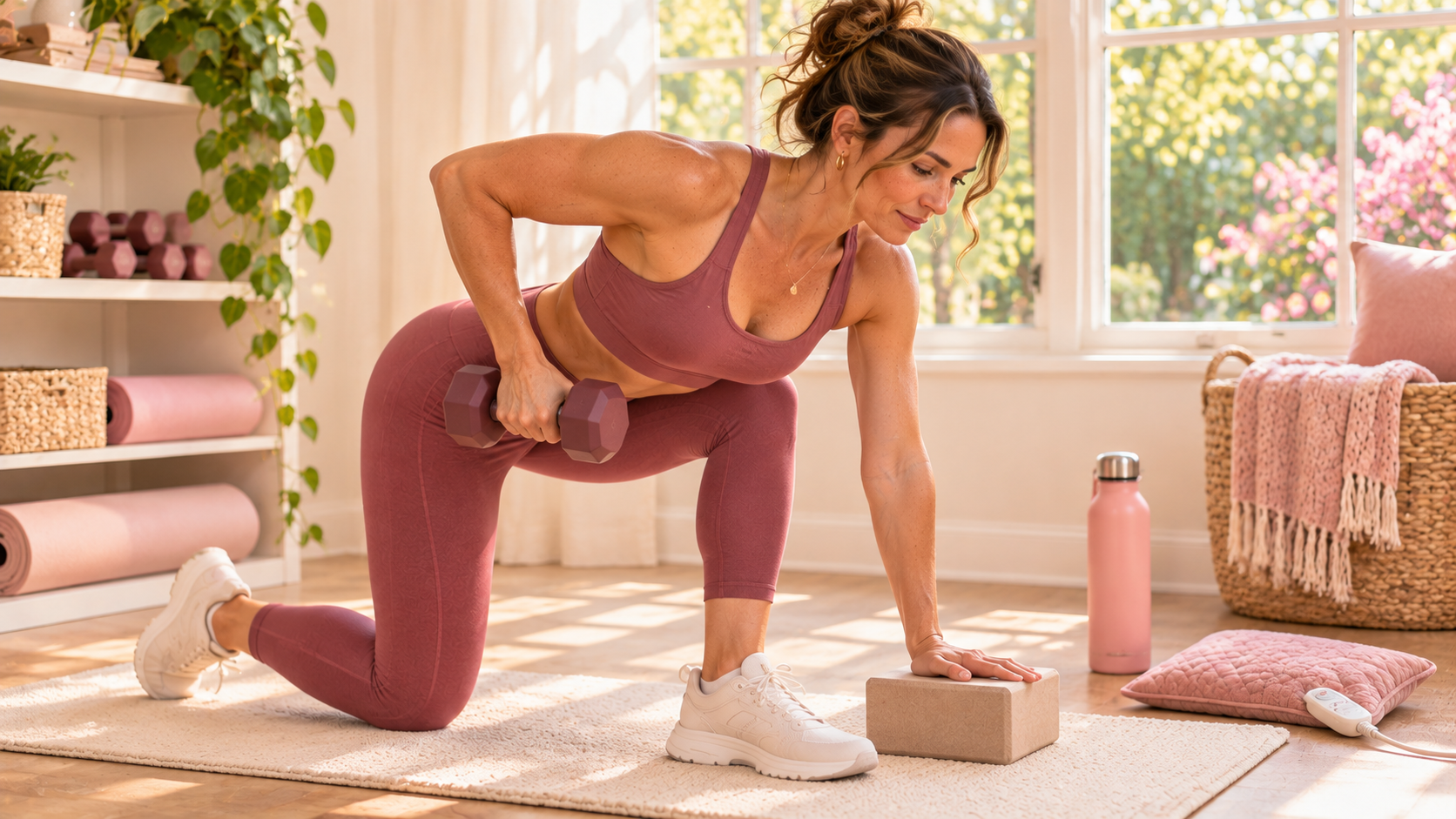
Your feed probably has a plan for every day of your cycle. Yoga only on your period. Heavy lifting in week two. No intense workouts in the luteal phase. It sounds so tidy. But does your menstrual cycle really affect your workouts, and should you be planning around it?
Here’s what the research actually says about cycle syncing, energy and performance, why you might still feel very different from week to week and a simple, flexible way to adjust your training that works with your body instead of a calendar.
We’re health coaches, not doctors. This is general information. If you have very painful or heavy periods, irregular or missing periods, or a condition like endometriosis or PCOS, please talk to your doctor or OB-GYN.
The short answer
- 📊The researchPerformance barely changes
Large research reviews have found that exercise performance might be reduced by a trivial amount, if at all, during the early part of the cycle. For strength training, current evidence shows no meaningful effect of cycle phase.
- 📅The trendRigid cycle syncing isn’t proven
There isn’t strong evidence to support structuring your whole training plan around cycle phases.
- 🤒Your bodySymptoms are real
Cramps, fatigue, bloating, poor sleep and mood changes can absolutely affect how a workout feels. Those deserve respect.
- 🎯The planListen to you, not an app
The best approach is personal: notice your own patterns and adjust on the days you need to.
Your cycle in 60 seconds
A menstrual cycle is counted from the first day of one period to the first day of the next. In adults it often ranges from about 21 to 35 days, and it can vary from month to month. Here’s a simplified look at the phases:
- Menstrual phase (your period)Estrogen and progesterone are at their lowestEarly follicular
- Follicular phaseEstrogen rises as your body gets ready to ovulateRising energy for many
- OvulationEstrogen peaks and an egg is releasedMid-cycle
- Luteal phaseProgesterone rises, then both hormones fall before your periodPMS for some
Those day counts are just an example of a 28-day cycle. Everyone’s cycle is different, and ovulation doesn’t always happen on day 14, which is one of the biggest problems with one-size-fits-all cycle plans.
What the research says
Here’s the good news for women who just want to train: the science is pretty reassuring.
- Overall performance: A 2020 review and meta-analysis in Sports Medicine pulled together the available studies and concluded that exercise performance might be trivially reduced during the early follicular phase (around your period) compared with other phases. Because the effect was so small, studies varied so much and many were low quality, the authors said general guidelines can’t be formed. Instead, they recommended a personalized approach.
- Strength training: A 2023 umbrella review that looked at the existing reviews on resistance training concluded that it is premature to say that short-term hormone fluctuations meaningfully influence strength performance or longer-term strength and muscle gains.
- The research itself is messy. Many studies guess at cycle phases from calendar dates instead of confirming them with hormone tests, which makes the results harder to trust. Leading researchers have called for an end to estimating phases this way.
- What this means for you: You don’t need to avoid hard workouts or heavy lifting at any point in your cycle because of hormones alone.
One more thing worth knowing: the assumption that women’s hormones make them “complicated” research subjects has historically been used as a reason to leave women out of exercise science. Better research is coming, and so far, it’s showing that women can train hard all month long.
So what about cycle syncing?
Cycle syncing is the idea of changing your workouts (and often your food and lifestyle) based on which phase of your cycle you’re in. A typical plan might suggest gentle movement during your period, high-intensity training in the follicular phase and lighter workouts in the luteal phase.
It’s huge online, with millions of views on TikTok. But when health and fitness experts look at the research, the common verdict is that the evidence just isn’t there for the physiological claims. A recent analysis in The BMJ also found no convincing evidence that menstrual tracking and cycle syncing improve health, well-being or performance.
What cycle syncing gets right
- It gets women paying attention to their cycles, which is valuable.
- It normalizes talking about periods and training.
- It gives permission to rest on rough days.
Where it can backfire
- It can make you skip hard workouts on days you actually feel great.
- It relies on app predictions that may not match your real cycle.
- It can make training feel complicated and rule-heavy, which makes it harder to stay consistent.
- It can frame normal hormone changes as something to fear.
Our take: cycle awareness, yes. Rigid cycle rules, no. Use what you learn about your body to make better choices on the day, not to talk yourself out of workouts you’d actually enjoy.
Why you still feel different from week to week
If the science says performance barely changes, why do some weeks feel so much harder? Because the research mostly measures average performance in labs, while you’re living with real symptoms in real life.
- 😩Period daysCramps and pain
Painful periods are common and can make some exercises uncomfortable or impossible on certain days.
- 😴Before your periodPoorer sleep
Many women sleep worse in the days before their period, and poor sleep makes any workout feel harder.
- 🥺Luteal phaseBloating and water retention
Feeling puffy or heavy can make you feel slower, even if your strength hasn’t changed.
- 😤PMSMood changes
Irritability, low mood or anxiety can make motivation drop.
- 🩸EnergyHeavy bleeding and low iron
Heavy periods can lead to low iron, which can cause real fatigue and make exercise feel much harder.
- 🌡️Luteal phaseFeeling warmer
Body temperature rises slightly after ovulation, which some women notice in hot workouts.
Your experience is real, even if a lab study wouldn’t pick it up. Interestingly, research on female athletes has found that many report feeling their cycle affects their performance, even when studies don’t show big changes. Both things can be true: your strength may not change much, while how you feel can change a lot.
PMS vs. PMDD
Most women notice some premenstrual symptoms, like bloating, breast tenderness, irritability or fatigue, in the week or two before their period. Regular exercise, good sleep and steady meals may help many women feel better during this time.
For some women, though, the mood symptoms are severe: deep sadness, hopelessness, intense anxiety or rage that affects relationships and work, then lifts after the period starts. That may be premenstrual dysphoric disorder (PMDD), a real and treatable condition. If that sounds like you, please talk to your doctor. If you ever have thoughts of harming yourself, call or text 988.
Adjust by symptoms, not the calendar
Instead of planning your training around which phase an app says you’re in, check in with yourself on the day. This is sometimes called autoregulation, and coaches use it with athletes all the time. A few examples:
Bad cramps→Gentle walk, yoga or easy cycling. Movement often helps period pain.Heavy flow day→Dark shorts, period underwear or a menstrual cup, and plan bathroom access.Wiped out and tired→Keep the session but drop the weight or cut a set. Still showing up counts.Bloated or puffy→Skip moves that press on your belly and focus on legs, back and arms.Poor sleep before your period→Shorter workout, longer warm-up and an earlier bedtime.Feeling strong and energized→Go for it: try a heavier weight, an extra set or a faster interval.Low mood or irritable→A walk outside or a workout with a friend can lift your mood.
A simple check-in before you train
- Rate your energy from 1 to 5.
- Notice symptoms: cramps, bloating, headache, poor sleep.
- Pick your version: 4–5 = full workout or push harder, 3 = planned workout, 1–2 = shorter or gentler version.
- Start your warm-up anyway. Many women feel better 10 minutes in. If you still feel rough, switch to the easy version without guilt.
A flexible training week
The easiest way to train with your cycle (and with life in general) is to build a plan with a “regular” version and an “easy” version of each day. Then you just pick one based on how you feel. Here’s an example:
- Monday: strengthRegular: full-body dumbbell workout · Easy: same moves, lighter weights, two sets
- Tuesday: walkRegular: 30-minute brisk walk · Easy: 20-minute stroll outside
- Wednesday: rest or stretch10 minutes of mobility, a heating pad if needed
- Thursday: strengthRegular: lower body and core · Easy: glute bridges, band work and gentle core
- Friday: cardioRegular: intervals · Easy: steady bike or swim
- Weekend: fun movementHike, dance, play with the kids or a walk with friends
Both versions keep your habit going, which is what really drives results over time. Missing one hard workout won’t change your progress. Quitting for a week because you felt bad one day might.
How to track what matters
Tracking your cycle can still be really useful, as long as you focus on your own patterns. Experts note that getting to know your cycle can have benefits even though blanket cycle-syncing advice isn’t supported. For two or three months, jot down:
- The first day of each period and how heavy it is.
- Energy and mood on a simple 1–5 scale.
- Sleep quality.
- Symptoms like cramps, headaches or bloating.
- How your workouts felt, and whether you hit your usual weights or paces.
After a few cycles, you may see your own patterns. Maybe the day before your period is always rough, or maybe you feel amazing mid-cycle. Or maybe you’ll find there’s no pattern at all, which is just as useful to know. Your tracking can also help your doctor if you ever need to talk about painful, heavy or irregular periods.
What about injury risk?
You may have heard that women are more likely to get injured at certain points in their cycle, especially knee injuries like ACL tears. Some research has explored this. A 2023 review from the University of Vigo in Spain suggested hormonal changes might affect biomechanics and movement patterns in female athletes in ways that could raise injury risk.
But the research is still early and mixed, much of it involves competitive athletes, and it’s not clear enough to tell everyday exercisers to avoid any activity during a particular phase. What we do know works to lower injury risk, all month long:
- Warm up properly for 5 to 10 minutes before harder workouts.
- Strength train your legs, hips and core, which supports your knees and joints.
- Focus on good form, especially landing softly and keeping knees in line with toes during jumps and squats.
- Progress gradually rather than jumping into big increases in weight, mileage or intensity.
- Sleep and fuel well, since fatigue and under-eating raise injury risk too.
Working out on your period
Yes, you can work out on your period, and it may even help. A Cochrane review found that regular exercise, whether low-intensity like yoga or high-intensity like aerobics, may provide a large reduction in the intensity of period pain compared with doing nothing. Most of the studies had women exercise about three times a week for 45 to 60 minutes, and the overall quality of the evidence was low, but the results are encouraging.
- Choose what feels good: walking, cycling, yoga, strength training or your usual workout.
- Use the right products: period underwear, a menstrual cup or disc, or a fresh tampon or pad before you start.
- Wear dark bottoms if that helps you feel more confident.
- Use heat or pain relief if your doctor says it’s okay. A heating pad before or after can help.
- Take it easy if you need to. A gentle walk still counts.
Fueling through your cycle
- Eat enough, every phase. Under-fueling is one of the biggest threats to a healthy cycle (more on that below).
- Watch your iron if you have heavy periods. Iron-rich foods like beans, lentils, lean red meat and leafy greens, paired with vitamin C, can help. Ask your doctor before taking iron supplements.
- Protein and fiber help keep energy steady and cravings in check. Our protein guide and fiber guide show how.
- Hydrate, especially if you feel warmer in the second half of your cycle.
- Honor cravings without guilt. A little extra hunger before your period is common. Respond with a filling snack rather than restriction.
Birth control, postpartum and perimenopause
- 💊Steadier hormonesHormonal birth control
Many hormonal contraceptives reduce the natural rise and fall of hormones, so “phases” don’t work the same way. Still pay attention to symptoms and how you feel.
- 🤱Cycles may pausePostpartum and breastfeeding
Periods may not return for months while breastfeeding, and early cycles can be irregular. Follow your provider’s guidance on returning to exercise. Our postpartum exercise guide can help.
- 🌼Less predictablePerimenopause
Cycles can become irregular and symptoms like hot flashes and poor sleep can affect training. Strength training becomes even more important for muscle and bone. See our perimenopause guide.
When to see a doctor
Your cycle is a sign of your overall health. Talk to a doctor if you notice:
- Missed periods. If you’re not pregnant and your periods stop or become very irregular, especially while training hard or eating less, get it checked. Losing your period from overtraining or under-eating isn’t normal. It can be a sign of relative energy deficiency in sport (RED-S), which can affect your bones and long-term health.
- Very heavy periods, like soaking through a pad or tampon every hour or two, passing large clots or needing to change overnight.
- Severe period pain that keeps you from your daily life or doesn’t improve with over-the-counter pain relief. It could be a sign of conditions like endometriosis or fibroids.
- Constant fatigue, shortness of breath or dizziness, which can be signs of low iron or anemia.
- Stress fractures or repeated injuries.
- Severe mood changes before your period that affect your relationships or work.
Heavy periods are surprisingly common among active women. In one study, heavy menstrual bleeding was reported by 37% of elite athletes, and 32% of exercising women reported a history of anemia, but only 22% had sought medical advice. You don’t have to just push through it.
Questions to bring to your appointment
- “Is my period flow or pain normal, or should we look into it?”
- “Could low iron be causing my fatigue? Can we check my ferritin?”
- “My periods have become irregular since I started training more. Could I be under-fueling?”
- “What are my options for managing period pain or heavy bleeding?”
Bring your cycle notes. Dates, flow, pain levels and energy ratings give your doctor a much clearer picture than “my periods are rough.”
Cycle and workout myths
- Myth #1What you might have heard
“You should never work out on your period.”
What’s actually trueExercise during your period is safe for most women, and regular exercise may actually reduce period pain. Do what feels right for your body that day.
- Myth #2What you might have heard
“You can only lift heavy in the first half of your cycle.”
What’s actually trueCurrent research reviews have not found that cycle phase meaningfully affects strength or muscle gains. If you feel good, lift.
- Myth #3What you might have heard
“Cycle syncing is proven science.”
What’s actually trueIt’s a popular trend, but experts say the evidence for rigid, phase-based training plans isn’t there yet.
- Myth #4What you might have heard
“Losing your period means you’re training hard enough.”
What’s actually trueMissing periods from training or under-eating isn’t normal. It can be a sign of low energy availability, which can harm bones and performance.
- Myth #5What you might have heard
“If I’m tired before my period, I’m just being lazy.”
What’s actually trueSymptoms like fatigue, poor sleep and cramps are real. Adjusting your workout on a rough day is smart training, not weakness.
- Myth #6What you might have heard
“My app knows exactly what phase I’m in.”
What’s actually trueMost apps estimate phases from dates. Cycles vary from month to month, so the app’s guess may be off.
Your turn
For your next two cycles, keep a simple note on your phone: period start date, energy (1–5) and how each workout felt. Then look back. Your own data will tell you more than any one-size-fits-all plan.
The bottom line is freeing: your body isn’t fragile for half the month, and you don’t need a color-coded calendar to train well. You can lift heavy, run fast and push hard whenever you feel ready. And on the days your body asks for something gentler, you can listen without guilt. That’s not a compromise. That’s exactly how smart, sustainable training works for every woman, every week of the month, whatever season of life you’re in right now.
Want a training plan that flexes with your energy, your schedule and your real life? That’s exactly what our coaches build. And if you’re new to strength training, our 20-minute dumbbell workout is a great place to start, any day of the month.
Sources
- McNulty et al., Sports Medicine (2020): The effects of menstrual cycle phase on exercise performance in eumenorrheic women: a systematic review and meta-analysis
- Colenso-Semple et al., Frontiers in Sports and Active Living (2023): Current evidence shows no influence of women’s menstrual cycle phase on acute strength performance or adaptations to resistance exercise training
- Optimum Nutrition (citing Elliott-Sale et al., 2025): Syncing your training with your menstrual cycle: does it really work?
- Tom’s Guide: Top experts debunk the cycle syncing trend
- National Geographic: Should you sync your workouts to your menstrual cycle?
- mindbodygreen (on a BMJ analysis): We’ve been told to work with our cycles, but the science isn’t so simple
- CBC: Clinicians say more research into cycle syncing is needed
- CBC Day 6: Menstrual cycle syncing: what clinicians say
- Women’s Health via AOL: Should you cycle sync your workouts?
- Cochrane: Exercise for dysmenorrhoea (period pain)
- Boston Children’s Hospital: Female athletes and menstruation
- Henry Ford Health: Is it normal for female athletes to lose their periods?
- American Family Physician: Relative energy deficiency in sport (RED-S)
- ACOG: Premenstrual syndrome (PMS)
- 988 Suicide & Crisis Lifeline: Call or text 988
- Bruinvels et al., PLOS ONE (2016): The prevalence and impact of heavy menstrual bleeding in elite and non-elite athletes
This article is for general information and isn’t medical advice. Talk with your doctor or midwife about what’s right for you.
- Menstrual cycle
- Cycle syncing
- Strength training
- Women’s health
- Workouts
Find your strength. Find your girls.
Tell us how you like to move and what gets in the way. We’ll reply within two business days with coaching and community that fit every week of your month.
Questions
Good questions.
Does your menstrual cycle affect workout performance?
Research suggests the effect is small. A 2020 meta-analysis found exercise performance might be trivially reduced during the early follicular phase, and a 2023 review found no clear effect of cycle phase on strength or muscle gains. Symptoms like cramps, fatigue and poor sleep can still make workouts feel harder on some days.
Is cycle syncing your workouts backed by science?
Not strongly. Experts say there isn’t enough high-quality evidence to support structuring your entire training plan around cycle phases. Paying attention to your own symptoms and adjusting on the day is a more evidence-based approach.
Is it okay to work out on your period?
Yes. Exercise during your period is safe for most women, and a Cochrane review found regular exercise may reduce period pain. Choose whatever type of movement feels good that day.
Can I lift heavy weights during my luteal phase?
Yes. Current research does not show that cycle phase meaningfully affects strength. If you feel good, you can lift heavy at any point in your cycle.
Is it normal to lose your period from exercise?
No. Losing your period from heavy training or not eating enough can be a sign of relative energy deficiency in sport (RED-S), which can harm bone health and performance. Talk to your doctor if your periods stop or become irregular.
 Fitness
 Nutrition
 Womanhood & Lifestyle