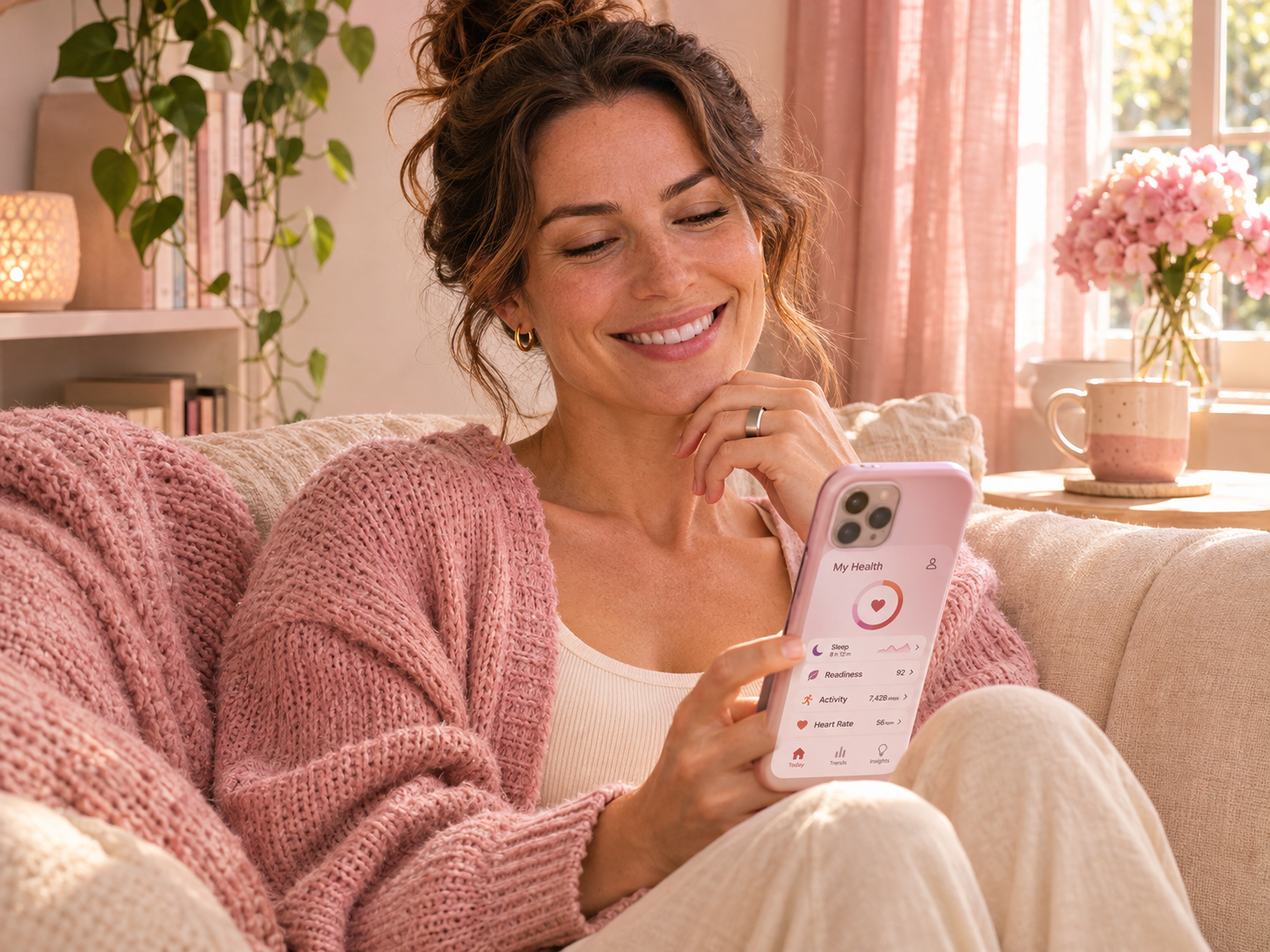
A ring that notices your temperature shift before your period starts. An app that has logged millions of cycles. A virtual clinic that can connect you with a menopause specialist from your couch. Women’s health technology has never been more powerful. But many women still feel alone with what the data is telling them.
That’s the opportunity. For brands like Oura, Flo and Maven Clinic, the next chapter of women’s health isn’t only about better sensors or smarter AI. It’s about trust, education and community, the human side of health that turns information into confidence. This page explains where women’s health is heading, what these brands are already doing and how a partnership with Pink in Progress could help.
Please note: Oura, Flo and Maven Clinic are examples of prospective collaborators based on mission and audience alignment. Pink in Progress has no existing partnership, affiliation or endorsement with these brands.
The women’s health gap
Women live longer than men on average, but they don’t necessarily live healthier. A landmark 2024 report from the World Economic Forum and the McKinsey Health Institute found that women spend 25% more of their lives in poor health than men. Closing that gap, the report estimated, could add the equivalent of about seven healthy days per woman each year and boost the global economy by at least $1 trillion annually by 2040.
The report also noted that women’s health is often narrowed to sexual and reproductive health, which underrepresents the real burden women carry. Conditions like endometriosis can go undiagnosed for years, menopause care is uneven and many women juggle their own health with caring for everyone else.
- ⏰WEF and McKinsey, 202425% more time
Women spend 25% more of their lives in poor health than men.
- 💰WEF and McKinsey, 2024$1 trillion
The potential annual boost to the global economy by 2040 if the gap closes.
- 📆WEF and McKinsey, 20247 healthy days
Roughly how much healthy time each woman could gain every year.
From tracking to care
For years, women’s health technology mostly meant period tracking. That’s changing fast. In 2026, the biggest names in the space are connecting tracking, artificial intelligence and clinical care, and they’re increasingly working together.
- Wearables are going deeper. Smart rings and watches now estimate cycle phases, flag possible ovulation and track symptoms across life stages like perimenopause.
- AI is getting specialized. Brands are building models designed specifically around women’s physiology rather than relying on general-purpose chatbots.
- Data is connecting to care. Tracking apps and wearables are linking to telehealth providers, so a pattern in the data can lead to a real conversation with a clinician.
- Partnerships are multiplying. Tech companies, clinics and benefits providers are teaming up rather than trying to do everything alone.
All of this is good news for women. But technology alone can’t answer every question a woman has at 2 a.m., and it can’t replace the reassurance of hearing “me too” from someone who’s been there.
Three brands leading the way
Oura: a wearable built around women
Oura has become one of the most visible names in women’s health technology. According to Femtech Insider’s summary of its 2026 IPO filing, women make up 72% of Oura’s 5 million paid members, and the company is expanding from sleep and cycle tracking into fertility, pregnancy, postpartum, perimenopause, menopause and healthy aging. A third of new members are buying their first wearable.
In February 2026, Oura launched its first proprietary AI model designed for women’s health, built into its Oura Advisor tool and grounded in research reviewed by its in-house clinicians and women’s health experts. In May, it added hormonal birth control support and Menopause Insights, built around a questionnaire that measures how 22 symptoms affect quality of life. Oura has also partnered with clinical companies including Maven Clinic, linking ring data to real-world care.
Flo: the world’s biggest cycle tracker
Flo is one of the most widely used women’s health apps in the world. The company says it has been downloaded half a billion times and has more than 80 million monthly active users. Its features include cycle and ovulation tracking, personalized insights, daily education and a private community, and its content is supported by a network of more than 100 medical experts.
In October 2026, Flo announced a multi-year partnership with Google Health, backed by a strategic investment. Starting in early 2027, users who choose to link the apps will be able to combine Flo with wearable data like sleep, heart rate and skin temperature, and the companies plan a joint research program on topics like early signs of perimenopause, PCOS, endometriosis and fibroids. Flo has also made privacy a visible priority, from its Anonymous Mode to consent-first data sharing in the new partnership. Through its Pass it on Project, Flo says it has donated more than 29 million Premium subscriptions.
Maven Clinic: care for every stage
Maven Clinic describes itself as the world’s largest virtual clinic for women’s and family health, with care that spans fertility and family building, maternity, parenting and pediatrics, and menopause and midlife. Maven says it partners with more than 2,300 employers and health plans covering 28 million lives.
Maven is reaching more women directly, too. In May 2026, it launched a direct-to-consumer platform that connects GLP-1 and hormone care with on-demand access to more than 30 specialties. In November, it announced that its virtual clinic is now in network with more than 475 health plans, which MedCity News reported makes it accessible to about 80% of commercially insured people. Earlier in the year, Maven expanded its fertility program to include ovulation prediction insights from Oura, a sign of how closely these brands are already connected. In September, Maven also hosted Onward, its first annual summit on the future of women’s and family health.
The trust gap
Here’s the challenge. As health information becomes easier to access, it also becomes harder for women to know what to trust. In a survey Maven released in May 2026 of more than 1,500 women ages 30 to 60:
- Nearly half said they had turned to social media for health guidance.
- 46% had tried a health product based on non-clinical recommendations.
- 54% suspected their symptoms were connected but felt they were treated as separate problems.
- 47% said having one provider who understands their whole health would most improve their care.
Those numbers tell a clear story. Women are hungry for answers, and when they can’t find them in the exam room, they look to each other. The brands that win will be the ones that meet women in those spaces with accurate, warm and honest support, rather than more noise.
Community is also where women decide what to try next. A friend’s recommendation, a story shared in a support circle or a calm explanation from someone who has been through the same thing often carries more weight than any ad. When a health brand is part of those conversations in a genuine, well-labeled way, it earns something no algorithm can generate on its own: the confidence of women who feel heard. That’s why the most forward-looking brands are pairing their technology with trusted communities, not competing with them.
Health tech vs. community
- Tracks sleep, cycles, temperature and symptoms
- Spots patterns over months and years
- Available any time, on demand
- Personalized to one woman’s data
- Can feel private, and sometimes lonely
- Shares what those patterns feel like day to day
- Turns data into conversation and context
- Shows up on a regular schedule
- Reminds women they’re not the only one
- Builds trust, accountability and friendship
The future of women’s health needs both: smart tools and real people.
Where Pink in Progress fits
Each of these brands brings serious technology and clinical expertise. Here’s where a partnership with us could add the human layer.
The common thread is that data and care are only part of the picture. Women also need a place to talk about what they’re experiencing, learn in plain language and feel less alone. That’s what Pink in Progress is built for.
What we bring
Pink in Progress is a women’s wellness community built around coaching, small circles and practical, research-backed content. Ritner Digital is the team behind Pink in Progress, so strategy, writing, design and community all come from one place.
- 🧬ContentWomen’s health library
Sourced guides on perimenopause, iron deficiency, cycles and workouts and more.
- 🤝ConnectionCircles and coaching
Small groups where women talk openly and keep showing up for themselves.
- 🏙️LocalCity communities
In-person events and guides in our cities, bringing digital audiences together face to face.
- ✅TrustHonest standards
Clear sponsor labels, careful sourcing and no invented reviews or testimonials.
Eight partnership ideas
These are starting points, not finished proposals. Tap a category to filter. Each idea notes which brands it might suit best.
- Community
1.🌙Cycle and sleep circles
Small monthly circles where women compare notes on how their cycle shapes their sleep, energy and mood, then talk through what they’ve noticed in their own tracking. No one has to share their data, and no one is told what their numbers should be.
What it could include: Monthly virtual circles, a shareable reflection worksheet and a companion guide built on our menstrual cycle and workouts article.
- Content
2.🔥Perimenopause, decoded
A plain-language series on the symptoms many women don’t connect to perimenopause, from sleep changes to brain fog, reviewed by a qualified clinician. It builds on our popular guide to perimenopause symptoms nobody warned you about.
What it could include: Clinician-reviewed articles, a symptom conversation guide for appointments and a live Q&A circle.
- Campaigns
3.💤The four-week sleep reset
A guided, low-pressure challenge focused on small sleep habits, like a consistent wind-down or a cooler bedroom, with weekly group check-ins. Women can join with or without a wearable, so no one is left out.
What it could include: A four-week plan, weekly check-ins and an honest recap of what helped, shared with permission.
- Community
4.🩺Ask a clinician nights
Live, virtual evenings where women can ask a licensed provider the questions they never have time for in a rushed appointment, from heavy periods to postpartum recovery. General education only, never individual diagnosis.
What it could include: Quarterly live sessions, written takeaways and links to care options for women who want more help.
- Community
5.🌱Trying to conceive, together
Fertility journeys can be isolating, especially when friends seem to get pregnant easily. Small, carefully moderated circles give women a place to talk without judgment, with clear guidance on where to find clinical support.
What it could include: Moderated peer circles, a resource guide and optional sessions with fertility educators.
- Content
6.📚Every life stage library
A connected set of guides covering a woman’s health from first periods to pregnancy, postpartum, perimenopause and beyond, written warmly and sourced carefully, so women can find what they need at each stage.
What it could include: A sponsored guide collection, printable checklists and newsletter features, all clearly labeled.
- Content
7.📊Your data, without the spiral
Health data can empower women, but it can also fuel worry. This series helps women read trends rather than single scores, understand what normal variation looks like and know when a change is worth raising with a provider.
What it could include: Explainer articles, a short video series and a “questions to ask your doctor” worksheet.
- Campaigns
8.💼Know your benefits
Many women don’t know whether their employer or health plan already covers support for fertility, maternity or menopause. A friendly campaign could help women check their benefits and feel confident asking HR the right questions.
What it could include: A benefits checklist, a short explainer series and an HR conversation guide.
What women want from health brands
Women don’t want more data for its own sake. Based on the research above and the conversations that happen in our community, here’s what tends to matter most:
- To be believed. Many women have had symptoms dismissed. Brands that validate their experiences earn lasting loyalty.
- Plain language. Clear explanations of what a trend might mean, without jargon or alarm.
- Context, not just numbers. Women want to know what’s normal for them, and when a change is worth raising with a provider.
- Whole-person care. Hormones, sleep, mood, metabolism and life stage are connected, and women want them treated that way.
- Privacy they can count on. Clear, simple choices about what’s shared and with whom.
- Community. The comfort of knowing other women are going through the same thing.
Privacy comes first
Women’s health information is some of the most personal data there is. Cycle dates, fertility goals, pregnancy and menopause symptoms all deserve care. The brands in this space know it: Flo built Anonymous Mode, and its Google Health partnership requires explicit permission for each type of data and purpose, with the option to withdraw at any time. Oura says conversations with its women’s health AI are hosted on its own infrastructure.
Pink in Progress partnerships are designed so that women never have to trade their privacy to take part. Our circles, content and events don’t require anyone to share health data, connect an app or buy a device. We don’t collect personal health information for partners, and any feedback we share is voluntary, anonymous or used only with permission.
How to show up well
When a health brand joins a women’s community, the details shape whether it feels like a trusted guide or just another ad:
- Lead with education. Helpful, accurate information builds more trust than any promotion.
- Bring real experts. Clinicians, researchers and health educators answering real questions go a long way.
- Make it inclusive. Not every woman owns a wearable or a premium subscription. Programs should welcome everyone.
- Respect every life stage. A 25-year-old tracking her cycle and a 52-year-old navigating menopause need different things.
- Stay for the long run. Health journeys take months and years. Brands that show up consistently become part of the story.
Mistakes to avoid
- Overpromising. Wellness tools can support health, but they aren’t a diagnosis. Claims should stay accurate and modest.
- Fear-based messaging. Scaring women into tracking or buying erodes trust quickly.
- Treating women’s health as only fertility. Sleep, heart health, bones, mental health and aging all matter.
- Showing only one kind of woman. Women of every age, body, background and budget want to see themselves.
- Being vague about data. If women aren’t sure how their information is used, many will simply walk away.
Our principles
- Women’s health information stays theirs; we never collect or pass on personal health data for a partner
- Health content is sourced and reviewed by a qualified clinician
- Education never replaces care, and we always point women toward licensed providers
- Every sponsored or gifted mention is clearly labeled
- Women share experiences in their own words, with permission, and we never invent reviews
- No fear-based messaging, shame or promises a product can’t keep
In women’s health, trust is everything. These principles help protect it.
Every sponsored piece is clearly labeled, in line with the Federal Trade Commission’s endorsement guidance. When women share their experiences, we use their own words with their permission, and we never invent reviews, quotes or testimonials.
How we’d measure success
- Participation: how many women joined a circle, event or program, and how many came back.
- Confidence: short, voluntary check-ins asking whether women feel more informed and more confident talking with a provider.
- Content engagement: time spent with guides, worksheet downloads and replies.
- Questions answered: the topics women ask about most, shared in aggregate to help shape future education.
- Honest feedback: what worked, what didn’t and what women want next, shared only with permission.
What a season together could look like
- Listen and planShort, anonymous surveys and a kickoff circle to learn what women want to understand about their health.Insight
- Launch the circlesMonthly virtual circles around one topic, like sleep, cycles or perimenopause, open to every woman.Community
- Add the educationClinician-reviewed guides, a live Q&A and practical worksheets, all clearly labeled.Content
- Celebrate and recapAn in-person event in one of our cities, honest feedback and a plan for the next season.Recap
Beyond these three brands
Oura, Flo and Maven Clinic are clear examples, but the same approach fits many companies working in women’s health, including menopause care providers, fertility benefits companies, other wearable and app makers, at-home testing brands, telehealth platforms and employers building better benefits. Our Partner With Us page lists more of the industries we’d love to work with.
How to start
If your brand is shaping the future of women’s health, we’d love to talk. Our Partner With Us page outlines all seven ways we work with brands, and our piece on community-led marketing explains our approach to building community around a brand.
To start the conversation, fill out our short form or email cara@ritnerdigital.com. Our brand kit has everything needed for co-branded work.
Data can tell a woman what’s happening. Community helps her feel ready for it. Let’s build both together.
Sources
- McKinsey Health Institute and World Economic Forum (2024): Closing the women’s health gap
- McKinsey Health Institute (2024): New report highlights $1 trillion potential
- Femtech Insider (2026): Oura’s IPO filing reveals its women’s health strategy
- MobiHealthNews (2026): Oura launches women’s health AI model
- Oura (2026): Introducing our first proprietary AI model for women’s health
- Oura (2026): Birth control support and Menopause Insights
- Forbes (2026): Oura’s latest update on women’s health
- Momentum (2026): Oura’s clinical partnerships
- Flo Health via PR Newswire (2026): Flo Health and Google Health join forces
- Google (2026): We’re partnering with Flo Health
- Engadget (2026): Google teams up with Flo
- Maven Clinic (2026): Maven expands virtual clinic nationwide
- MedCity News (2026): Maven Clinic goes in network with 475 plans
- Maven Clinic (2026): Maven expands its fertility program with Oura insights
- MobiHealthNews (2026): Maven Clinic launches Onward summit
- Federal Trade Commission: Disclosures 101 for social media influencers
Brand details are drawn from each company’s public statements and news coverage as of November 2026.
- Women’s health
- Partnerships
- Femtech
- Community
- Brand collaborations
Let’s build the future of women’s health together.
Tell us about your brand and the women you want to support. We’ll reply within two business days with next steps.
Questions
Good questions.
Does Pink in Progress partner with Oura, Flo or Maven Clinic?
Not currently. These brands are examples of prospective collaborators based on mission and audience alignment. Their inclusion does not imply an existing partnership, affiliation or endorsement.
Why focus on women’s health partnerships now?
Women spend 25% more of their lives in poor health than men, according to the World Economic Forum and McKinsey Health Institute. At the same time, women’s health technology is moving from simple tracking toward AI, wearables and connected clinical care.
What are Oura, Flo and Maven doing in women’s health?
Oura launched a women’s health AI model and menopause and birth control features in 2026. Flo announced a multi-year partnership with Google Health. Maven Clinic launched a direct-to-consumer platform and went in network with more than 475 health plans.
Why does community matter if the technology is so good?
Data can show patterns, but women also want context, reassurance and plain-language education. In a 2026 Maven survey, nearly half of women said they had turned to social media for health guidance, a sign that many are looking for trusted peers.
What kinds of partnerships could you create?
Ideas include cycle and sleep circles, a perimenopause education series, a four-week sleep reset, ask a clinician nights, trying-to-conceive circles, a life-stage guide library, a health data literacy series and a know-your-benefits campaign.
How do you protect women’s privacy?
Our programs never require women to share health data, connect an app or buy a device. We don’t collect personal health information for partners, and any feedback is voluntary, anonymous or shared only with permission.
How would you measure success?
We’d look at participation, return rates, confidence check-ins, content engagement and honest feedback shared with permission.
How can a brand get in touch?
Fill out the form on our homepage or email cara@ritnerdigital.com. We’ll reply within two business days and set up a discovery call.
 Women’s health
 Stories & spotlights
 Stories & spotlights