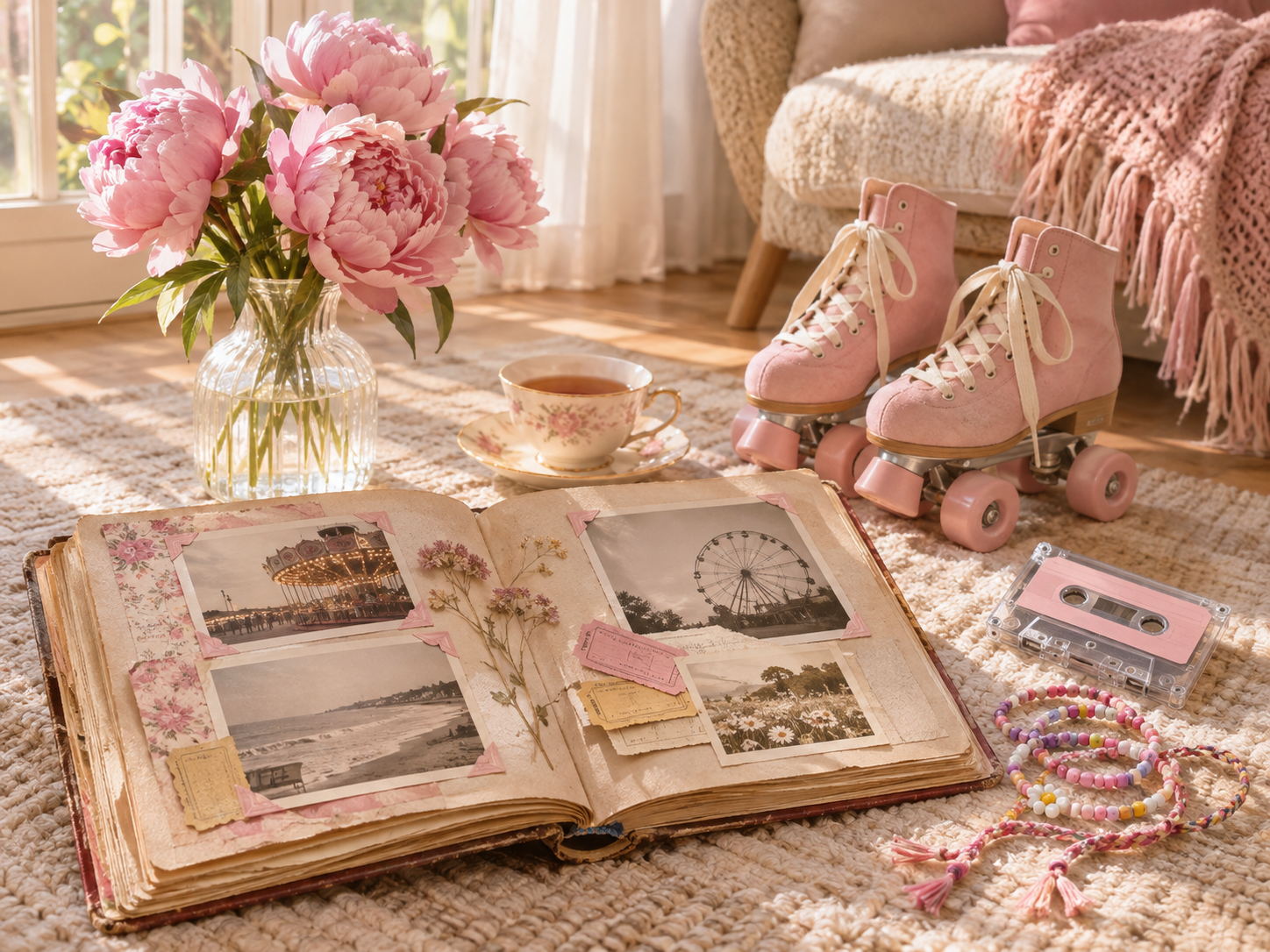
Think about the girl you were at nine. The one who collected stickers like they were rare coins, who had a best friend and a secret handshake, who could spend a whole Saturday building a fort out of couch cushions and call it a mansion. She didn’t go anywhere. She just got really, really busy.
Somewhere between the first job, the first apartment, the first baby, the first mortgage or the first heartbreak, a lot of us started treating the playful, curious, sentimental parts of ourselves like something we were supposed to outgrow. Like a phase. Like a pair of light-up sneakers that got donated with the rest of the stuff that didn’t fit anymore.
We don’t think girlhood is a phase. We think it’s a way of moving through the world: with curiosity, with a sense of fun, with a soft spot for the things that mean something, and with friends who make ordinary days feel like an adventure. That doesn’t have an expiration date. And as it turns out, psychology research has a lot to say about why keeping those parts of yourself close is good for you, at 25, at 45 and at 75.
This post is about what girlhood really means when you’re a grown woman, why the word has taken over the internet, what the science says about play, curiosity, nostalgia and wonder, and simple ways to reconnect with the girl you were without pretending you’re not the woman you are.
Girlhood, the way we mean it, isn’t about being young. It’s about staying curious, playful, sentimental and connected, at any age, while still being a capable, grown woman who pays her bills and runs her life.
What we mean by girlhood
When we say “girlhood,” we’re not talking about acting like a child, avoiding responsibility or wishing you were 22 again. We’re talking about a handful of qualities that most of us had in abundance as girls and that tend to get quieter as life gets louder:
- Playfulness. Doing something just because it’s fun, without needing it to be productive.
- Curiosity. Wanting to know how things work, asking “why,” and trying something new without worrying about being good at it.
- Sentimentality. Keeping the note, the ticket stub, the friendship bracelet. Caring about things because of what they mean, not what they cost.
- Wonder. Stopping to look at a sunset, a full moon or a really good cloud.
- Friendship as a priority. Treating time with your girls as something important, not something that gets squeezed in after everything else.
- Bravery to be a beginner. Raising your hand, trying out for the team, signing up for the thing, even when you might be bad at it.
None of those qualities are childish. They’re human. Kids just have more permission to show them. Adults, and especially women carrying a lot, often have to give ourselves that permission on purpose.
That’s the heart of this post. Girlhood isn’t a number. It’s a mindset you can return to whenever you want, and it can live right alongside being a mom, a professional, a partner, a caregiver and a grown woman with a very full calendar.
Why everyone’s talking about girlhood
If you’ve spent any time online in the last few years, you’ve seen it. “Girl dinner.” “Girl math.” “Hot girl walks.” Friendship bracelets traded at concerts, bows on everything, grown women calling each other “the girls” and “girlies.” 2023 in particular got called the year of the girl, with Barbie in theaters and the Eras Tour selling out stadiums.
Writers and researchers have had a lot to say about why. In an NPR conversation looking back at 2023, writer Isabel Cristo suggested that part of the appeal was a response to a bleak and stressful landscape for adult women. Vox culture writer Rebecca Jennings pointed out that many of the viral “girl” terms are really just cute, relatable names for ordinary habits, and that they often spread more like marketing than meaning.
There are fair critiques, too. An essay from the University of Oxford’s TORCH humanities center asked why so many adult women were framing themselves through girl-archetypes, and noted the risk that some of these trends cast capable women as helpless. Other critics have worried that trends like “girl dinner” can sometimes slide into making undereating look cute.
We think both things can be true. Some of the trend is fluff, some of it is marketing and some of it deserves a side-eye. But underneath the hashtags, a lot of women are reaching for something real: joy that isn’t tied to productivity, friendships that feel like home and permission to love what we love without apology.
That’s the part we want to keep. Not the shrinking, not the “I’m just a girl, I can’t possibly,” and definitely not anything that makes skipping meals look like a personality. Just the curiosity, the play, the sentiment and the sisterhood.
The parts of girlhood worth keeping
Here’s how those girlhood qualities tend to show up in grown-up life, when we let them.
- 🎠PlayDoing things just for fun
Roller skating, a puzzle, a board game night, dancing in the kitchen while the pasta boils. No goal, no metrics, just joy.
- 🔍CuriosityAsking “why?” again
Taking a pottery class, learning bird names, falling down a happy research rabbit hole about something nobody asked you to learn.
- 💌SentimentKeeping what matters
Scrapbooks, letters, old playlists, the recipe card in your grandmother’s handwriting. Meaning over minimalism.
- 🌟WonderNoticing the good stuff
Stopping for the sunset, the first snow, the cherry blossoms. Letting something be beautiful without photographing it first.
- 👯♀️FriendshipMaking time for your girls
The group chat, the walk, the “come over in sweatpants” night. Friendship treated like it matters, because it does.
- 🏅CourageBeing brave enough to be new
Signing up for the 5K, the dance class, the book club. Being a beginner in public, like you did at every new school year.
You probably still have more of these than you think. They might just be buried under the to-do list. The good news is that research suggests they’re worth digging out.
Play isn’t just for kids
We tend to think of play as something children need and adults outgrow. The research tells a different story.
Psychiatrist Stuart Brown, who founded the National Institute for Play, has spent decades studying play in people and animals. The Institute describes play as something voluntary, naturally motivated and pleasurable, done for its own sake. Brown is known for a line that has stuck with a lot of people: “The opposite of play is not work, it’s depression.” His point isn’t that play cures anything. It’s that play is a basic human need, not a luxury.
Psychologist René Proyer has studied playfulness in adults specifically. In a 2013 study of 255 adults, he found that more playful adults reported greater life satisfaction and were more likely to pursue enjoyable activities and an active way of life. In another online study across the lifespan, Proyer found that playfulness seemed to matter in every age group, with robust links to different measures of well-being.
And here’s the encouraging part: playfulness may be something you can practice. In a study published in Applied Psychology: Health and Well-Being, Proyer and colleagues gave 533 people simple exercises, like writing down the playful things that happened each day. Participants became more playful, and researchers observed a temporary, moderate boost in well-being. Small, but real, and from something as easy as paying attention.
Play isn’t a reward you earn after the work is done. It’s part of what keeps you going.
Find your kind of play
Brown’s Institute describes several “play personalities,” from collectors who love gathering things to kinesthetes who find joy in movement. You don’t need to take a quiz to figure out yours. Just think back:
- Were you the girl who organized everything? Your play might be collecting, curating or making things beautiful: a scrapbook, a garden, a perfectly arranged bookshelf.
- Were you always moving? Your play might be dancing, skating, hiking, swimming or a walk club.
- Were you the storyteller? Writing, journaling, theater, karaoke or telling the best stories at dinner.
- Were you the builder? Puzzles, LEGO, crafts, baking, sewing or fixing things around the house.
- Were you the one who started the games? Game nights, trivia, planning the girls’ trip, hosting.
Whatever you loved at nine is a pretty good clue to what might light you up at 39.
Curiosity, all grown up
Little girls are question machines. Why is the sky blue? Where do worms go when it rains? What happens if I mix these two paints? Curiosity is one of the most natural things in the world, and one of the easiest to lose when you’re just trying to get through the week.
Psychologist Todd Kashdan, who directs the Well-Being Laboratory at George Mason University, has studied curiosity for years. In research with Michael Steger, he found that curiosity was linked with greater well-being and meaning in life, both as a stable trait and on a day-to-day basis. On days when people were more curious and explored more, they tended to feel more meaning and satisfaction.
Kashdan has also suggested that even if you don’t think of yourself as a naturally curious person, curiosity can be cultivated. Trying new things can feel uncomfortable at first, but curious people tend to be rewarded for that discomfort over time.
Ways to wake up your curiosity
- Learn something useless. The names of the stars. How sourdough works. The history of your town. Just because.
- Ask one more question. In conversations, follow up. “Wait, how did you get into that?” is a friendship builder too.
- Take the class. Pottery, watercolor, salsa, beginner tennis. Being bad at something new is a very girlhood thing to do.
- Go somewhere new on purpose. A different park for your walk, a new coffee shop, a museum you’ve never visited.
- Follow your kids’ questions. If you have little ones, their “why?” can become your “huh, let’s find out together.”
Sentimental is a strength
If you’re the kind of woman who still has her middle school diary, every card your best friend ever wrote you and a shoebox of concert ticket stubs, you might have been told you’re “too sentimental.” We’d like to argue the opposite.
Nostalgia used to have a bad reputation. The word was coined by a Swiss physician in the 1600s to describe a kind of homesickness, and for a long time it was treated as something close to an illness. Over the past two decades, psychologists Constantine Sedikides and Tim Wildschut at the University of Southampton have helped change that picture.
Their research describes nostalgia as a mostly positive, slightly bittersweet emotion that serves real psychological functions. Across many studies, they and their colleagues have found that feeling nostalgic can boost feelings of social connection, self-esteem, meaning in life and a sense that your past and present self are connected. Their review on music-evoked nostalgia notes that a favorite old song can even instill a sense of youthfulness and optimism.
In other words: putting on the album you played on repeat at 15 and dancing around your kitchen isn’t silly. It might be one of the quickest ways to feel more like yourself.
A healthy kind of looking back
Nostalgia isn’t magic, and the researchers are careful about that too. Their more recent work notes that nostalgia’s benefits depend on the person and the situation, and that it’s more than just positivity. For some people in some seasons, looking back can stir up grief or a sense of loss. That’s okay. Healthy nostalgia is less about wishing you could go back and more about remembering who you’ve always been.
- Make a “girlhood playlist” of the songs from your favorite years and play it on your next walk.
- Pull out an old photo album with a friend or your kids and tell the stories behind the pictures.
- Recreate a favorite childhood snack or meal and eat it without a single thought about whether it’s “healthy enough.”
- Write a letter to your younger self. What would she be proud of? What would she want you to try again?
- Call the friend you’ve known the longest. Nothing brings back girlhood like someone who was there for it.
Wonder on purpose
Kids are experts at awe. A lightning bug, a tall building, a huge dog, a giant puddle. As adults, we’re often too busy to look up.
Researchers at UC San Francisco and UC Berkeley wanted to see what would happen if people practiced awe on purpose. In a study published in the journal Emotion in 2020, 52 healthy older adults took a 15-minute walk once a week for eight weeks. Half of them were simply asked to try to notice things that gave them a sense of awe along the way.
The “awe walk” group reported more positive emotions like compassion and gratitude in their daily lives, and less distress. The researchers even saw it in the selfies participants took on their walks: over time, the awe walkers put more of their surroundings in the frame and less of themselves, and their smiles grew measurably bigger. One of the researchers described the shift as a simple reminder to occasionally turn our attention outward instead of inward.
That’s about as close as science gets to describing a nine-year-old on a nature walk. And it’s something anyone can do, with or without a stroller.
How to take an awe walk
- Go somewhere a little bit new, or walk a familiar route with fresh eyes.
- Put your phone away, or at least out of your hand, for the first ten minutes.
- Look up and look close. Big things like sky and trees, small things like moss, frost and bugs.
- Notice what makes you go “oh.” That little catch in your chest is the feeling you’re looking for.
- Bring a friend or your kids and point things out to each other. Wonder is contagious.
If you already walk with us, try turning one walk club loop a month into an awe walk. Our post on starting a stroller walk club has ideas for routes.
How old do you feel?
Here’s a question researchers actually ask people: how old do you feel? Not how old are you, but how old do you feel?
It turns out most adults feel younger than their age. In the Midlife in the United States (MIDUS) study, more than 80% of participants reported a subjective age younger than their actual age. And a growing body of research has found that feeling younger is associated with better physical and mental health, better cognitive functioning, a lower risk of hospitalization and even longer life, even after researchers account for things like actual age and health.
One of the most famous studies in this area comes from Yale psychologist Becca Levy. In 2002, she and her colleagues looked at 660 adults aged 50 and older who had answered questions about aging back in 1975, like whether they felt they were becoming “less useful” as they got older. Up to 23 years later, the people with more positive views of their own aging had lived about 7.5 years longer, on average, than those with more negative views, even after accounting for things like health, income and loneliness.
An honest note: these studies show links, not proof. Feeling younger might help keep people healthy, and being healthy might also help people feel younger. Your mindset isn’t a magic shield, and it’s never your fault if you get sick. But how you think about getting older does seem to matter.
For us, the takeaway isn’t “stay young forever.” We don’t believe in fighting your age or putting timelines on women’s bodies. It’s that the stories we tell ourselves about getting older matter. If you believe that growing up means getting smaller, quieter and less fun, that belief can shape your choices. If you believe you can stay curious, playful and connected for life, that can shape your choices too.
Myths about growing up
A lot of us absorbed some pretty unhelpful ideas about what being a grown woman is supposed to look like. Let’s flip a few.
- Myth #1What we’ve been told
“Being playful is immature.”
A truer versionResearch links adult playfulness with greater life satisfaction and a more active life. Playful and responsible aren’t opposites. You can run a meeting and roller skate on the weekend.
- Myth #2What we’ve been told
“Being sentimental means you’re stuck in the past.”
A truer versionNostalgia research suggests looking back can boost connection, meaning and a sense of continuity in who you are. Remembering isn’t the same as refusing to move forward.
- Myth #3What we’ve been told
“Growing up means getting serious.”
A truer versionGrowing up means getting capable. You can handle real responsibilities and still laugh until you cry with your friends.
- Myth #4What we’ve been told
“Moms don’t have time for fun.”
A truer versionTime is tight, but play can be tiny: a five-minute dance party, a silly walk, a game with your kids. Small counts.
- Myth #5What we’ve been told
“After a certain age, it’s too late to start something new.”
A truer versionWomen start running, painting, dancing and building new friendships at every age. Being a beginner is a girlhood skill, and you still have it.
What girlhood isn’t
We love the idea of girlhood as a state of mind. We also want to be clear about what we don’t mean, because some versions of the “girl” trend can go sideways.
- 🚫Not thisShrinking yourself
Girlhood isn’t “I’m just a girl, I can’t do hard things.” You can. You do, every day.
- 🚫Not thisSkipping meals and calling it cute
A snack plate can be a fun dinner. Regularly not eating enough isn’t a personality. Please feed yourself like someone you love.
- 🚫Not thisFighting your age
This isn’t about looking younger or chasing your 20s. Every age gets to be playful, curious and fun.
- 🚫Not thisAvoiding real life
Play is a break and a recharge, not a way to escape everything forever. Grown-up stuff still gets done.
- 🚫Not thisBuying your way into it
You don’t need the bows, the merch or the tumbler. Girlhood is free. It’s a feeling, not a shopping cart.
- 🚫Not thisBeing exclusive
Girlhood is for every woman who wants it: every age, size, background and season of life.
If a trend makes you feel smaller, less capable or worse about your body, it isn’t the kind of girlhood we’re talking about. The real thing should make you feel more like yourself, not less.
Girlhood after kids
Becoming a mom can feel like the moment girlhood officially ends. Suddenly you’re the grown-up in every room. You’re the one who packs the snacks, remembers the doctor’s appointments and makes sure everyone has a coat. It’s easy to feel like your own fun got packed away with your pre-baby jeans.
Here’s the twist: kids can be one of the best invitations back into girlhood. They want to play. They want to make forts, have dance parties, hunt for bugs and watch the same movie 40 times. When you join them, not just supervise, you get to play too.
- Play the game, don’t just watch it. Get on the floor. Build the tower. Be the dragon.
- Share your girlhood favorites. The books, the movies, the games you loved. Watching your kid love them too is pure joy.
- Let them see you have fun. Kids who watch their moms laugh, learn and play are learning that grown-ups get to have joy too.
- Keep something just for you. Play with your kids is lovely. Play with your friends, without anyone needing a snack, matters too.
And if you’re in the thick of the newborn days and play feels impossible, that’s okay. This is a season. Our posts on getting your pink back and new mom loneliness talk about finding your way back to yourself, gently and at your own pace.
Ways to reconnect with your girlhood
Here are some of our favorite ways to bring a little girlhood back into grown-up life. Pick one. Pick the one that made you smile when you read it.
- 📿With friendsHost a craft night
Friendship bracelets, beading or painting, with snacks and an old playlist. Bracelet kits are cheap and surprisingly addictive. See options on Amazon →
- 🛷MovementGo roller skating
A rink night or a smooth park path. Wrist guards and knee pads are your friend. See options on Amazon →
- 📖SentimentStart a scrapbook or memory jar
Tickets, notes, little wins. Write one good thing on a slip of paper each week and read them all at New Year’s. See options on Amazon →
- 🌙FriendshipHave a grown-up sleepover
Pajamas, face masks, a comfort movie and staying up talking. The sleeping-on-the-floor part is optional.
- 🎨CuriosityTake a beginner class
Pottery, dance, watercolor, tennis. Go with a friend and agree to be terrible at it together.
- ✉️ConnectionWrite real letters
A card to an old friend, a note to your future self or a pen pal. Getting mail is still magic. See options on Amazon →
- 🎼NostalgiaMake the playlist
The songs from your favorite years. Play it in the car, on your walk or while you fold laundry.
- 🧩PlayBring back game night
Card games, puzzles or the board game you loved as a kid. Low stakes, high giggles. See options on Amazon →
Product links are general Amazon searches so you can compare options and prices. We don’t earn anything from them.
Girlhood, with your girls
Almost everything on that list is better with friends. That’s not an accident. Some of the most girlhood things there are, like the inside jokes, the late-night talks and the “come over right now” texts, depend on having people. If your friendships have drifted, you’re not alone, and it’s not too late. Our post on finding a workout buddy as an adult has scripts for reaching out, and our post on why working out with friends works explains why movement and friendship are such a good pair.
A week of small girlhood moments
You don’t need a whole Saturday free. Here’s what a week of tiny girlhood moments could look like, even on a busy schedule.
- MondayPlay one song from your teen years and dance while you make breakfast.
- TuesdayTake a 15-minute awe walk. Look up, look close, leave the phone in your pocket.
- WednesdayLearn one random fact about something you’re curious about. Tell someone at dinner.
- ThursdayText the friend you’ve known the longest a memory you have together.
- FridayMake a childhood favorite snack or dinner and enjoy every bite.
- SaturdayDo something playful with friends or your kids: a game, skating, a craft or a park.
- SundayWrite down the playful moments from your week. (Yes, that’s the same exercise from the playfulness research.)
That last one is our favorite. Noticing your playful moments helps you have more of them. It’s a small habit with a big ripple.
If play feels far away right now
Sometimes life is just heavy. Grief, burnout, a new baby, a divorce, money stress or a health scare can make “have more fun!” sound almost insulting. If that’s where you are, please hear this: you don’t have to force joy. Our post on why “just be happy” isn’t the whole story talks about how your circumstances matter just as much as your mindset.
Start smaller than small. A warm drink by a window. One song. A text to a friend. Girlhood will wait for you.
If you’ve lost interest in things you used to enjoy, or you’ve felt down, numb or hopeless for more than two weeks, please talk to your doctor or a mental health professional. Losing your sense of fun can be a sign of depression, which is common and treatable.
If you’re pregnant or a new mom, call or text the National Maternal Mental Health Hotline at 1-833-852-6262, any time. If you’re in crisis, call or text 988.
Your turn
The girl you were is still in there. She still loves glitter, or bugs, or books, or cartwheels, or whatever it was. This week, do one thing she would have loved. That’s it. That’s the whole assignment.
Growing up doesn’t have to mean growing out of joy. You can be a capable, responsible, grown woman and still be curious, playful, sentimental and silly with your friends. In fact, the research suggests those qualities might help you feel better, connect more and even age with a lighter step.
So keep the friendship bracelets. Make the playlist. Take the class. Go on the walk and look up. Call your girls.
And if you want more women in your life who still know how to have fun, that’s exactly what our circles and walk clubs are for. Come find your strength. Come find your girls.
Sources
- National Institute for Play: The importance of play for adults
- European Journal of Humour Research (2013): Proyer: The well-being of playful adults
- Proyer: Playfulness over the lifespan and its relation to happiness
- Martin Luther University Halle-Wittenberg: Study suggests playfulness can be trained (Applied Psychology: Health and Well-Being)
- Motivation and Emotion (2007): Kashdan & Steger: Curiosity and pathways to well-being and meaning in life
- Psychology Today: Cultivating curiosity
- Wildschut & Sedikides (2022): Psychology and nostalgia: towards a functional approach
- University of Southampton: The psychological benefits of music-evoked nostalgia
- Journal of Experimental Social Psychology (2026): Weingarten, Wei, Wildschut & Sedikides: Principles of nostalgia
- UC San Francisco: ‘Awe walks’ boost emotional well-being
- Midlife in the United States (MIDUS): Subjective age across adulthood
- Stephan et al. (2018): Subjective age and mortality in three longitudinal samples
- Yale News: Thinking positively about aging extends life more than exercise and not smoking
- Vox: “Girl” trends and the repackaging of womanhood
- NPR: Why 2023 was the Year of the Girl
- University of Oxford TORCH: Girl math, girl dinner: an essay on girls and girlhood on the internet
- HRSA: National Maternal Mental Health Hotline
- 988 Suicide & Crisis Lifeline
Product links are Amazon searches, and we don’t earn anything from them. This article is for general information and isn’t medical or mental health advice. Pink in Progress offers coaching and community, not therapy.
- Girlhood
- Play
- Nostalgia
- Friendship
- Mindset
Find your strength. Find your girls.
Tell us a little about where you are and what the girl you used to be loved to do. We’ll reply within two business days with circles, walk clubs and coaching that fit your season.
Questions
Good questions.
What does “girlhood is a state of mind” mean?
It means the playful, curious, sentimental and friendship-loving parts of yourself don’t have an age limit. You can be a capable adult woman and still make room for fun, wonder and your girls.
Is it immature for adult women to call themselves girls?
Not necessarily. Critics worry some “girl” trends can make women seem less capable, and that’s worth noticing. But for many women, “the girls” is simply about friendship and joy. What matters is whether it makes you feel more like yourself, not smaller.
Is play actually good for adults?
Research suggests so. Studies by psychologist René Proyer link adult playfulness with greater life satisfaction and a more active life, and one study found that simple exercises, like writing down playful moments each day, increased playfulness and briefly boosted well-being.
Is nostalgia good for you?
Often, yes. Research from the University of Southampton suggests nostalgia can boost social connection, self-esteem, meaning in life and a sense of continuity in who you are. Its benefits depend on the person and situation, and it can be bittersweet.
Does feeling younger affect your health?
Studies have linked feeling younger than your age, and having positive views about aging, with better health and longer life. These are associations, not proof, but they suggest the way we think about getting older matters.
How can a busy mom reconnect with her playful side?
Start tiny: one favorite song, a 15-minute walk where you notice beautiful things, a game with your kids or a text to an old friend. Then plan one playful thing with friends, like a craft night or a beginner class.
Keep reading
 Our story
 Community