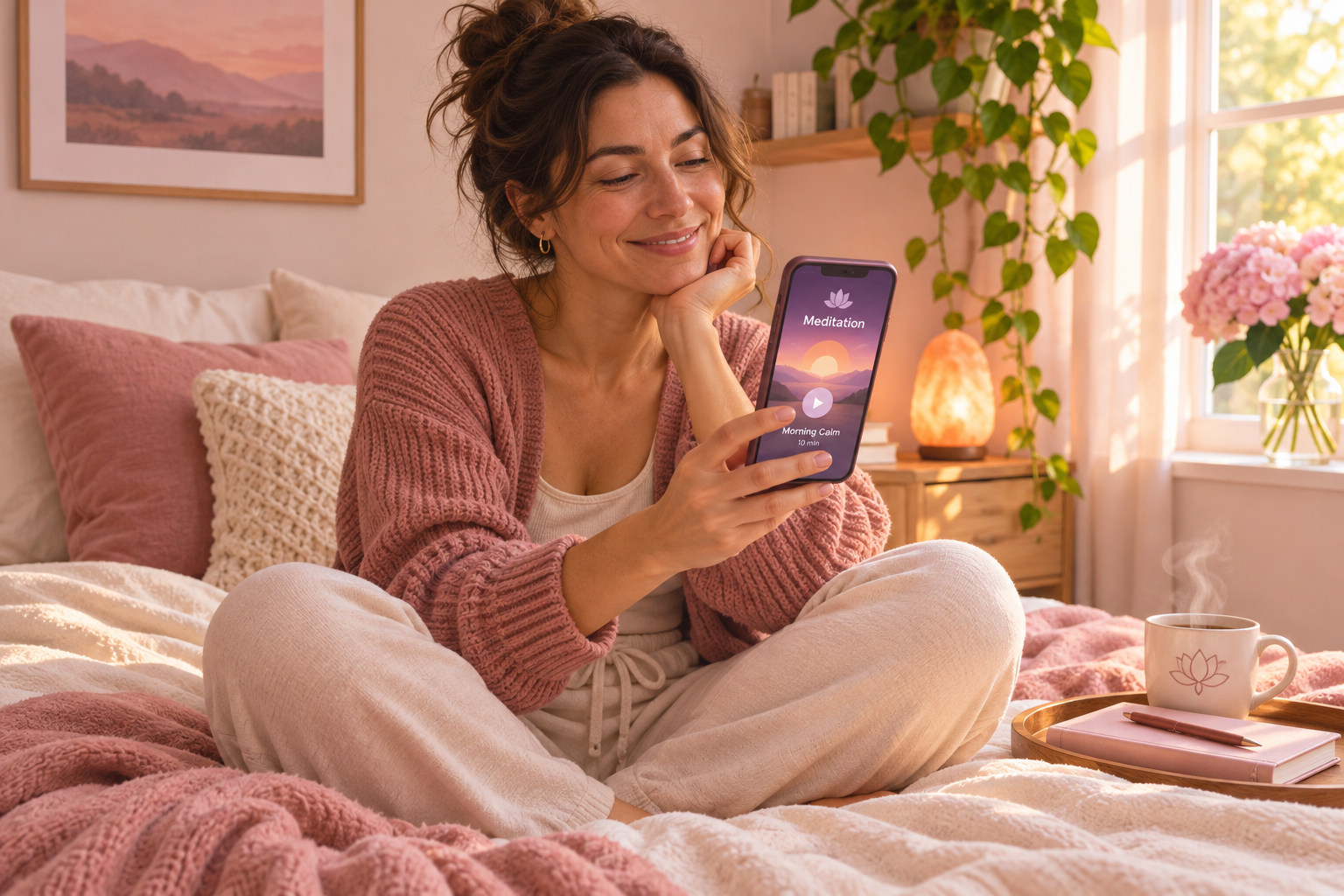
You download a mental health app, start your first meditation and feel a little calmer. Then, three sessions in, a screen pops up asking for $70 a year. Sound familiar? When you’re already stretched thin, a surprise subscription is the last thing you need.
The good news: there are excellent mental health apps that are actually free, made by nonprofits, universities and government agencies. Here are 12 we’d recommend to a friend, what’s free in each, how to protect your privacy and when an app isn’t enough.
Good to know: apps can support your mental health, but they don’t replace professional care. If you’re in crisis or thinking about suicide, call or text 988 in the U.S., any time.
Why “free” is complicated
Almost every mental health app is free to download. Far fewer are free to actually use. Researchers at Beth Israel Deaconess Medical Center reviewed 201 apps for conditions like pain, sleep and headaches and found that about 90% were free to download, but fewer than half were truly free. Most sleep apps, about 81%, weren’t truly free to use.
Many popular apps rely on free trials that turn into paid subscriptions, or lock most of their content behind a paywall. That’s not necessarily bad, since good apps cost money to build. But if your budget is tight, it helps to know which apps are genuinely free and which offer a useful free tier.
- 📥Free to downloadAbout 90%
Share of apps in one study that cost nothing to install.
- 💰Truly freeUnder half
Share that were actually free to use without paying.
- 🛏Sleep apps81%
Share of sleep apps in the study that weren’t truly free.
How we chose
We looked for apps that meet a few simple standards:
- Real free value. Either completely free, or with a free version that’s genuinely useful on its own.
- Credible makers. Nonprofits, universities, government agencies or teams working with psychologists and researchers.
- Evidence-based approaches. Mindfulness, cognitive behavioral therapy and emotion skills with research behind them.
- Privacy-minded. Clear privacy practices, especially for sensitive information.
- Still active in 2026. Every app on this list was available and listed as free as of November 2026.
We labeled each one as truly free (no paid tier) or a generous free tier (free core features with an optional upgrade). We have no affiliation with any of these apps and don’t earn anything from links.
12 free mental health apps
Tap a category to filter. Prices and features can change, so double-check the app store listing before you download.
- Meditation & calm
1.🌿Medito
Made by: Medito Foundation, a nonprofit.
Hundreds of guided meditations, sleep stories, courses and breathing exercises, plus a simple timer. Medito says every meditation, course, sleep story and feature is free, with no ads and no account required.
What’s free: 100% free. No paywall, no ads.
Best for: Beginners who want a calm, ad-free meditation app.
Visit Medito → - Meditation & calm
2.🧠Healthy Minds Program
Made by: Healthy Minds Innovations, affiliated with the Center for Healthy Minds at the University of Wisconsin–Madison.
A step-by-step program of short meditations and podcast-style lessons on awareness, connection, insight and purpose. It includes “active” practices you can do while walking or folding laundry.
What’s free: Free, funded by donations. No subscription.
Best for: Women who want structure and the science behind each practice.
Visit Healthy Minds Program → - Meditation & calm
3.🕌️UCLA Mindful
Made by: UCLA Mindful, the mindfulness education center at UCLA Health.
Basic meditations in multiple languages, wellness meditations for people with health challenges, weekly drop-in sessions, talks and a timer.
What’s free: Entirely free, with no hidden fees or subscriptions.
Best for: Short, no-frills sessions from a trusted source.
Visit UCLA Mindful → - Meditation & calm
4.😊Smiling Mind
Made by: Smiling Mind, an Australian not-for-profit.
A mental fitness program developed by psychologists and educators, with meditations and tools for mindfulness, flexible thinking, connection and rest. It also has family-friendly content you can use with kids.
What’s free: Free for individuals and families, with no paid membership.
Best for: Moms who want to practice with their kids, too.
Visit Smiling Mind → - Meditation & calm
5.🔔Insight Timer
Made by: Insight Network, Inc..
One of the biggest free libraries anywhere, with hundreds of thousands of guided meditations, sleep tracks, music and talks from thousands of teachers, plus a customizable timer.
What’s free: Large free library. An optional MemberPlus plan adds courses and offline listening.
Best for: Variety lovers who like to explore different teachers.
Visit Insight Timer → - Mood & emotions
6.🌈How We Feel
Made by: The How We Feel Project, a nonprofit, created with the Yale Center for Emotional Intelligence.
Daily check-ins use a color-coded grid of emotion words to help you name exactly how you feel, then suggest short strategies like breathing, reframing or movement. You can spot patterns with sleep and exercise over time.
What’s free: Free, funded by donations. No in-app purchases or ads.
Best for: Women who struggle to put feelings into words.
Visit How We Feel → - Mood & emotions
7.🐦Finch
Made by: Finch Care, a public benefit corporation.
A gentle self-care app where you care for a virtual bird by setting small goals, journaling and checking in on your mood. It’s playful, low-pressure and great for building tiny habits.
What’s free: Core features free. Finch Plus adds customization and extras.
Best for: Anyone who finds self-care hard to keep up with.
Visit Finch → - Mood & emotions
8.📅Daylio
Made by: Relaxio.
A quick mood and activity tracker. Tap your mood and what you did, and over time you can see how sleep, exercise or time with friends lines up with how you feel. No writing required.
What’s free: Core tracking free. Premium unlocks advanced stats and backups.
Best for: Busy women who want to log in seconds.
Visit Daylio → - Sleep & coping skills
9.🛡️PTSD Coach
Made by: U.S. Department of Veterans Affairs, National Center for PTSD.
Education about trauma, symptom tracking and practical tools for managing distress, plus quick access to crisis resources. Despite the name, it’s designed so that anyone who has been through trauma can use it.
What’s free: Completely free, from the U.S. government.
Best for: Anyone coping with the aftermath of a traumatic experience.
Visit PTSD Coach → - Sleep & coping skills
10.🍃Mindfulness Coach
Made by: U.S. Department of Veterans Affairs, National Center for PTSD.
A self-guided training program that teaches mindfulness step by step, with guided exercises and a tracking log. It’s straightforward and free of distractions.
What’s free: Completely free.
Best for: A structured, no-nonsense introduction to mindfulness.
Visit Mindfulness Coach → - Sleep & coping skills
11.😴Insomnia Coach and CBT-i Coach
Made by: U.S. Department of Veterans Affairs, with Stanford School of Medicine for CBT-i Coach.
Two sleep apps based on cognitive behavioral therapy for insomnia (CBT-I), a leading treatment for chronic insomnia. Insomnia Coach is a self-guided program, and CBT-i Coach is designed to use alongside a provider. Both include sleep diaries and tips.
What’s free: Completely free.
Best for: Women whose sleep problems are fueling stress or low mood.
Visit Insomnia Coach and CBT-i Coach → - Sleep & coping skills
12.👪PTSD Family Coach
Made by: U.S. Department of Veterans Affairs, National Center for PTSD.
Support for partners, family members and loved ones of people who may be experiencing PTSD, with education, stress tools and ideas for taking care of yourself too.
What’s free: Completely free.
Best for: Women supporting a partner or family member through trauma.
Visit PTSD Family Coach →
Do mental health apps actually work?
The honest answer is that it depends on the app and how you use it. Some apps have been studied directly. The Healthy Minds Program, for example, says research with its app found that just five minutes of practice a day led to a 28% reduction in stress, an 18% reduction in anxiety and a 24% reduction in depression. Others are built on approaches with strong evidence, like cognitive behavioral therapy for insomnia, which is the foundation of the VA’s sleep apps.
But many apps make big claims with little proof, and even good apps only help if you use them. An eMarketer analysis in 2026 noted that most people give health apps a try, but only about 3% are still using them after 30 days. That’s why we focused on apps from credible sources with approaches that have research behind them, and why the habit tips below matter as much as the app you choose.
Think of an app like a set of home exercises from a physical therapist. Done regularly, they can make a real difference. They work best as part of a bigger plan that includes sleep, movement, connection and, when needed, professional care.
Which app to try first
Not sure where to start? Match your app to what you need most right now.
You don’t need five apps. Pick one, try it for two weeks and see how you feel. If it doesn’t click, try another. The right app is the one that feels easy and kind enough that you actually want to open it again tomorrow.
Apps for different seasons of life
What you need from a mental health app can change a lot depending on where you are in life:
- New moms. Short practices you can do while feeding or rocking a baby matter most. Healthy Minds Program’s active practices and Medito’s short sessions fit well, and Finch’s tiny goals can help on foggy days. If you’re struggling, the National Maternal Mental Health Hotline is free and confidential.
- Busy working women. A quick check-in with How We Feel or Daylio takes less than a minute and can help you notice patterns, like how meetings, sleep or skipped lunches affect your mood.
- Midlife and perimenopause. Sleep often gets harder in these years. Insomnia Coach and Insight Timer’s sleep content can help, and our guide to perimenopause symptoms explains why sleep and mood can shift.
- Caregivers. PTSD Family Coach and short guided breaks can help you care for yourself while you care for someone else.
- Grief and hard seasons. Gentle meditation, journaling and connection can help, but grief is not something an app can fix. Our widow support circle and divorce support circle offer human support.
Check your benefits, too
Some paid apps and services may already be free to you. Many employers offer an employee assistance program, often called an EAP, which can include a few free counseling sessions and sometimes app memberships. Some health plans, universities and public libraries offer free access to wellness apps too. It’s worth checking your benefits portal or asking HR before you pay for anything.
When apps disappear
Free apps depend on funding, and sometimes that runs out. MindShift CBT, a popular free anxiety app from the nonprofit Anxiety Canada, announced it would stop receiving updates and support after March 31, 2025, and that all user data would be permanently deleted. Many people had used it for years.
It’s a good reminder not to keep your only copy of important reflections inside an app. If an app lets you export your journal or mood data, do it every so often. And if you love a nonprofit app, consider donating what you can, since many of the apps on this list are funded by people like you.
Your privacy matters
Mental health apps can collect some of the most personal information there is: your moods, worries, sleep and sometimes your darkest moments. Not all of them protect it well. When Mozilla reviewed 32 popular mental health apps in 2023, 59% earned its “Privacy Not Included” warning label, and 40% had gotten worse over the previous year.
There were bright spots. Mozilla gave PTSD Coach, from the U.S. Department of Veterans Affairs, a “Best Of” citation for doing privacy and security right. According to Penn Medicine’s employee assistance program, when you use a VA mobile app, no data that could be used to identify you is sent to the VA or third parties.
Before you download any app, it’s worth a quick look at its privacy policy and the privacy section in the app store. Apps that don’t require an account, like Medito, can also reduce how much personal information you share.
How to check any app
New apps launch all the time. If you find one that’s not on this list, the MIND database at MindApps.org, created by the Division of Digital Psychiatry at Beth Israel Deaconess Medical Center, is a free tool for checking it. It evaluates mental health apps using a framework developed with the American Psychiatric Association and lets you filter by cost, privacy and evidence.
- Is everything I need actually free, or will I hit a paywall after a few days?
- Who made it, and are psychologists, researchers or clinicians involved?
- Does it have a clear privacy policy, and does it sell or share my data?
- Can I delete my data, and can I use it without creating an account?
- Does it make big promises, like curing anxiety or replacing therapy?
- Does it point me to real help if I’m in crisis?
If an app can’t pass these, keep looking. There are good free options.
Making an app habit stick
Downloading an app is easy. Opening it again tomorrow is the hard part. A few ideas help:
- Start tiny. Two or three minutes counts. A short practice you actually do beats a long one you skip.
- Attach it to something you already do. Check in with your mood after brushing your teeth, or breathe for a minute before you open email.
- Put it where you’ll see it. Move the app to your home screen, and consider moving distracting apps off it. Our guide to screen time apps can help.
- Use gentle reminders. Set one reminder at a time of day that works, not five that nag.
- Pair it with paper. If screens feel like one more demand, a journal for healing can be a lovely companion.
- Do it with someone. Share a meditation with a friend or try an app with your partner. Connection helps habits last.
- Expect to miss days. Streaks break. Just start again without judgment.
Using apps alongside therapy
If you’re already working with a therapist, an app can be a helpful companion. Some, like CBT-i Coach, were designed specifically to use alongside a provider. Mood trackers like Daylio or How We Feel can give you something concrete to bring to sessions, such as how your mood changed after a hard week or which days felt lighter. Ask your therapist whether there’s an app they recommend for practicing the skills you’re working on together, and share only what feels comfortable. The goal isn’t more homework. It’s making the support you already have work a little harder for you between appointments.
When an app isn’t enough
- Everyday stress, worry or low mood
- Trouble winding down or sleeping
- Wanting to understand your emotions better
- Building habits like breathing, journaling or meditation
- Extra practice between therapy sessions
- You’re having thoughts of suicide or self-harm
- Low mood or anxiety lasts more than two weeks or keeps getting worse
- It’s hard to work, parent or get through the day
- You’re using alcohol or other substances to cope
- You had a baby in the past year and feel hopeless, anxious or not like yourself
If you’re in crisis, call or text 988 to reach the 988 Suicide & Crisis Lifeline in the U.S. It’s free and available 24/7.
Reaching out isn’t a failure. It’s a sign you’re taking your mental health seriously. Not sure who to see? Our guide to the difference between a coach, dietitian and therapist can help you figure out what kind of support fits. If you’ve recently had a baby, our guide to postpartum depression vs. the baby blues explains the warning signs.
Free support beyond apps
- 988 Suicide & Crisis Lifeline. Call or text 988, or chat online at 988lifeline.org, 24/7.
- Crisis Text Line. Text HOME to 741741 to reach a trained crisis counselor.
- National Maternal Mental Health Hotline. Call or text 1-833-TLC-MAMA (1-833-852-6262) for support during pregnancy and after birth.
- NAMI. The National Alliance on Mental Illness offers free support groups and a HelpLine.
- Community connection. Peer support, support groups and friendship can be powerful medicine. Our virtual circles are one place to start.
Taking care of your mind shouldn’t come with a price tag. Start with one free app, one small habit and one person you can talk to.
Sources
- eMarketer (2026): Health and fitness app usage 2026
- JMIR mHealth and uHealth (2022): Evaluation of apps in the MIND database for pain, sleep and headache
- Medito Foundation: A truly free meditation app
- Medito Foundation: The Medito app
- Center for Healthy Minds: Healthy Minds Program app
- Healthy Minds Innovations: The free Healthy Minds Program
- UCLA Health: UCLA Mindful app FAQ
- Smiling Mind: The Smiling Mind app
- Engadget (2026): The best meditation apps
- Insight Timer: How much does Insight Timer cost?
- App Store: How We Feel
- App Store: Finch: Self-Care Pet
- ChoosingTherapy (2026): Daylio app review
- VA National Center for PTSD: Self-care mobile apps
- Penn Medicine EAP: VA mobile apps and privacy
- Rutgers University: CBT-i Coach overview
- MindShift CBT listing: MindShift CBT closure notice
- Mozilla Foundation (2023): Mental health apps and privacy
- Division of Digital Psychiatry, BIDMC: About MindApps.org
- 988 Suicide & Crisis Lifeline: 988 Lifeline
- HRSA: National Maternal Mental Health Hotline
- NAMI: NAMI HelpLine
This article is for general information and isn’t medical advice. Talk with your doctor or midwife about what’s right for you.
- Mental health
- Apps
- Mindfulness
- Self-care
- Free resources
Feel supported, not sold to.
Tell us a little about you and your season of life. We’ll reply within two business days with coaching and circles that fit.
Questions
Good questions.
What is the best completely free mental health app?
It depends on what you need. Medito, Healthy Minds Program, UCLA Mindful and Smiling Mind are completely free for meditation. How We Feel is free for understanding emotions. The VA’s PTSD Coach, Mindfulness Coach and Insomnia Coach are free for coping skills and sleep.
Are free mental health apps any good?
Many are excellent. Several are made by nonprofits, universities and government agencies using approaches like mindfulness and cognitive behavioral therapy. The key is choosing apps from credible developers with clear privacy practices.
Can I use the VA’s mental health apps if I’m not a veteran?
Yes. The VA’s National Center for PTSD says its mobile apps can be used by anyone, and they’re free.
Are mental health apps private?
Not always. When Mozilla reviewed 32 popular mental health apps in 2023, 59% received its Privacy Not Included warning. Check each app’s privacy policy, and look for apps that don’t require an account or that don’t share identifying data.
Can a mental health app replace therapy?
No. Apps can help you build skills, track moods and practice between sessions, but they don’t replace care from a licensed professional, especially for depression, anxiety disorders, trauma or thoughts of suicide.
Is Insight Timer really free?
Insight Timer has a very large free library of guided meditations, sleep tracks and talks. An optional MemberPlus subscription adds extras like courses and offline listening.
What happened to MindShift CBT?
Anxiety Canada announced that MindShift CBT would stop receiving updates and support after March 31, 2025, and that user data would be deleted. It’s a good reminder to export data from apps you rely on.
What should I do if I’m in crisis?
Call or text 988 to reach the 988 Suicide & Crisis Lifeline in the U.S., available 24/7. If you’re in immediate danger, call 911.
 Picks & lists
 Picks & lists
 Coaching & habits