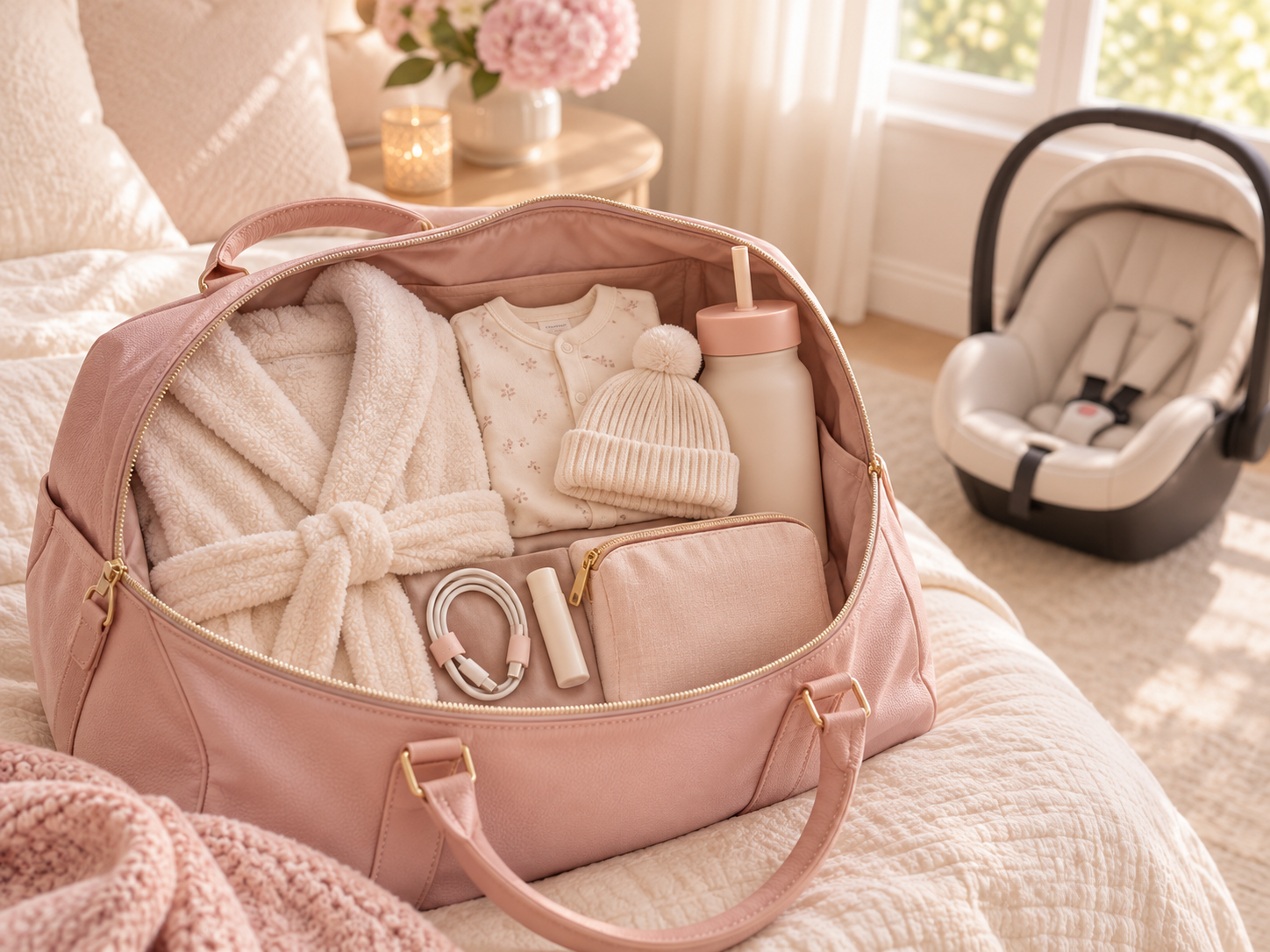
Search “hospital bag checklist” and you’ll find lists with 60 items on them. Three outfits for baby in two sizes. A full skincare routine. Twinkle lights. A labor playlist speaker. A newborn photo backdrop. It’s enough to make anyone feel behind before labor even starts.
Here’s the relief: you need a lot less than you think. Hospitals provide much of what you’ll use during your stay, and you’ll probably be there for only a day or a few. What you really need is a handful of essentials, a few comfort items that make a big difference, and a properly installed car seat.
This guide walks through exactly what to pack, what the hospital usually gives you, what’s worth bringing for comfort, and what you can happily leave at home. It’s written for a hospital birth, but most of it works for a birth center too. And if your birth doesn’t go to plan, which is common and okay, this list still has you covered.
One more thing before the list: there’s no “right” way to pack. Some women love a beautifully organized bag with labeled pouches. Others toss in a toothbrush, a phone charger and a hoodie at the last minute and are completely fine. Both are okay. The goal is simply to feel a little more ready, not to get it perfect.
The short list
If you only read one section, make it this one. These are the true must-haves:
- 🪪PapersID and insurance card
Plus any hospital pre-registration paperwork and your birth preferences, if you have them.
- 🔌PhonePhone and a long charger
Hospital outlets are often far from the bed. A 10-foot cord is a game changer.
- 👗YouComfy going-home clothes
Loose, soft and roughly what fit you at about six months pregnant.
- 👶BabyA going-home outfit
One outfit in newborn size and one in 0 to 3 months, plus a hat.
- 🚘Must haveAn installed car seat
Most hospitals won’t let you leave by car without one. Install it before labor.
- 💊HealthYour medications
Any prescriptions you take, in their original bottles, plus a written list.
Everything else is about comfort. Nice to have, but you’ll survive without it.
When to pack
Many people pack their hospital bag around 36 weeks of pregnancy, though the right timing depends on your pregnancy. If you have a high-risk pregnancy, are expecting twins or more, or have a planned delivery that’s earlier, your provider may suggest packing sooner.
A practical approach:
- 32 to 34 weeksMake your list. Wash baby’s going-home outfits. Buy anything you’re missing.
- 34 to 35 weeksInstall the car seat and get it checked.
- 35 to 36 weeksPack the bag and put it by the door or in the car.
- Last minuteKeep a sticky note on the bag for things you use daily: phone, charger, glasses, toothbrush, medications.
How long you’ll probably stay
Knowing your likely stay helps you pack the right amount. Under the federal Newborns’ and Mothers’ Health Protection Act, health plans that cover maternity care generally can’t restrict benefits for a hospital stay to less than 48 hours after a vaginal delivery or 96 hours after a cesarean. Your provider and you can decide to go home sooner if you’re both doing well.
In practice, that often means one to two nights after a vaginal birth and two to four nights after a C-section. So pack for about two to three days, not a week.
What the hospital usually gives you
This is where most overpacking happens. Cleveland Clinic notes it’s common to be sent home with things like peri bottles, diapers and wipes, mesh underwear and maternity sanitary pads.
Many hospitals provide:
- 🫠For youPostpartum care
Big pads, mesh underwear, a peri bottle, ice packs, witch hazel pads and numbing spray.
- 🏥For youGowns and basics
Hospital gowns, grippy socks, basic toiletries, pillows and blankets.
- 👶For babyDiapers and wipes
Newborn diapers, wipes, swaddle blankets, a hat and often a simple shirt.
- 🍼FeedingFeeding support
Lactation help, and formula or a hospital-grade pump if medically needed. Ask your hospital about its policy.
Every hospital is different, so call ahead or ask on your hospital tour: “What do you provide for me and the baby?” And before you leave, ask your nurse if you can take extras home. Many hospitals will send you home with pads, mesh underwear, a peri bottle and diapers.
Papers, phone and practical stuff
- Photo ID and insurance card. Keep them in an easy-to-reach pocket.
- Hospital paperwork. Pre-registration forms, if your hospital uses them.
- Birth preferences. A one-page list of what matters to you, with a few copies for the care team.
- Medication list. Names and doses of everything you take, plus allergies.
- Pediatrician’s name and number. The hospital will ask who will see your baby after discharge.
- Phone and a long charging cable. And a small power bank as backup.
- Glasses or contact lens supplies. If you wear contacts, bring glasses too. Contacts can be uncomfortable during a long labor or surgery.
- A pen. For forms, feeding logs and the questions you’ll want to remember.
For labor
Labor can be fast or long. These items help with comfort either way:
- Lip balm. Hospital air is dry, and breathing through contractions dries your lips fast.
- Hair ties or a headband. You’ll want your hair off your face.
- Something to wear, if you want. The hospital gown works, but some people prefer their own dark nightgown or a labor gown.
- Socks or slippers with grip. Your feet may get cold, and floors are slippery.
- A water bottle with a straw. Much easier to sip from while lying down or in different positions.
- Comfort items. A playlist, headphones, a small massage ball or a favorite pillow with a colored pillowcase so it doesn’t get mixed up with hospital ones.
- Snacks, if allowed. Check your hospital’s policy on eating during labor. Your partner will definitely need snacks.
For recovery
The hospital covers the medical basics, but these make the first days more comfortable:
- Comfortable underwear. The hospital’s mesh underwear is honestly great for the first day or two. After that, many women prefer soft, dark, high-waisted underwear a size up.
- A robe or loose pajamas. Something easy to open for feeding and skin-to-skin, and dark colors are forgiving.
- A nursing bra or soft bralette. Your breasts will change a lot in the first few days.
- Toiletries. Toothbrush, toothpaste, face wipes, deodorant, dry shampoo, moisturizer. A shower can feel amazing after birth.
- Shower shoes. Flip-flops for the hospital shower.
- Your own pads, if you prefer. Hospital pads are thick. Some women bring their own for the trip home.
- Stool softener? Ask your nurse. They can often provide one, and it can make the first bathroom trip easier.
- A going-home outfit. Loose, soft, and roughly what fit at six months pregnant. Your belly will still be there, and that is completely normal.
If you’re feeling nervous about how your body will look and feel after birth, we wrote a gentle guide to postpartum body image.
For feeding
However you plan to feed your baby, you don’t need much in the bag. Hospital nurses and lactation consultants are there to help.
- Nursing pads. Your milk may not come in for a few days, but some women leak earlier.
- Nipple cream. If you plan to breastfeed, a small tube can help with early soreness.
- A nursing pillow, maybe. Some hospitals have them. If you love yours, bring it, but regular pillows work too.
- Formula plan. If you plan to formula feed, ask your hospital whether it provides formula and which kind. Many do.
- Your pump? Probably not. Hospitals usually have hospital-grade pumps if you need one. Bring your own only if you want help learning to use it.
Breast, bottle, pumping or a mix, every feeding choice is valid. Read “You didn’t fail. Fed is best.” if you need the reminder.
For baby
Babies need surprisingly little at the hospital. The hospital provides diapers, wipes, blankets and often a hat and shirt.
- Two going-home outfits. One newborn size and one 0 to 3 months, since you won’t know the size until you meet. Zip-up sleepers are easier than snaps.
- A hat and socks or footed sleeper. Newborns lose heat easily.
- A light blanket. For over the car seat straps if it’s chilly, never under them.
- Mittens, maybe. Newborn nails can be sharp. Many sleepers have fold-over mitten cuffs.
- A special outfit for photos, if you want. Totally optional and very sweet.
You don’t need diapers, wipes, a baby bath kit, a full wardrobe or a stack of swaddles. Save space.
The car seat: the one thing you can’t forget
The car seat isn’t technically in the bag, but it’s the most important item on this list. The American Academy of Pediatrics recommends that all infants ride rear-facing, starting with their first ride home from the hospital.
Installing it correctly is harder than it looks. According to data from child passenger safety technicians, more than two-thirds (67.1%) of car seats they checked in 2024 were incorrectly installed and used.
- Install it a few weeks early. Follow both the car seat manual and your vehicle manual.
- Get it checked. Find a certified child passenger safety technician. Many fire stations, hospitals and safety organizations offer free checks. NHTSA has a tool to find inspection stations near you.
- Practice buckling. Use a stuffed animal or doll to learn how the harness adjusts.
- Never in the front seat. A rear-facing seat should never go in front of an active airbag.
- Skip the puffy coat. The AAP warns that bulky clothing, including winter coats and snowsuits, can compress in a crash and leave the straps too loose. Buckle baby in regular clothes and lay a blanket over the straps.
Many hospitals have someone check that your baby is properly buckled before you leave. Don’t be shy about asking a nurse for help.
For your partner or support person
Whoever comes with you will be living at the hospital too, and they’ll be more helpful if they’re fed and rested.
- A change of clothes, a sweatshirt and comfortable shoes
- Toiletries and any medications they take
- Phone, charger and headphones
- Plenty of snacks and a water bottle. Labor can be long, and the cafeteria may be closed at 3 a.m.
- A pillow and small blanket for the pull-out chair
- Cash or a card for parking and vending machines
- A list of who to text with news, and when
Need snack ideas for both of you? Our list of one-handed snacks for new moms works great for a hospital bag too.
Extras for a planned C-section
If you’re having a planned cesarean, or just want to be ready in case, a few items make recovery easier:
- High-waisted underwear. The waistband should sit above your incision, not on it.
- Loose, soft clothing. Dresses or high-waisted joggers that don’t rub your belly.
- A small pillow. Holding it against your belly when you cough, laugh or ride in the car can help. Hospitals may give you one.
- Slip-on shoes. Bending to tie laces won’t be fun for a while.
- A longer stay’s worth of basics. You may be there an extra night or two.
Ask your care team for specifics. Many hospitals give C-section patients a binder or other recovery supplies.
Small things that make a big difference
These won’t show up on every list, but they’re tiny, cheap and often worth their weight:
- 👝ComfortYour own pillow
Hospital pillows can be thin and crinkly. Use a bright pillowcase so it comes home with you.
- 😎RestEye mask and earplugs
Hospitals are bright and noisy at all hours. These help you grab sleep between feeds and checks.
- 🛍️LaundryA plastic or wet bag
For anything that gets messy, so it doesn’t touch the clean clothes.
- 📝MemoryA small notebook
For feeding times, questions for the pediatrician and the little moments you’ll want to remember.
- 🍫Thank youTreats for the nurses
Totally optional, always appreciated. A box of individually wrapped snacks goes a long way.
- 🍰CelebrateA favorite snack for you
Something you’ve been craving for after birth. You’ll be hungry, and you’ve earned it.
What to leave at home
These are the most common overpacking culprits:
- Skip itLeave at home
Diapers, wipes and pads
WhyThe hospital usually provides these during your stay, and often sends extras home with you.
- Skip itLeave at home
Jewelry and valuables
WhyRings may need to come off if you swell, and hospital rooms aren’t secure. Leave them home.
- Skip itLeave at home
A full baby wardrobe
WhyBaby will mostly wear a diaper, a hospital shirt and a swaddle. Two outfits is plenty.
- Skip itLeave at home
Your pre-pregnancy jeans
WhyYour belly will still be round for a while. Soft, stretchy clothes will feel much better.
- Skip itLeave at home
A huge suitcase
WhyHospital rooms are small. A weekender bag plus a small tote for baby is usually enough.
- Skip itLeave at home
Candles
WhyOpen flames aren’t allowed. Battery candles or string lights are fine if you want ambiance.
Packing tips that actually help
- Pack two or three small bags. One for labor, one for postpartum and baby, and one for your partner. You won’t need everything at once, and it’s easier to grab what you need.
- Use packing cubes or zip bags. Label them: “labor,” “after birth,” “baby going home.” Your partner will thank you.
- Put a list on top. Include last-minute items like your phone, charger, glasses and medications.
- Keep the bag in the car from about 36 weeks, or right by the door.
- Pack a bag for the drive home. A small kit with a pad, a water bottle and a burp cloth in the car can be handy.
- Think about the season. A sweater for you, a warmer hat for baby, and a car seat blanket if it’s cold.
- Plan for other kids and pets. Write down who’s caring for them, with phone numbers, and leave instructions at home.
A printable-style checklist
| Bag | Must have | Nice to have |
|---|---|---|
| Papers | ID, insurance card, medication list, pediatrician info | Birth preferences, a pen |
| Tech | Phone, long charging cable | Power bank, headphones |
| Labor | Lip balm, hair ties, grippy socks | Own gown, water bottle with straw, playlist |
| Recovery | Toiletries, going-home outfit, nursing or soft bra | Robe, own underwear, shower shoes, dry shampoo |
| Feeding | Your plan, written down | Nursing pads, nipple cream, nursing pillow |
| Baby | Two going-home outfits, hat, installed car seat | Light blanket, mittens, photo outfit |
| Partner | Clothes, toiletries, snacks, charger | Pillow, blanket, cash for parking |
A few things worth buying
You likely have most of what you need at home already. If you’re missing anything, these are the items most often worth it. Links go to general Amazon searches, and we don’t earn anything from them.
-
A 10-foot charging cable
The most-loved hospital bag item
Lets you use your phone in bed while it charges from an outlet across the room.
Look for: The right connector for your phone, and a braided cable that won’t tangle.
-
A soft postpartum robe
For skin-to-skin and hallway walks
Easy to open for feeding, comfortable over a gown and nice for visitors.
Look for: A dark color, soft fabric and pockets.
-
A water bottle with a straw
Labor, recovery and feeding
Much easier to sip from while lying down or holding a baby, and you’ll use it for months.
Look for: A leak-proof lid and an insulated bottle that holds 24 to 40 ounces.
-
Zip-up newborn sleepers
For the ride home
Two-way zippers are so much easier than snaps on a squirmy newborn.
Look for: One newborn and one 0 to 3 months size, with fold-over mitten cuffs.
Before you get home
The bag is only half the prep. A few things to set up at home so the first days are easier:
- A recovery station in your bathroom: pads, peri bottle, comfortable underwear and pain relief your provider recommends.
- A feeding station where you’ll sit most: water, snacks, burp cloths, a phone charger and a nightlight.
- Easy food. A few freezer meals, or a simple plan like our 10-minute dinner rotation.
- A safe sleep space for baby: on their back, on a firm, flat surface, with no pillows, blankets or bumpers.
- Help lined up. Who can bring meals, walk the dog or watch older kids during the first weeks?
- Your support numbers. Your OB or midwife, your pediatrician, a lactation consultant and the National Maternal Mental Health Hotline at 1-833-852-6262.
Call 911 for chest pain, trouble breathing, seizures, or thoughts of harming yourself or your baby. Call your provider right away for bleeding that soaks through a pad in an hour or clots the size of an egg or bigger, a fever of 100.4°F or higher, a headache that won’t go away or changes in your vision, a red or swollen leg, or an incision that isn’t healing. If you can’t reach your provider, call 911 or go to the emergency room. For emotional support any time, call or text the National Maternal Mental Health Hotline at 1-833-852-6262.
Myths
- Myth #1What you’ve heard
“You need to pack for every possibility.”
The truthThe hospital covers most of what you’ll use. Your partner can always grab something from home or a store.
- Myth #2What you’ve heard
“Bring your own diapers and pads.”
The truthMost hospitals provide them and often send extras home. Ask before buying.
- Myth #3What you’ve heard
“You’ll fit back into your normal clothes to go home.”
The truthMost women still look several months pregnant at discharge. That’s completely normal.
- Myth #4What you’ve heard
“If the car seat clicks in, it’s installed right.”
The truthMost car seats checked by technicians have mistakes. Get yours checked for free.
- Myth #5What you’ve heard
“A cozy snowsuit keeps baby safe in the car.”
The truthBulky clothing under the straps can make them too loose. Use a blanket over the buckled straps instead.
Your turn
This week, do three things: call your hospital and ask what they provide, book a free car seat check, and put your ID, insurance card and a long charger in a bag by the door. That’s most of the hard part done.
Packing your hospital bag is one of those small, practical tasks that can make a big, unknown day feel a little more manageable. But remember: you don’t need the perfect bag. You need the essentials, a car seat, and people around you who will help.
If you’re getting ready to meet your baby and want a circle of women walking the same road, from late pregnancy to those first wobbly weeks at home, we’d love to welcome you.
Sources
- Cleveland Clinic: What to pack in your hospital bag
- Progyny (clinically reviewed): Hospital bag checklist
- Lamaze International: Hospital bag checklist
- Healthline: Hospital bag checklist
- CMS: The Newborns’ and Mothers’ Health Protection Act
- American Academy of Pediatrics (HealthyChildren.org): Rear-facing car seats
- American Academy of Pediatrics: Winter car seat safety tips
- Ford: Two-thirds of car seats are installed incorrectly (2024 technician data)
- CDC Hear Her campaign: Urgent maternal warning signs
- NHTSA: Car seats and booster seats, including inspection station finder
Product links are general Amazon searches, and we don’t earn anything from them. Every hospital is different, so check with yours about what it provides. This article is for general information and isn’t medical advice.
- Hospital bag
- Labor and delivery
- Pregnancy
- New moms
- Car seat safety
Find your strength. Find your girls.
Tell us a little about where you are right now. We’ll reply within two business days with new mom circles, stroller walk clubs and coaching for life with a newborn.
Questions
Good questions.
When should I pack my hospital bag?
Many people pack around 36 weeks. If you have a high-risk pregnancy, are expecting multiples or have an earlier planned delivery, your provider may suggest packing sooner.
What does the hospital provide after birth?
Many hospitals provide pads, mesh underwear, peri bottles, ice packs, gowns, basic toiletries, newborn diapers, wipes and swaddle blankets. Call ahead to ask what yours provides.
How many baby outfits should I pack?
Two is plenty: one in newborn size and one in 0 to 3 months, plus a hat. Baby will mostly wear a diaper, a hospital shirt and a swaddle during the stay.
How long will I stay in the hospital after giving birth?
Federal law generally protects coverage for at least 48 hours after a vaginal birth and 96 hours after a cesarean, though you may go home sooner if you and your provider agree. Pack for about two to three days.
Do I need to bring a car seat to the hospital?
Yes, if you’re driving home. Install a rear-facing car seat before labor and get it checked by a certified technician, since most car seats checked have installation or use mistakes.
What should I not bring to the hospital?
Leave jewelry and valuables, candles, large suitcases, your pre-pregnancy jeans, and big packs of diapers, wipes or pads, since the hospital usually provides those.
 New moms
 Nutrition