Why Pink in Progress is a natural partner for body confidence campaigns
What Dove, Aerie and Rare Beauty have built around real beauty and self-acceptance, where our community fits and eight campaign ideas for brands that want to help women feel at home in their bodies.
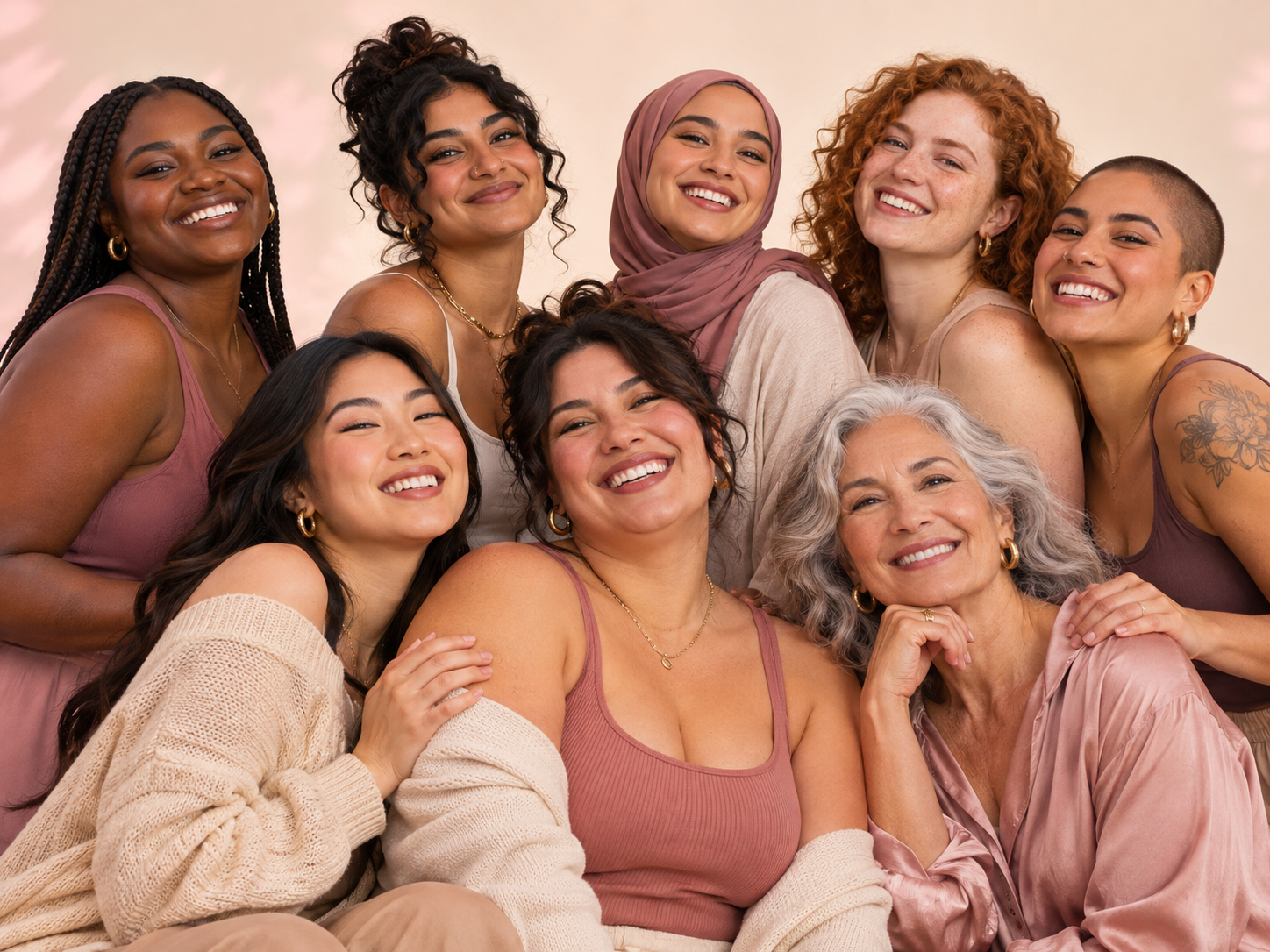
Body confidence isn’t a campaign theme at Pink in Progress. It’s the reason we exist. Every post, circle and coaching conversation is built around helping women feel stronger and more at home in their bodies, through pregnancy, postpartum, midlife and every season in between.
That’s why we believe Pink in Progress is a natural partner for brands running body confidence campaigns, especially brands like Dove, Aerie and Rare Beauty that have made real beauty, real bodies and self-acceptance part of who they are. This page explains why, with what each brand has publicly committed to, where our work fits and eight campaign ideas we’d love to build.
Please note: Dove, Aerie and Rare Beauty are examples of prospective collaborators based on mission and audience alignment. Pink in Progress has no existing partnership, affiliation or endorsement with these brands.
Why body confidence matters right now
The pressure on women to look a certain way hasn’t gone away. It has changed shape. To mark 20 years of its Campaign for Real Beauty, Dove surveyed more than 33,000 people across 20 countries for its 2024 report, The Real State of Beauty. It found that one in three women feel pressure to alter their appearance because of what they see online, even when they know the images are fake or AI-generated. In the U.S., more than one in three women said they would give up a year of their life to achieve an ideal look or body.
Social media plays a part. In a 2023 study published by the American Psychological Association, 220 university students aged 17 to 25 with symptoms of anxiety or depression were split into two groups. Those who cut their social media use by about half for a few weeks felt significantly better about their appearance and weight than those who kept scrolling as usual.
- 🤖2024 Dove reportAI is raising the bar
One in three women feel pressure to change how they look because of online images, even ones they know are fake or AI-generated.
- ⏳U.S. womenA year of life
More than one in three U.S. women said they’d give up a year of life to achieve an ideal look or body.
- 📵APA, 2023Less scrolling helps
Young people who halved their social media use for a few weeks felt better about their appearance and weight.
Brands that take this seriously need partners who can do more than post a hashtag. They need people who know the research, speak to women honestly and can turn a message into support women actually use.
Three brands that set the standard
Dove: two decades of Real Beauty
Dove launched its Campaign for Real Beauty in 2004, built on a striking finding: only 2% of women around the world considered themselves beautiful. Today, its Real Beauty pledge promises to feature real women as they truly are, with content free of digital and AI distortion. In 2024, Dove became the first beauty brand to commit to never using AI to represent real people in its advertising.
Through the Dove Self-Esteem Project, the brand offers free, academically validated tools to parents, teachers and young people, and it has a goal of educating 250 million young people by 2030. In 2026, Dove focused on keeping girls in sports, with a Big Game ad and a FIFA World Cup 2026 campaign called The Game Is Ours. It has also begun creating body confidence tools for adult women, including a confidence journal and a video series.
Aerie: real, unretouched and no AI
Aerie stopped retouching photos of people and bodies in 2014 under its #AerieREAL platform. In 2025, it recommitted to never using AI to generate bodies or change the people in its images. In 2026, the brand doubled down with a campaign starring Pamela Anderson, who has become known for going mostly makeup-free. Aerie’s chief marketing officer described the no-AI pledge as a natural next step in evolving its original 2014 commitment.
Aerie has also built a creator program around the same idea, and Modern Retail reported in May 2026 that it had drawn 12,000 members. Its message is simple: what customers see should match the real people they see in the mirror.
Rare Beauty: self-acceptance and mental health
Selena Gomez founded Rare Beauty in 2019 to help people embrace their uniqueness instead of comparing themselves to others. The brand donates 1% of all sales to the Rare Impact Fund, which works to expand access to mental health services for young people. At launch, the fund set a goal of mobilizing $100 million, and by early 2026 it had raised more than $30 million.
Rare Beauty expanded into more than 1,500 Ulta Beauty stores in February 2026, its first major retail expansion since launching in 2020. Its focus on mental health and self-acceptance makes it a natural fit for conversations about comparison, perfectionism and feeling like enough.
Where Pink in Progress fits
Each of these brands already does important work. Here’s where a partnership with us could add something new.
The common thread is simple. Each brand has made a public promise about how women are shown and supported, and each focuses mostly on girls, young people or a national audience. Pink in Progress focuses on grown women in specific seasons of life, like new motherhood, midlife and starting over, and we meet them in small groups as well as online. That makes us a complement to the work these brands already do, not a copy of it.
What we bring to body confidence work
Pink in Progress is a women’s wellness community built around coaching, small circles and practical, research-backed content. Ritner Digital is the team behind Pink in Progress, so strategy, writing, design and community all come from one place.
- 📚ContentA library on body image
We’ve already written about body neutrality, postpartum body image, going gray, non-scale wins and the pressure to always be improving.
- 🌱ConnectionReal community
Our circles and city walks give women a place to talk about their bodies with people who get it, not just a post to scroll past.
- 🔍CredibilityResearch you can trust
Every article ends with linked sources, and we avoid claims we can’t support.
- 🎨CraftContent people use
Our posts include guides, worksheets, checklists and filterable lists, built to be saved and shared.
Eight campaign ideas
These are starting points, not finished proposals. Tap a category to filter. Each idea notes which brands it might suit best.
- Content
1.🤱The postpartum mirror
A sourced guide and story series on body image after birth: the physical changes nobody mentions, the pressure to “bounce back” and how to treat a changing body with patience. It builds on our existing postpartum body image coverage.
What it could include: A long-form guide, a printable “kind words for a new body” card and a virtual circle for new moms.
- Community
2.👩👧The words we pass down
A mother-and-daughter conversation series about how the way we talk about our own bodies shapes how our kids see theirs. A natural companion to our essay on what we leave our daughters.
What it could include: Conversation prompts, a short guide for parents and a live circle for moms of tweens and teens.
- Community
3.🚶♀️Real bodies, real walks
Community walks in our cities where women show up exactly as they are: no filters, no “after” photos, just movement and conversation. Photos, if any, are real and unretouched.
What it could include: Monthly walks, a walking route guide and unretouched photo recaps shared with consent.
- Campaigns
4.📱The two-week scroll reset
A gentle challenge built on research showing that cutting social media use helped young people feel better about their appearance. Women track how they feel, swap comparison for connection and share what changed.
What it could include: A daily email series, a simple tracking sheet and an end-of-challenge reflection circle.
- Content
5.🤍Body neutrality, explained
Not every woman wants to love her body every day. An evidence-based explainer on body neutrality, which focuses on what your body does rather than how it looks. It extends our body neutrality guide.
What it could include: A sponsored educational guide with sources, FAQs and a reflection worksheet.
- Campaigns
6.🌟Rare conversations
A mental health and self-acceptance series pairing honest essays with small, guided circles where women talk about comparison, perfectionism and feeling like enough.
What it could include: Four essays, a facilitator guide and a series of virtual circles, with crisis resources included.
- Content
7.🧓Gray, lined and unfiltered
A celebration of aging bodies and faces, from going gray to laugh lines to midlife strength, written with women in their 40s, 50s and beyond. It builds on our essay on going gray.
What it could include: A feature series with real, unretouched portraits and a midlife confidence guide.
- Campaigns
8.⚽Back in the game
Girls aren’t the only ones who quit sports because of how they feel in their bodies. A campaign inviting grown women back to the sports and movement they loved, at any size and any age.
What it could include: A return-to-sport guide, beginner plans and community meetups for women getting back out there.
What two decades of real beauty campaigns teach us
Looking across Dove, Aerie and Rare Beauty, a few patterns stand out. They’re the same principles we’d bring to any campaign we help build.
- Commitments outlast campaigns. Dove’s pledge and Aerie’s no-retouching promise have lasted more than a decade because they are policies, not one-off ads. Women notice when a brand keeps its word year after year.
- Education goes further than inspiration. The Dove Self-Esteem Project offers free tools that parents and teachers can actually use. A moving film gets attention; a worksheet or workshop helps someone change how she thinks.
- Real people are the message. Aerie built its pledge into its marketing so thoroughly that its CMO calls being real its number one marketing pillar. When the people in the content look like the people reading it, trust follows.
- Mental health belongs in the conversation. Rare Beauty ties self-acceptance directly to mental health support. Body image and emotional well-being are deeply connected, and campaigns that treat them together feel more honest.
- New pressures need new answers. Both Dove and Aerie have expanded their pledges to cover AI. As the tools that shape what women see keep changing, body confidence work has to keep up.
What a community partner adds
Large campaigns are brilliant at reaching millions of people at once. What they often can’t do is sit with one woman in a small group while she talks about how hard it was to see herself in photos after her baby was born. That’s the kind of moment a community partner can create.
A partnership with Pink in Progress could take a brand’s big message and translate it into something personal: a circle, a walk, a guide written for a specific season of life or a conversation prompt a mom can use with her daughter that night. It turns a campaign into support, and support is what women remember.
What a year together could look like
- Listen and learnShort surveys and circles to hear what women in our community feel about their bodies right now.Insight
- Launch the anchor contentA sourced guide or series built around the brand’s message, clearly labeled as sponsored.Content
- Bring it to lifeCommunity walks, virtual circles or a challenge that turns the message into action.Community
- Reflect and shareA recap of what we created, what women told us and ideas for the year ahead.Recap
Shorter projects work too. A single guide, one circle series or a licensed article can be a meaningful first step.
How we’d measure impact
Views and clicks matter, but they don’t tell you whether a woman feels any differently about her body. We’d agree on measures with each partner up front, which could include:
- Engagement that means something, such as time spent with a guide, downloads of a worksheet or replies to a newsletter.
- Participation, like how many women joined a circle, walk or challenge and how many came back.
- Simple before-and-after check-ins about how participants feel, using short, voluntary questions rather than anything clinical.
- What women tell us in their own words, shared only with permission and never invented or edited to sound better.
Why grown women matter too
Much of the body confidence conversation rightly focuses on girls and teens. But body image doesn’t settle at 18. Women face new pressures through pregnancy and postpartum recovery, after illness or surgery, in midlife and as they age. Dove’s own 2024 research found that pressure to look a certain way affects women as well as girls, and the brand has since begun creating tools specifically for adult women.
Grown women are also the ones shaping how the next generation sees itself. The way a mom talks about her own body at the dinner table, in the dressing room or in front of the mirror can stay with her kids for years. Supporting women’s body confidence is also a way of supporting their daughters and sons.
That’s where Pink in Progress lives: with women in the middle of real life who want to feel strong, rested and like themselves again. We can help brands reach those women with content and community that meet them where they are.
Beyond these three brands
Dove, Aerie and Rare Beauty are the clearest examples, but they aren’t the only brands doing meaningful work in this space. Intimates and apparel brands that design for a wide range of bodies, maternal wellness brands that speak honestly about postpartum recovery and fitness brands that celebrate strength over size all share the same goal. Our Partner With Us page lists more of the industries we’d love to work with.
If your brand is new to body confidence work, that’s okay too. A few good places to start:
- Audit your imagery. Who appears in your photos, and how much are they edited?
- Check your language. Words like “flaws,” “fix” and “bounce back” can quietly undo a positive message.
- Start with education. A helpful, honest guide earns more trust than a slogan.
- Partner with people who live it. Work with communities and creators whose values match yours every day, not just during a campaign.
Our body confidence standards
Body confidence campaigns can backfire when they feel like marketing dressed up as empowerment. Critics have questioned whether beauty brands are the right messengers for self-esteem campaigns at all, and that skepticism is fair. The answer is to do the work carefully and consistently, not just in a single ad.
- Show real women of different ages, sizes, skin tones and abilities
- Use real, unretouched photos of people in campaign content
- Talk about what bodies do, not just how they look
- Back every health and wellness claim with credible sources
- Clearly label every sponsored or gifted mention
- Before-and-after photos or “bounce back” language
- Weight-loss framing, calorie targets or diet culture
- AI-generated or digitally reshaped bodies in partner campaigns
- Shaming any body, including “skinny” or “strong” ideals
- Invented testimonials, reviews or quotes
Body confidence work only lands when the people behind it actually live it.
Every sponsored piece is clearly labeled, in line with the Federal Trade Commission’s endorsement guidance, and we keep coaching within scope. When body image concerns cross into disordered eating, depression or anxiety, we point women to doctors, therapists and trusted support lines.
Questions for our first call
The best campaigns start with clear answers about who they’re for and what they should change. These are the questions we like to explore together early on.
- Who do we most want to reach: girls, young women, new moms or women in midlife?
- What do we want women to feel after seeing this campaign?
- What would make this feel real rather than like another ad?
- Where does our audience need support beyond the campaign itself?
- How will we know it helped, not just that it was seen?
You don’t need every answer. Working through them together is where good campaigns start.
How to start
If your brand is planning a body confidence campaign, or you’re looking for a partner to extend work you’re already doing, we’d love to talk. Our Partner With Us page outlines all seven ways we work with brands, from sponsored educational content and community activations to campaign development and content licensing.
To start the conversation, fill out our short form or email cara@ritnerdigital.com. Journalists and podcast hosts can also book us as an expert source or guest, and our brand kit has everything needed for co-branded work.
Real women. Real bodies. Real support. That’s what we’d bring to every body confidence campaign we’re part of.
Sources
- Dove: The Dove Real Beauty pledge
- Dove via PR Newswire (2024): Dove marks 20 years of Real Beauty
- Dove: Keep beauty real and The Real State of Beauty report
- Happi (2024): Dove sheds light on impossible beauty standards
- Dove via PR Newswire (2026): Dove champions girls’ confidence at the FIFA World Cup 2026
- Dove via Business Wire (2025): Body confidence tools for women
- B&T (2025): Dove’s Real Beauty campaign and its critics
- Aerie: 100% Aerie Real
- Marketing Brew (2026): Aerie doubles down on its no-AI pledge
- Modern Retail (2026): Aerie’s creator program and its no-AI rule
- Rare Beauty: Rare Impact Fund
- Happi (2026): Rare Beauty company profile
- Glossy (2026): Rare Beauty breaks Ulta Beauty’s launch-day record
- Premium Beauty News (2026): Rare Beauty expands to Ulta Beauty
- American Psychological Association (2023): Reducing social media use significantly improves body image in teens, young adults
- Federal Trade Commission: Disclosures 101 for social media influencers
Brand details are drawn from each company’s public statements and news coverage as of November 2026. If body image concerns are affecting your eating, mood or daily life, please talk with a doctor or mental health professional.
- Body confidence
- Partnerships
- Real beauty
- Self-acceptance
- Brand collaborations
Let’s help women feel at home in their bodies.
Tell us about your brand and the campaign you’re imagining. We’ll reply within two business days with next steps.
Questions
Good questions.
Does Pink in Progress partner with Dove, Aerie or Rare Beauty?
Not currently. These brands are examples of prospective collaborators based on mission and audience alignment. Their inclusion does not imply an existing partnership, affiliation or endorsement.
Why is Pink in Progress a good fit for body confidence campaigns?
Body confidence is central to everything we do. We bring a library of body image content, real community through circles and city walks, research-backed writing and clear standards against diet culture and digital distortion.
What kinds of body confidence campaigns could you create?
Ideas include a postpartum body image series, mother-and-daughter conversations, real-body community walks, a two-week social media reset, body neutrality education, mental health circles, midlife features and a return-to-sport campaign for grown women.
Do you use real, unretouched photos in partner campaigns?
Yes. Partner campaign content features real people with no AI-generated or digitally reshaped bodies, so it fits the commitments brands like Dove and Aerie have made publicly.
What is the Dove Real Beauty pledge?
Dove pledges to feature real women as they truly are, with content free of digital and AI distortion, and in 2024 it committed to never using AI to represent real people in its ads.
What is Aerie Real?
Aerie stopped retouching photos of people and bodies in 2014, and in 2025 it recommitted to never using AI to generate bodies or change the people in its images.
What is the Rare Impact Fund?
Rare Beauty donates 1% of all sales to the Rare Impact Fund, which works to expand access to mental health services for young people. It set a goal of mobilizing $100 million.
How can a brand get in touch?
Fill out the form on our homepage or email cara@ritnerdigital.com. We’ll reply within two business days and set up a discovery call.
 Stories & spotlights
 Mind & mood
 Coaching & habits