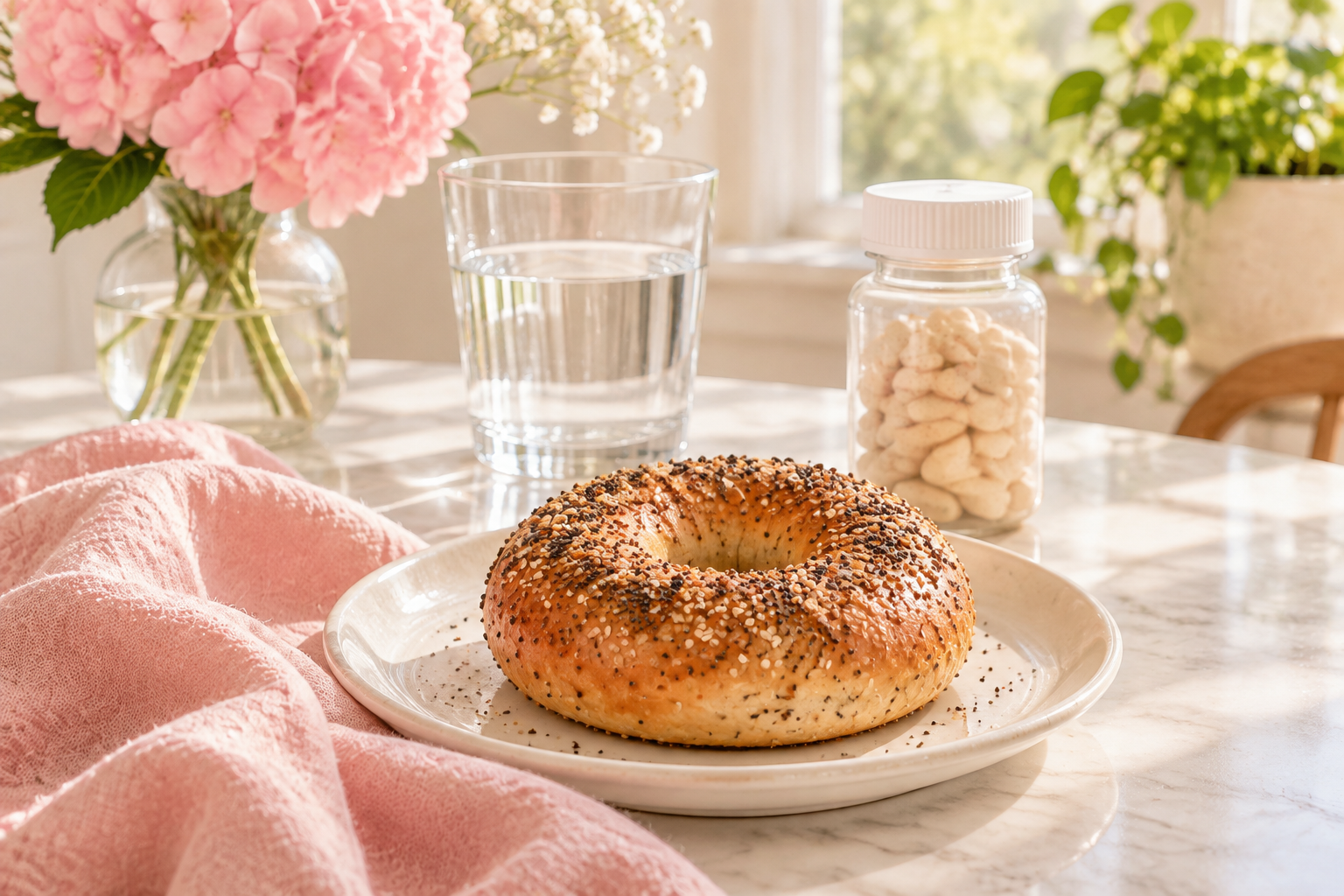
When I was pregnant with my first, I failed a drug test at my OB’s office. I don’t do drugs. I don’t smoke. I was the girl drinking water at every party and reading every label. And there it was: a positive result for opiates. The reason turned out to be an everything bagel.
I’m writing this because I had no idea this could happen, and almost nobody I’ve told since knew either. When I went looking for answers afterward, I found stories that scared me much more than my own: moms who tested positive at the hospital while in labor, who were reported to child services and who, in at least one case, had their newborn taken away for days. Over a bagel.
So here’s my very simple, very strong advice: skip everything bagels and anything with poppy seeds while you’re pregnant. It’s not worth the stress of being looked at sideways, or of being accused of something even once. Below I’ll walk you through why poppy seeds trigger these tests, the documented cases where it escalated, the foods to watch for and what to do if it happens to you.
I’m a mom and a coach, not a doctor or a lawyer. This post is for awareness, not medical or legal advice. Testing policies and reporting laws vary by hospital and state, so talk to your OB or midwife about yours, and talk to a lawyer if you’re facing an investigation.
The day I failed a drug test
It was a routine prenatal appointment. I peed in the cup like I had a dozen times before, and I honestly didn’t think twice about it. Then the result came back positive for opiates.
I remember the feeling more than the words. Shock first, then a hot wave of embarrassment, then fear. I knew I hadn’t taken anything. But I also knew that what I knew didn’t matter as much as what the piece of paper said. I could suddenly picture how I looked from the other side of the desk, and it wasn’t “excited first-time mom.”
I racked my brain. No medications. Nothing new. And then it clicked: I’d had an everything bagel that morning. I’d heard the old joke about poppy seeds and drug tests, the one from sitcoms, but I genuinely thought it was a myth. It isn’t.
That night I did what we all do. I googled. And the more I read, the more I realized how lucky I was that this happened at a prenatal visit and not on the day I gave birth. Because the stories from labor and delivery were a whole different level.
Even though I knew the truth, I felt like I’d done something wrong. I replayed it for days. I felt judged at my next appointment, whether or not anyone was actually judging me. Pregnancy already makes you feel like everyone is watching what you eat, drink and do. This made it ten times worse.
I don’t ever want another mom to go through that over breakfast. So let’s talk about it.
Why poppy seeds trigger opiate tests
Poppy seeds come from the opium poppy, the same plant that morphine and codeine come from. The seeds themselves don’t contain much opiate, but during harvesting they can pick up residue from the rest of the plant. Washing and processing reduce it, but the amount left on seeds varies a lot from batch to batch and brand to brand.
When you eat food with poppy seeds, your body absorbs some of that morphine and codeine, and it shows up in your urine. A standard urine drug screen is an immunoassay. It’s fast and cheap, and it looks for opiates as a group. It can’t tell the difference between morphine from a bagel and morphine from a pill.
Researchers have studied this for decades. In a well-known study published in Forensic Science International in 1998, volunteers who ate poppy seed cake had positive urine opiate results for up to 24 hours afterward. More recent work has found that some poppy seed products can produce very high codeine levels in urine. Morphine from poppy seeds can generally remain detectable in urine for up to about two days, depending on how much you ate and the test being used.
The important part: this isn’t about eating a huge amount. The New Jersey moms’ attorney told reporters how little poppy seed it took. They had eaten bagels with everything seasoning.
There is a way to tell the difference, at least sometimes. A confirmatory test, using a lab method like gas or liquid chromatography with mass spectrometry, measures the specific substances and how much of each is there. Labs can look at the pattern of morphine and codeine, and some look for a poppy marker called thebaine. That’s why asking for confirmation matters so much. But in several of the stories below, moms say they asked and didn’t get one before they were reported.
Why hospital tests can be stricter than workplace tests
Every drug test has a cutoff, the level above which a result counts as positive. In 1998, the U.S. Department of Health and Human Services raised the cutoff for opiates in federal workplace testing from 300 to 2,000 ng/mL. A big reason was poppy seeds. Too many people were testing positive after eating perfectly legal food.
But that federal standard applies to federally regulated workplace testing. It doesn’t control what a hospital lab uses for a pregnant patient. Many labs still use the lower 300 ng/mL cutoff, and some use even lower ones.
The numbers in the real cases are striking:
- In the Pennsylvania case, the mom’s result was 501 ng/mL. Her lawsuit pointed out that was well below federal workplace guidelines, and right in line with what you’d expect a few hours after eating poppy seeds.
- In the New Jersey cases, the ACLU alleged that one hospital’s test used a threshold 200 times lower than federal guidelines.
- The hospital in the Pennsylvania case tested all obstetric patients at its low cutoff, and the mom’s lawyers argued that made false positives likely.
Lower cutoffs catch more real drug use. They also catch more bagels. And when a positive result can be reported to child welfare, a false positive isn’t just an inconvenience.
Real cases where it escalated
I wanted to be careful here. There are a lot of scary posts on the internet, and I only wanted to share stories backed by court filings, civil rights organizations or established news outlets. Each of these is cited and linked in the sources at the bottom. These are the moms’ accounts as described in their lawsuits and complaints.
- April 2010 · PennsylvaniaA 3-day-old taken from her parents
Elizabeth Mort ate a bagel with poppy seeds shortly before checking in to deliver her daughter at Jameson Hospital in New Castle, Pennsylvania. The hospital drug tested all obstetric patients for opiates at a cutoff far below the federal workplace standard. Her result, 501 ng/mL, was reported to Lawrence County Children and Youth Services without anyone explaining it to her. Her baby never tested positive. Caseworkers and police took the newborn into protective custody and kept her away from her parents for five days. The ACLU of Pennsylvania sued, and in 2013 the case settled for $143,500 along with policy changes at both the hospital and the county.
- 2020 · New YorkEverything bagel bites before birth
According to reporting by The Imprint, Laura Kuzdale of Dunkirk, New York, says the only thing she did to bring child protective services into her life was eat “Everything Bagel Bites” before giving birth in 2020. She filed a lawsuit over what happened next.
- 2021 · New YorkTwo moms, one hospital, one bagel and one salad
Two women gave birth at Garnet Health Medical Center in Middletown, New York. One had eaten a poppy seed bagel; the other had eaten a salad with poppy seed dressing. Both were drug tested without their consent, both tested “presumptive positive” and both later tested negative, as did their babies. Even so, both families were reported to the state child abuse register, child welfare workers searched their homes and both moms say they were told they couldn’t breastfeed. The New York Civil Liberties Union and Pregnancy Justice (then National Advocates for Pregnant Women) filed discrimination complaints.
- 2022 · IllinoisA Polish Easter cake
The Associated Press reported that a suburban Chicago first-time mom says she was drug tested without consent before giving birth at St. Alexius Medical Center and tested positive for opiates. She had eaten makowiec, a traditional Polish poppy seed cake, at Easter. She says staff dismissed her explanation, her baby was taken to the NICU even though he showed no withdrawal symptoms and her family went through months of monitoring.
- 2022 · New JerseyEverything bagels for breakfast
Two New Jersey moms delivered at Hackensack University Medical Center and Virtua Voorhees Hospital. Each says she ate a bagel with poppy seeds before going in. Neither baby ever tested positive. Both moms were reported to the state’s child protection agency. One went through a roughly two-month investigation, including a drug and alcohol evaluation where she gave a urine sample in front of a caseworker, and her daughter’s discharge was delayed. The other was cleared after a monthslong investigation. The ACLU of New Jersey filed civil rights complaints on their behalf.
- May 2026 · New YorkA first-of-its-kind ruling
Five years after the Garnet Health complaints were filed, the NYCLU announced that New York’s Division of Human Rights had sustained Crystal H.’s sex and pregnancy discrimination claim. The ruling requires the hospital to stop the practice, train employees and pay fines and civil penalties to the state.
The Pennsylvania case is the one that stuck with me most. The court filings describe how Elizabeth Mort’s obstetrician knew about the result but didn’t mention it, because in her experience many initial screens came back as false positives and her patient had tested clean during pregnancy. The family only figured out the poppy seed connection after Elizabeth’s father started researching on his own. The day after the baby was taken, the county itself told the court that there was no evidence of illegal drug use by the mom.
As part of the 2013 settlement, policies changed. The hospital agreed to report results only if the baby tests positive, and the county agreed to discuss test results with parents before asking a court to remove a child. That’s progress. But it’s one hospital and one county.
And these aren’t the only cases. A Pennsylvania mom sued a Pittsburgh hospital in 2020 after she says she was drug tested without consent and a false positive was reported to child welfare, even though her newborn tested negative. Reporting on that case noted that lawsuits or ethical complaints have been filed in New York, California, Alabama, Maryland and other states, after mothers say poppy seed bagels or salad dressing caused unconfirmed or false positive results.
The pattern in these stories
Reading these cases one after another, I noticed the same things kept happening. It helped me understand where the risk really is.
- The mom ate something ordinary. A bagel, a salad, a muffin, a holiday cake. Nothing anyone would think twice about.
- She was tested around delivery, often without being told, or without understanding what the test was for or what would happen if it came back positive.
- The screening test came back positive for opiates, sometimes at a level far below the federal workplace standard.
- The baby tested negative, or showed no signs of exposure.
- The mom explained the poppy seeds. In several cases she asked for a confirmatory test and says she didn’t get one.
- The hospital reported her anyway, often because its protocol required it.
- Child welfare investigated: home visits, interviews, months of follow-up, and in the worst case, a newborn taken away.
- Eventually she was cleared. But the case could stay on record, and nobody can give her back those first days or weeks.
That’s why I say it’s not worth it. The bagel isn’t dangerous to your baby. The test result is what can go wrong. And when you’re in labor or newly postpartum, you’re in the weakest position you’ll ever be in to argue your case.
One of the New Jersey moms said the hospital judged her as an unfit mother before she even had the chance to be one. I felt a small version of that in my OB’s office. I can’t imagine feeling it while holding my newborn.
Who gets tested, and when
Here’s something I didn’t know: whether you get a urine drug test, and what happens to the result, depends a lot on where you live and where you give birth.
The American College of Obstetricians and Gynecologists (ACOG) recommends that every pregnant patient be screened for substance use early in pregnancy. But screening, in ACOG’s guidance, means validated questionnaires and conversations with your provider, applied to everyone equally. It does not mean routine lab testing of your urine. ACOG and the American Academy of Pediatrics have also said that drug testing should happen with the patient’s consent, and that she should be told how a positive result will be used, including whether it could be reported to child welfare.
In practice, it varies widely:
- Some hospitals test every patient who comes to labor and delivery. The Pennsylvania hospital in the Mort case did.
- Some test based on “risk factors,” which can include things like limited prenatal care. Advocates and researchers have raised concerns that this kind of targeted testing falls much more heavily on low-income women and women of color.
- Some ask for written consent first. In 2020, New York City began requiring its public hospitals to get written consent before drug testing pregnant patients and new mothers.
- Some OB offices include a drug screen in routine prenatal labs. That’s how I found out.
Legal pressure is building. In New York, the attorney general’s office has looked into drug testing of pregnant patients and new moms, and the state’s Division of Human Rights ruled in 2026 that testing a pregnant patient without her consent was discrimination. But none of that changes what happens at your hospital next week. You can’t control the hospital’s policy. You can control your breakfast.
What to skip while you’re pregnant
This is the easy part. Poppy seeds hide in more places than you’d think, so here’s my list.
- 🥯The big oneEverything bagels
Most everything seasoning blends include poppy seeds, and a bagel is coated in them. This is what got me, and it shows up again and again in the real cases below.
- 🍋BakeryLemon poppy seed anything
Muffins, loaf cakes, scones and pound cake. A single large muffin can carry a lot of seeds.
- 🥗SneakyPoppy seed dressing
Bagged salad kits and restaurant salads often use it. One of the New York moms traced her positive test to a salad with poppy seed dressing.
- 🍰TraditionalPoppy seed cakes and rolls
Makowiec (Polish poppy seed roll), beigli, kolaches with poppy filling, hamantaschen with mohn filling and strudel. Holiday baking is full of them.
- 🍔Check the topSeeded buns and rolls
Some hamburger buns, onion rolls, kaiser rolls, challah and deli rolls are topped with poppy seeds.
- 🧂LabelsEverything seasoning on other foods
Everything bagel seasoning on avocado toast, eggs, crackers, bagel chips, pretzels, frozen bites, cream cheese and even popcorn.
A few label-reading tips:
- “Everything” usually means poppy. Most blends combine sesame, poppy seeds, dried garlic, dried onion and salt. If a food says “everything,” assume it has poppy seeds unless the label says otherwise.
- Look for little blue-black dots. Poppy seeds are tiny, round and dark gray or blue-black. Sesame seeds are larger, flatter and white or black.
- Ask at bakeries and restaurants. Seeded rolls, dressings and pastries aren’t always labeled.
- Watch holiday tables. Polish, Czech, Hungarian, Jewish and German baking traditions use a lot of poppy seed filling. As a Polish girl, makowiec at Christmas and Easter was always on the table. Not while pregnant.
- Don’t forget white poppy seeds. Some recipes, including certain curries and Indian dishes, use ground white poppy seeds (sometimes called khus khus) to thicken sauces. You might not see them at all.
Easy swaps: plain, sesame, onion, garlic or cinnamon raisin bagels. Lemon blueberry muffins instead of lemon poppy seed. Honey mustard or balsamic instead of poppy seed dressing. You can even make your own “everything” seasoning with sesame, dried garlic, dried onion and flaky salt, and leave the poppy out.
How long to avoid them
My honest answer: for your whole pregnancy, and through your hospital stay after birth.
You might think you only need to stop a couple of days before a test. The problem is that you usually don’t know when a test is coming. I didn’t know a drug screen was part of my prenatal labs that day. And labor doesn’t send you a calendar invite. Plenty of babies arrive weeks early. Poppy seeds can show up in urine for up to about two days, so a bagel on the morning your water breaks could still be in your system when you’re admitted.
If I had to rank it:
- The whole pregnancyPrenatal visits can include a drug screenSkip them
- The last monthLabor can start any dayStrictly skip
- Delivery and hospital stayWhen testing is most commonAbsolutely skip
- Before any other testIncluding some job screensGood habit
Honestly, it’s just easier to make it a pregnancy rule, like deli meat or sushi. You don’t have to think about it, and you never have to wonder.
And while we’re talking about it: tell your OB or midwife about every medication you take, including prescription cough syrup or pain medicine with codeine. Some medications can also trigger a positive opiate screen. If it’s in your chart, it’s much easier to explain a result.
Myths I believed
Before this happened to me, I believed a few of these myself.
- Myth #1What people assume
“You’d have to eat a mountain of poppy seeds to fail a test.”
What’s actually trueNot true. Researchers and the federal government have documented positive opiate screens after ordinary foods like poppy seed cake and bagels. The federal government raised its own workplace cutoff in 1998 for exactly this reason.
- Myth #2What people assume
“If you tell them it was a bagel, they’ll just retest.”
What’s actually trueSometimes. But in several of the cases above, moms say they explained the poppy seeds and asked for a confirmatory test and were still reported. Saying it out loud matters, but it isn’t a guarantee.
- Myth #3What people assume
“If the baby tests negative, nothing happens.”
What’s actually trueIn the New York and New Jersey cases, the babies tested negative and the moms were still reported to child welfare. Policies vary by hospital and state.
- Myth #4What people assume
“Only people who use drugs need to worry about this.”
What’s actually trueEvery mom in these stories says she didn’t use drugs. That’s the whole point. A screening test can’t tell the difference between a bagel and a pill.
- Myth #5What people assume
“Poppy seeds are dangerous for the baby.”
What’s actually trueThat’s not the concern here. The small amount in baked goods isn’t the worry. The worry is a positive test, and everything a positive test can set in motion.
If you test positive anyway
If it happens, first: breathe. A false positive from poppy seeds is real and well documented. You aren’t crazy, and you aren’t the first. Here’s what I’d do, based on what I lived through and what I learned from these cases.
- Speak up right away. Tell your provider exactly what you ate and when: “I had an everything bagel at 7 a.m.” Mention any medications too. Ask them to write it in your chart.
- Ask for a confirmatory test. Ask specifically whether the sample can be sent for confirmation by mass spectrometry, which can measure the exact substances and levels. Ask that this happen before any decisions are made.
- Ask what the result will be used for. “Will this be reported to anyone? What is your policy?” You have a right to understand what’s happening.
- Ask whether your baby was tested, and what the result was.
- Write it all down. Times, names, what you ate, what you were told. Take a photo of the bagel bag or receipt if you still have it. It sounds dramatic until you need it.
- Request copies of your results and your records, including the cutoff level the lab used.
- Stay calm and cooperative, even though you’ll feel scared and angry. Bring your partner or a support person into the conversation.
- Get legal help if anyone contacts child welfare. Talk to a family law attorney. Organizations like your state’s ACLU affiliate and Pregnancy Justice have worked on exactly these cases.
If you’ve already been through an investigation, I’m so sorry. Feeling anxious, angry or numb afterward is a normal response to something frightening. Please talk to your provider, and know you can call or text the National Maternal Mental Health Hotline at 1-833-852-6262, any time.
Questions to ask your provider before birth
You don’t have to wait for something to go wrong. At one of your third-trimester appointments, or on your hospital tour, you can simply ask. Most providers will be glad you did.
- “Do you do urine drug testing as part of prenatal care? When?”
- “Does the hospital where I’m delivering test patients in labor? All patients, or only some?”
- “Will I be asked for consent before a drug test?”
- “If a screen is positive, is it confirmed before anything is reported?”
- “What foods or medications should I avoid so I don’t get a false positive?”
Then put a note in your birth plan: “Please ask me before any drug testing, and confirm any positive screen before reporting.” It may not change the hospital’s policy, but it puts your wishes on record.
For partners and family
This is one where your support people can genuinely help.
- Don’t bring everything bagels to the hospital. I mean it. The “I’ll grab breakfast on the way” run is exactly when this happens. Plain, cinnamon raisin or sesame. Or a breakfast sandwich.
- Check the snacks. Muffins, rolls and that well-meaning bakery box from your aunt can all have poppy seeds.
- Be her advocate. If something comes back positive, she’s exhausted, in pain or medicated. You can ask the questions above, request the confirmatory test and take notes.
- Hold off on the holiday baking. If she’s pregnant over the holidays, maybe the poppy seed roll waits until next year.
Your turn
I know this post might sound a little intense for something as innocent as a bagel. That’s exactly why I wanted to write it. Most of us have no idea this is a real risk until it happens to us, and by then we’re the one trying to convince a stranger that we’re telling the truth.
Skip the everything bagel. Skip the lemon poppy seed muffin. Skip the poppy seed dressing. Nine months without them is easy. Being looked at sideways, even once, is not.
If this happened to you too, you’re not alone, and it wasn’t your fault. And if you’re pregnant right now, send this to a friend who’s expecting. It might save her a really bad day.
If you want a group of women who share this kind of real-life, nobody-told-me stuff, that’s exactly what our circles are for. Come find your people.
Sources
- ACLU of Pennsylvania: Mort v. Lawrence County Children and Youth Services, et al.
- Courthouse News Service: Baby taken away for a poppy seed bagel
- WESA (Pittsburgh NPR): Policies change as part of poppy seed child custody settlement
- New York Civil Liberties Union (2021): Complaints on behalf of mothers reported to CPS after poppy seed consumption caused false positive drug tests
- Jezebel: Two moms reported to child services for false positive drug tests
- New York Civil Liberties Union (2026): In a first, NYS Division of Human Rights rules nonconsensual drug testing of pregnant mother is discrimination
- CBS News: New moms sue hospitals, claiming bagels with poppy seeds led to failed drug tests
- Daily Herald (Associated Press): Woman alleges poppy seed cake led to positive opiate test
- The Imprint: NY attorney general investigates drug testing of pregnant and new moms
- Claims Journal (Associated Press): Mother sues Pittsburgh hospital over drug test reported to child protective services
- Journal of Military and Veterans’ Health: Poppy seed and prohibited drug testing
- ACOG / Society for Maternal-Fetal Medicine: Committee Opinion 711: Opioid use and opioid use disorder in pregnancy
- HRSA: National Maternal Mental Health Hotline
This article is for general information and isn’t medical advice. Talk with your doctor or midwife about what’s right for you.
- Pregnancy
- New moms
- Poppy seeds
- Drug testing
- Labor and delivery
Find your strength. Find your girls.
Tell us where you are right now. We’ll reply within two business days with mom circles, walk clubs and women who share the real stuff.
Questions
Good questions.
Can eating poppy seeds make you fail a drug test while pregnant?
Yes. Poppy seeds can carry traces of morphine and codeine from the opium poppy, and eating foods like everything bagels, poppy seed muffins or poppy seed dressing can cause a positive opiate result on a urine drug screen. This has been documented in research and in several cases involving pregnant women.
How long do poppy seeds stay in your urine?
Morphine from poppy seeds can generally be detected in urine for up to about two days, depending on how much you ate, the seeds themselves and the cutoff the lab uses. Because you often don’t know when you’ll be tested or when labor will start, it’s simplest to avoid poppy seeds for your whole pregnancy.
Are everything bagels safe during pregnancy?
The poppy seeds in an everything bagel aren’t considered a danger to your baby in normal food amounts. The concern is that they can cause a positive drug test. Since a positive result around delivery can lead to a report to child welfare in some hospitals and states, many moms choose to skip them until after the baby comes.
Do hospitals drug test women in labor?
Some do. Policies vary by hospital and state: some test all patients in labor and delivery, some test based on risk factors and some require written consent. ACOG recommends universal screening with questionnaires and conversations, not routine urine testing, and says testing should be done with the patient’s consent. Ask your provider what your hospital does.
What should I do if I test positive for opiates after eating poppy seeds?
Tell your provider right away what you ate and when, and ask for a confirmatory test, such as mass spectrometry, before any decisions are made. Ask how the result will be used, request copies of your results, write everything down and contact a family law attorney if child welfare becomes involved. This isn’t legal advice; talk to a lawyer about your situation.
 New moms
 New moms