Lat pulldown: proper form, grip and common mistakes
How to use the lat pulldown machine with confidence: setting up the seat and thigh pad, choosing a grip, pulling with your back instead of your arms, what the research says about grip width and the most common mistakes, plus home alternatives.
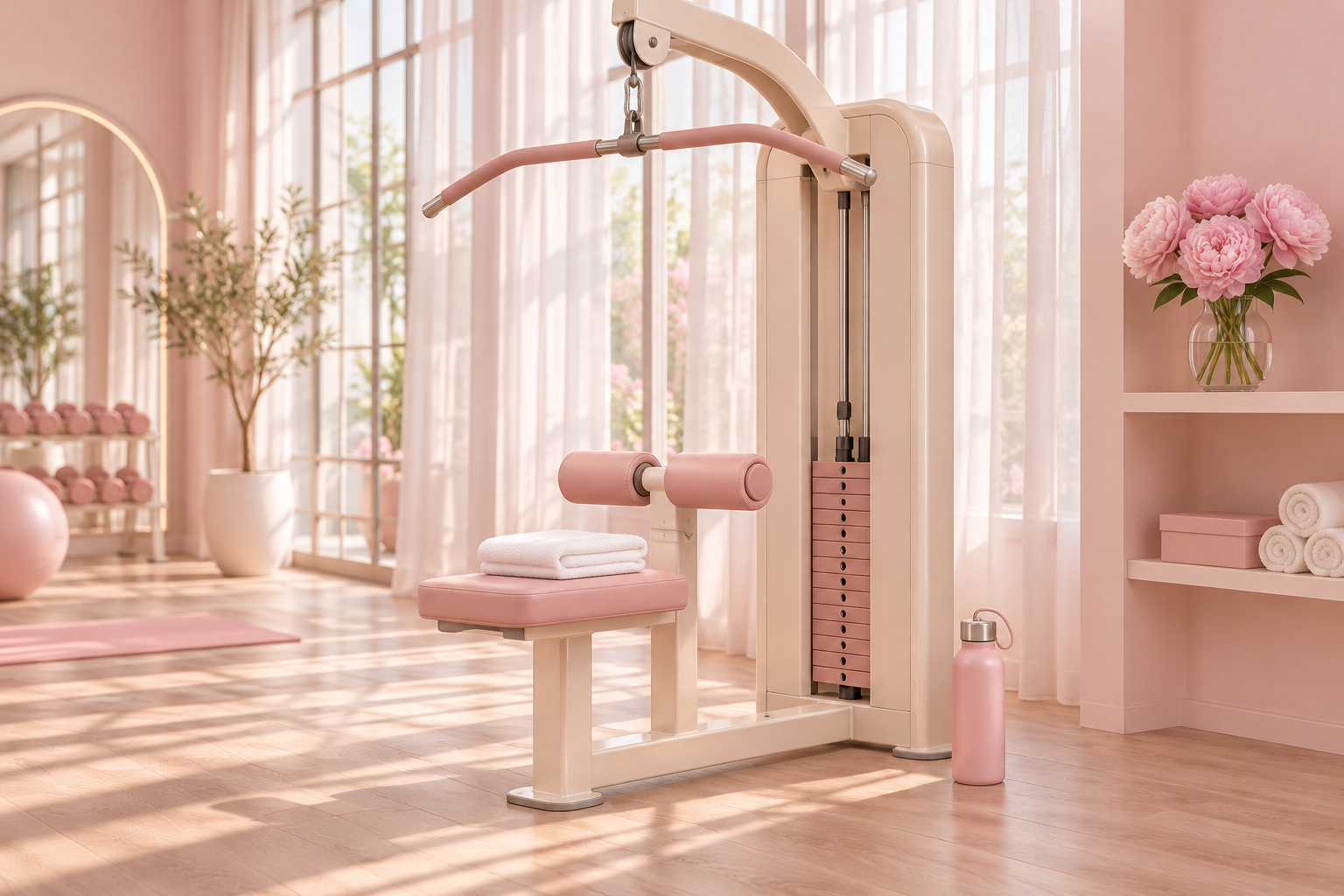
The lat pulldown machine is one of the first machines many women try in the gym, and one of the most misunderstood. It’s easy to sit down, grab the bar and yank it toward your chest with your arms, leaning way back and feeling it mostly in your biceps. With a few small changes, the same machine becomes one of the best back builders in the gym.
Your back muscles are hard to train well because you can’t see them working. You can watch your arms bend in the mirror, but your lats are behind you. That’s why setup and a few simple cues matter so much with this exercise. Once you learn to start the movement with your shoulder blades and drive your elbows down, you’ll feel the difference immediately.
This guide walks you through how to set up the machine, which grip to use, how to feel the right muscles and the most common mistakes, plus what to do if you train at home without a machine.
A quick note: This guide is general fitness information from coaches, not medical advice. If you have shoulder, elbow, neck or back pain, or are pregnant or newly postpartum, check in with your healthcare provider or a physical therapist before adding new strength work.
The short answer
- ⬇️What it isA seated vertical pull
Pull a bar from overhead down toward your upper chest.
- 🎯MusclesLats and upper back
Plus the backs of your shoulders, biceps and forearms.
- ✋Best gripPalms facing away
Research favors an overhand grip; width matters less than you’d think.
- ⚠️Top mistakeLeaning way back
A slight lean is fine. A big swing turns it into a row with momentum.
Watch it first
This tutorial comes from Erin Stern, a two-time Ms. Figure Olympia champion and fitness coach who has won 14 professional titles and written several training and nutrition books. In this video, she shares simple tips and cues for the lat pulldown, along with common mistakes to avoid. She also makes a great point: since we can’t see our backs as we train, we have to pay extra attention to form and to feeling the right muscles work.
Watch it once before your next workout, then again afterward. The cues often make much more sense once you’ve felt the movement for yourself.
Why train your back
- Everyday pulling. Your back powers pulling open heavy doors, lifting bags out of the car and pulling yourself up and out of a pool.
- Upper body balance. Most of us do a lot of pushing and reaching forward. Pulling exercises like pulldowns and rows strengthen the other side.
- Healthy shoulders. Strong lats and upper back muscles help support and control your shoulders.
- Working toward a pull-up. The lat pulldown trains the same pattern as a pull-up, and is a great way to build up to one.
- Posture support. Strong upper back muscles make it easier to sit and stand tall comfortably.
- Help with other lifts. Strong lats help keep the weight close in lifts like deadlifts and keep your shoulders steady when you press.
Chest up, shoulders down, elbows to your back pockets. Let your back do the pulling.
Muscles worked
| Muscle | Where it is | What it does in the pulldown |
|---|---|---|
| Latissimus dorsi (lats) | The large, wide muscles on the sides of your back | The main mover, pulling your upper arms down to your sides |
| Teres major | Near the outer edge of your shoulder blade | Helps the lats pull your arms down |
| Lower and middle trapezius | The middle of your upper back | Pull your shoulder blades down and together |
| Rhomboids | Between your shoulder blades | Help pull your shoulder blades together |
| Rear deltoids | The backs of your shoulders | Assist the pull, especially with a wide grip |
| Biceps and forearms | The fronts of your upper arms and your forearms | Bend your elbows and hold on to the bar |
| Core | Your trunk | Keeps your torso steady |
Setting up the machine
A good setup takes 30 seconds and makes the whole exercise feel better.
- Adjust the thigh pad. Sit down and set the knee pad so it presses snugly on top of your thighs. This keeps you from lifting off the seat as you pull.
- Set your feet. Place your feet flat on the floor.
- Choose your weight. Start lighter than you think, especially while learning.
- Grab the bar. Stand up, take hold of the bar with your chosen grip and sit back down, letting the bar pull your arms straight overhead. With a wide bar, hands just outside shoulder-width is a common starting point.
- Set your posture. Sit tall with your chest up. Lean back very slightly, about 10 to 20 degrees, so the bar can travel down in front of your face to your chest.
How to do a lat pulldown, step by step
- Start with a stretch. Let your arms reach fully overhead and feel a gentle stretch along the sides of your back.
- Set your shoulder blades. Before your elbows bend, pull your shoulder blades down and slightly back, away from your ears. The bar will move down a couple of inches.
- Pull with your elbows. Breathe out as you drive your elbows down and back toward your back pockets, bringing the bar down in front of your face.
- Finish at your upper chest. Bring the bar to about your collarbone or upper chest, keeping your chest lifted to meet it.
- Squeeze. Hold for a moment and feel the muscles along your sides and between your shoulder blades working.
- Return slowly. Breathe in as you let the bar rise back up over two to three seconds, until your arms are straight and you feel that stretch again.
- Stay seated. Keep your thighs under the pad and your torso steady for every rep.
The slow return is just as important as the pull. Many people let the weight stack crash back up, which misses half the work.
Feeling your back, not your arms
The most common complaint about lat pulldowns is “I only feel it in my arms.” Here are cues that help:
- Hands are hooks. Think of your hands as hooks holding the bar. Your arms just connect the bar to your back.
- Elbows lead. Focus on pulling your elbows down to your sides, not pulling the bar with your hands.
- Elbows to back pockets. Imagine putting your elbows into your back jeans pockets.
- Start with the shoulder blades. Pull your shoulder blades down first, then bend your elbows.
- Thumbless grip. Some people feel their back more with their thumb on the same side as their fingers. Try it with lighter weight.
- Slow down. A slower pull and a slower return make it easier to feel what’s working.
- Go lighter. When the weight is too heavy, your arms and momentum take over.
Erin highlights mind-muscle connection in her video, and research on other exercises suggests focusing your attention on the muscle you’re trying to work can help you feel it more. It’s worth trying here.
Your quick form checklist
- ThighsSnug under the pad.
- FeetFlat on the floor.
- TorsoTall with a slight backward lean, about 10 to 20 degrees.
- ChestLifted to meet the bar.
- ShouldersDown and away from your ears.
- ElbowsDriving down and slightly back, not flaring way behind you.
- Bar pathIn front of your face to your upper chest.
- NeckLong and relaxed, eyes forward or slightly up.
- TempoSmooth pull, two to three seconds back up.
Which grip should you use?
You’ll see many grips on the lat pulldown: wide, narrow, palms away, palms facing you and palms facing each other. Here’s what the research says.
Palms facing away tends to work the lats best
A 2010 study by Lusk and colleagues at Penn State Berks compared four lat pulldown grips: wide and narrow, each with palms facing away (pronated) and palms facing you (supinated). A pronated grip, with palms facing away, produced more lat muscle activity than a supinated grip. Grip width didn’t make a significant difference. The researchers recommended pulling to the front with a pronated grip, whatever the width.
Width matters less than you think
That’s good news. You don’t need an extremely wide grip to work your lats. A grip just outside shoulder-width is a comfortable, effective starting point for most people. Very wide grips can feel awkward on the shoulders and shorten your range of motion.
Other grips still have a place
| Grip | How it feels | Good for |
|---|---|---|
| Overhand, shoulder-width or a little wider | The classic pulldown | Your main lat exercise |
| Wide overhand | More upper back and rear shoulders | Variety, if comfortable for your shoulders |
| Neutral (palms facing each other) | Often the most shoulder-friendly | Sensitive shoulders, using a V-handle or parallel bar |
| Underhand (palms facing you) | More biceps involvement, often feels strong | Variety and building toward chin-ups |
The best grip is one you can use comfortably with good form. Many people use an overhand grip as their main pulldown and rotate in a neutral or underhand grip for variety.
Pull in front, not behind your neck
You might see people pulling the bar down behind their head. NASM recommends avoiding the behind-the-neck pulldown. Pulling in front of your neck works the lats just as well or better, and keeps your head, neck and shoulders in a better position. Pulling behind the neck requires pushing your head forward to make room for the bar, which isn’t worth the trade-off.
Stick with pulling the bar down in front of your face to your upper chest.
Common mistakes and how to fix them
1. Leaning way back
A big backward lean turns the pulldown into a rowing motion powered by momentum. The fix: Keep a slight lean, about 10 to 20 degrees, and keep your torso steady.
2. Pulling with your arms
Leading with your hands and biceps leaves your back underworked. The fix: Lead with your elbows and start each rep by setting your shoulder blades down.
3. Shrugging
Letting your shoulders creep up to your ears shifts work to your neck. The fix: Keep your shoulders down throughout, especially at the bottom of each rep.
4. Elbows flaring way back
Pulling your elbows far behind your body, especially as you tire, can stress the fronts of your shoulders. The fix: Keep your elbows coming down toward your sides, roughly in line with your body or slightly in front.
5. Pulling the bar too low
Dragging the bar down to your belly often rounds your shoulders forward. The fix: Stop at your upper chest or collarbone.
6. Letting the weight crash up
Releasing the bar quickly misses the lowering half of the exercise. The fix: Take two to three seconds to let the bar rise.
7. Using momentum
Rocking your body to start each rep means the weight is too heavy. The fix: Lighten the load and keep your torso still.
8. Craning your neck
Pushing your head forward to get out of the way of the bar strains your neck. The fix: Lean back slightly so the bar clears your face naturally, and keep your neck long.
Lat pulldowns and pull-ups
The lat pulldown trains the same pulling pattern as a pull-up, but you can choose a weight lighter than your bodyweight. That makes it a perfect stepping stone if you’d like to work toward your first pull-up.
Here’s an example of a path many women use:
- Build your pulldown. Work up to pulling a good portion of your bodyweight for 8 to 10 reps.
- Practice hangs. Hang from a pull-up bar with your shoulders pulled down, building up to 20 to 30 seconds.
- Try assisted pull-ups. Use an assisted pull-up machine or a strong resistance band looped around the bar.
- Add slow lowering. Jump or step up to the top of a pull-up and lower yourself as slowly as you can.
- Go for one. Test your first full pull-up every couple of weeks.
No pressure, though. You don’t need to do pull-ups to have a strong, healthy back. Pulldowns and rows are plenty.
At-home alternatives
No lat pulldown machine? You can still train the same muscles at home:
- Band pulldown. Anchor a resistance band high on a sturdy door or beam. Kneel or sit and pull it down to your chest, just like the machine.
- Kneeling single-arm band pulldown. The same idea, one arm at a time, to feel each side.
- Dumbbell pullover. Lying on a bench, lower a single dumbbell behind your head with straight-ish arms, then pull it back over your chest. Use a light weight.
- Rows. While rows pull horizontally instead of vertically, they train many of the same muscles. Our guide to the dumbbell bent-over row is a great place to start.
- Doorway pull-up bar. For assisted pull-ups and hangs.
Stop if you feel sharp or pinching pain in your shoulder, elbow or neck, pain that travels down your arm, numbness or tingling in your hands, or pain that lingers or gets worse after training. Check in with your healthcare provider or a physical therapist before continuing. Muscle fatigue and soreness the next day are normal; sharp or worsening pain is not.
How to choose your weight
- Start light. Choose a weight you can pull smoothly for 12 reps without leaning back or shrugging.
- Do a test set of 10. Pull smoothly and return slowly.
- Check your form. If you’re swinging, shrugging or only feeling your arms, go lighter.
- Aim for “two or three left.” A good working weight leaves two or three good reps in the tank.
- Progress slowly. Add reps first, then move the pin down one plate when the top of your range feels easy.
Machines vary a lot between gyms, so don’t compare numbers from one machine to another. Pay attention to how the weight feels instead.
How to add lat pulldowns to your week
The American College of Sports Medicine’s 2026 guidelines recommend training all your major muscle groups at least twice a week, and emphasize that the biggest benefit comes from simply doing some strength training at all. Here’s an example of how pulldowns could fit in. Treat it as a sample, not a prescription:
- BeginnerTwo full body days. Lat pulldowns: 2 sets of 10 to 12.
- BuildingTwo or three full body days. Lat pulldowns on one day, rows on another: 3 sets of 8 to 12.
- StrongerTwo upper body days. Pulldowns for 3 sets of 8 to 10 and rows for 3 sets of 10, with a different grip each day.
A balanced upper body session might look like this example:
- Lat pulldown: 3 sets of 10
- Dumbbell chest press: 3 sets of 10
- Dumbbell bent-over row: 2 to 3 sets of 10
- Dumbbell shoulder press: 2 to 3 sets of 10
- Farmer carry: 3 walks of about 30 seconds
Our guides to the dumbbell chest press, dumbbell bent-over row and dumbbell shoulder press round out this session. Pairing a pull with every push keeps your shoulders balanced.
Pregnancy and postpartum
The American College of Obstetricians and Gynecologists encourages women with uncomplicated pregnancies to do both aerobic and strength-conditioning exercise before, during and after pregnancy, with their provider’s guidance. The lat pulldown is a seated, supported exercise, which many women find comfortable during pregnancy.
- Get the green light first. Talk with your provider before starting or continuing strength training during pregnancy or after birth.
- Adjust the thigh pad. As your belly grows, make sure the pad sits comfortably on your thighs, not pressing on your bump.
- Breathe. Exhale as you pull and avoid holding your breath.
- Upper back strength helps. Feeding and holding a baby pulls your shoulders forward, so pulling exercises can feel especially good after birth.
- Postpartum, watch your belly. If you notice doming along the middle of your belly, leaking or pelvic heaviness, lighten the load and check in with a pelvic floor physical therapist.
Our guide to postpartum exercise and where to start has more gentle first steps.
What you need
At the gym, the machine is all you need. At home, here are some options to compare. These are general Amazon searches, not specific product picks. We don’t earn anything from these links.
- Resistance bands with a door anchor for band pulldowns. Search resistance bands with door anchors
- A doorway pull-up bar for hangs and assisted pull-ups. Search doorway pull-up bars
- Pull-up assistance bands to build toward a pull-up. Search pull-up assistance bands
- Lifting grips or gloves if your hands get sore. Search lifting grips
Myths
- Myth #1What you’ve heard
“The wider the grip, the better for your lats.”
The truthResearch found grip width didn’t change lat activity much. Choose a comfortable width.
- Myth #2What you’ve heard
“Pulling behind your neck works your back better.”
The truthPulling in front works the lats as well or better, with better neck and shoulder position.
- Myth #3What you’ve heard
“If I feel it in my arms, I need more weight.”
The truthUsually you need less weight and better cues, like leading with your elbows.
- Myth #4What you’ve heard
“Lean back to pull more weight.”
The truthA slight lean is fine. A big swing just adds momentum and takes work off your back.
- Myth #5What you’ve heard
“You need to do pull-ups to have a strong back.”
The truthPulldowns and rows build a strong back on their own.
The bottom line
The lat pulldown is a fantastic way to build a strong back once you learn to pull with your back instead of your arms. Set the thigh pad snugly, take an overhand grip just outside shoulder-width, lean back slightly and pull your shoulder blades down before driving your elbows toward your back pockets.
Bring the bar to your upper chest, squeeze and let it rise slowly. Choose a weight you can control, pair your pulldowns with pushing exercises and enjoy feeling stronger every time you pull open a heavy door.
Sources
- Erin Stern: How To Do A Lat Pulldown CORRECTLY (video, 2020)
- Erin Stern: About
- Wikipedia: Erin Stern
- Lusk, Hale and Russell, Journal of Strength and Conditioning Research (2010): Grip width and forearm orientation in the lat pulldown
- Mike Reinold: The lat pulldown and how to maximize latissimus activity
- NASM: Biomechanics of the lat pulldown
- Buonsenso and colleagues: Back muscle activation in lat pulldown grip variations
- Lyfta: Pull-up vs lat pulldown research summary
- American College of Sports Medicine: 2026 resistance training guidelines
- McMaster University via Medical Xpress: Train all major muscle groups at least twice a week
- ACOG Committee Opinion 804: Physical activity and exercise during pregnancy and the postpartum period
This article is for general information and isn’t medical advice. If you have pain, an injury, a health condition, or are pregnant or postpartum, talk with your healthcare provider or a physical therapist before starting a new exercise.
- Strength training
- Back
- Lats
- Gym machines
- Upper body
Find your strength. Find your girls.
Want someone to check your form and build a plan around your life? Tell us a little about where you are, and we’ll reply within two business days with coaching, circles and walk clubs near you.
Questions
Good questions.
What muscles does the lat pulldown work?
It mainly works your latissimus dorsi (lats), the large muscles on the sides of your back, plus your middle and lower traps, rhomboids, rear shoulders, biceps and forearms.
What is the best grip for lat pulldowns?
Research found an overhand grip (palms facing away) produced more lat activity than an underhand grip, while grip width didn’t matter much. A grip just outside shoulder-width is a great starting point.
Why do I feel lat pulldowns in my arms instead of my back?
Usually the weight is too heavy or you’re leading with your hands. Lighten the load, pull your shoulder blades down first and focus on driving your elbows toward your back pockets.
Should I lean back during a lat pulldown?
A slight lean of about 10 to 20 degrees is fine and helps the bar clear your face. Avoid leaning way back or swinging, which adds momentum and takes work off your back.
Is it okay to do lat pulldowns behind the neck?
It’s best to avoid them. Pulling in front of your neck works your lats just as well or better and keeps your head, neck and shoulders in a better position.
Can lat pulldowns help me do a pull-up?
Yes. They train the same pulling pattern with adjustable weight. Combine them with hangs, assisted pull-ups and slow lowering pull-ups to build toward your first one.
 Fitness
 Fitness