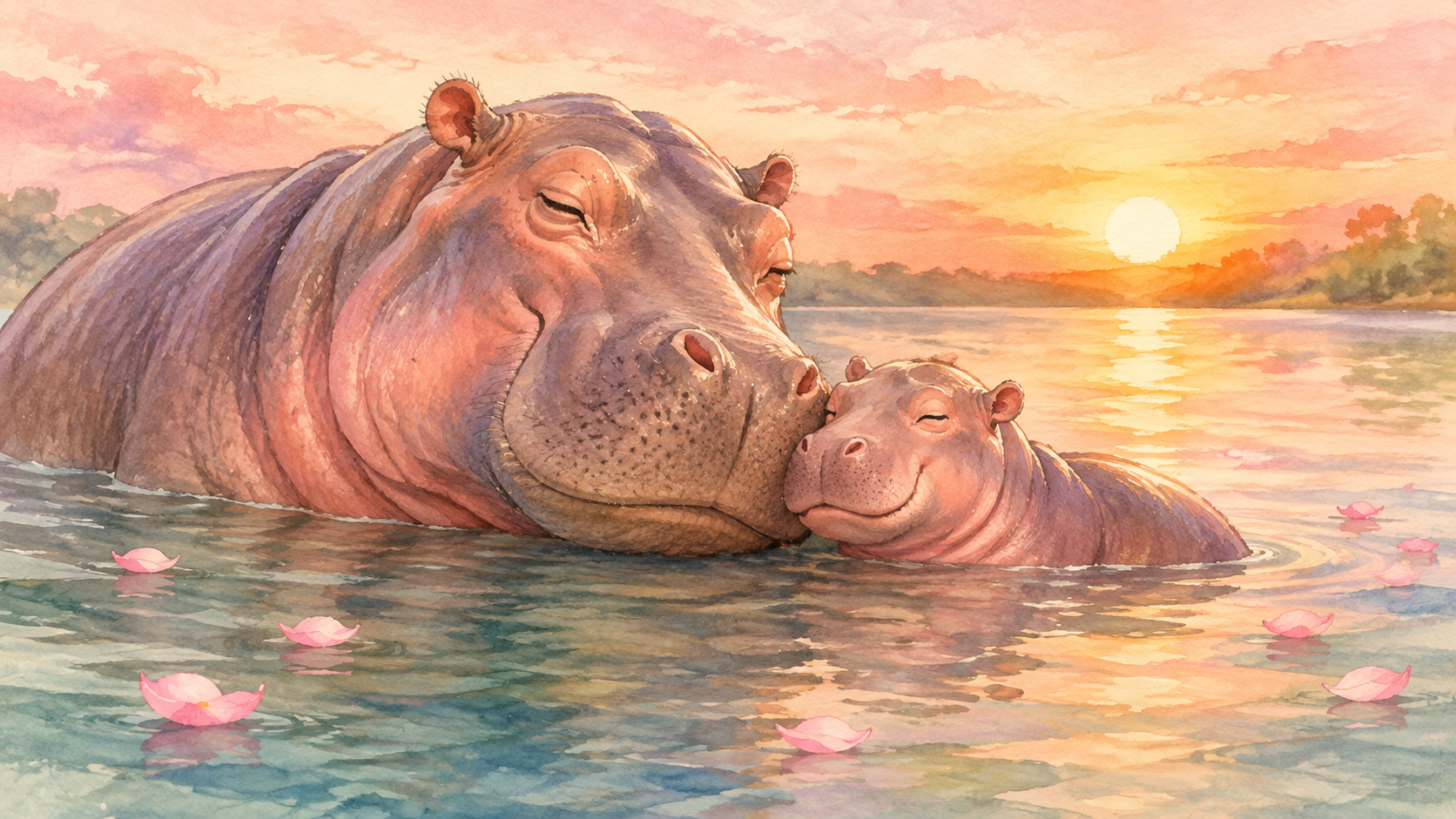
If you cried about a hippo this week, you’re not silly. Maybe it hit you in the car, or in the middle of scrolling during a night feed, or when your kid asked if Fiona was okay. Maybe you never set foot in Cincinnati and still felt it in your chest. You’re far from alone.
On November 19, 2026, the Cincinnati Zoo announced that Fiona the hippo had died after swallowing a hat that accidentally got into her habitat. She was 9 years old and would have turned 10 in January. Within minutes, the tributes poured in from around the world.
This post isn’t a news story. It’s for the feeling: the strange, real grief of losing someone you loved from a distance, the ache for her mama, Bibi, and the psychology of why it hurts so much. And it’s permission to feel all of it.
Who Fiona was to us
Fiona was born on January 24, 2017, six weeks premature. She weighed 29 pounds, which the zoo said was 25 pounds lighter than the lowest birth weight ever recorded for her species. She couldn’t stand or nurse on her own.
Her care team worked around the clock. They bottle-fed her milk from her mother, Bibi, along with supplements, and clinicians from Cincinnati Children’s Hospital helped early on. The zoo shared photos and videos of every milestone: her first steps, her first swim, each pound she gained. People around the world followed along and cheered her on. #TeamFiona was born.
And she made it. She grew into a 2,000-plus-pound hippo with a big personality, famous birthday fruit cakes and a fan base that included preschoolers, grandmothers and professional sports teams. Cincinnati’s mayor called her a symbol of perseverance and joy. The zoo’s board chair, Thane Maynard, said he had never known an animal so beloved in all his life.
For a lot of us, especially NICU moms, preemie families and anyone going through something hard, Fiona was more than cute. She was proof that tiny, fragile beginnings can still turn into something strong.
A life cut short
Part of what makes this so painful is that it wasn’t old age or a long illness. It was sudden, accidental and felt so preventable. After she swallowed the hat, her keepers and veterinarians cared for her around the clock. Surgery wasn’t an option because of her size, so they tried everything else they could. They even offered her a sniff of coffee, a scent she loved.
“We did not expect this outcome,” zoo director Dave Jenike said. “She fought until she couldn’t anymore.”
That’s the cruel twist that so many people are struggling with. The hippo who beat the odds as a baby didn’t get to beat them this time. Losses that feel unfair or “too soon” often bring more than sadness. You might feel angry, stuck replaying what happened or unable to make it make sense.
It’s natural to feel anger. But try not to pour it onto anyone. This was an accident that people will be heartbroken about for a long time, and the zoo has asked the public to give Fiona’s keepers and veterinary team space as they grieve. The people who cared for her every single day are hurting most of all.
Grieving for Bibi
For so many moms, the thought that lands hardest is Bibi.
Bibi and Fiona were famously close. When they were reunited after Fiona’s early care, Bibi was so protective and attentive that the keepers nicknamed the mother-daughter pair “BiFi.” For years, fans watched them swim, nap and float side by side in Hippo Cove. Later, Fiona became a big sister when Bibi had a baby boy, Fritz, in 2022. Fiona is survived by Bibi, Fritz and the millions of people who watched her grow up.
We don’t know exactly what Bibi understands or feels, and we shouldn’t pretend to. Researchers are still learning how animals experience loss. But we do know that hippos are social animals, and that Bibi and Fiona shared nearly a decade together.
And we know what happens in our hearts when we picture her. If you’re a mom, it’s almost impossible not to imagine your own child. That’s empathy, and it’s one of the most human things about us. Sometimes grieving for Bibi is also a quiet way of facing our deepest fear as mothers. Let yourself feel that, and then go hug your babies a little longer.
If you’ve lost a baby or a child, or spent time in the NICU, this news may hit very differently. Please be gentle with yourself, step away from the coverage if you need to and reach out to someone you trust.
Why it hurts: the psychology
“Why am I this sad about an animal I never met?” It’s one of the most common things people are asking right now. Psychology has some answers:
- 📱One-sided, still realParasocial bonds
A parasocial relationship is the connection we form with someone we follow but who doesn’t know us: a celebrity, a TV character or a hippo on your feed. Your brain doesn’t file Fiona under “stranger.” It files her under “someone I watched grow up.”
- 📈The researchCloseness, not contact, drives grief
In one experiment, researchers found that how close people felt to someone predicted how intensely they expected to grieve, whether that person was a celebrity or someone they knew in real life. Feeling close counts, even through a screen.
- 🔇Grief without permissionDisenfranchised grief
Grief researcher Kenneth Doka coined this term for losses that aren’t openly acknowledged or socially recognized. Pet loss, celebrity loss and animal loss often land here. You can even do it to yourself: “I shouldn’t be this upset over a hippo.”
- 🌟Symbolic lossWhat she stood for
Fiona wasn’t just a hippo. She was the preemie who made it, a daily dose of joy and proof that tiny, fragile things can grow strong. When a symbol of hope dies, it can feel like losing a little of that hope.
- 📚Old losses wake upStacked grief
A public loss can stir up private ones: a NICU stay, a pregnancy loss, a pet, a parent, a season of life. Research on celebrity deaths suggests existing vulnerabilities like loneliness can make these losses hit harder.
- 😤Sudden lossThe “it shouldn’t have happened” factor
Losses that are sudden, accidental or feel preventable are often harder to make peace with. They tend to bring anger, replaying and “what if” along with sadness.
- 👥Grieving togetherCollective grief
When a whole community mourns at once, the feeling gets amplified. The tributes, the memorial flowers and the comments remind us we’re not alone, and also keep the loss in front of us all day.
- 🫂The mama lensEmpathy for Bibi
If you’re a mom, you may picture Bibi and instantly imagine your own child. That’s empathy doing its job. It’s also why this one may land in your chest instead of just your head.
Put all of that together and of course it hurts. You watched her grow up. She stood for hope. Her loss was sudden and felt unfair. And you’re grieving alongside millions of other people who loved her too.
What you might be feeling
Grief rarely shows up as just one emotion. You might notice:
- Sadness that comes in waves, sometimes when you least expect it.
- Anger about how it happened or that it happened at all.
- Embarrassment about being this upset over a hippo.
- Heaviness for Bibi, Fritz and her keepers.
- Unexpected tears over older losses that this stirred up.
- Fear, especially as a parent, about how fragile life is.
- Gratitude for the joy she brought, mixed right in with the sadness.
- Numbness, or nothing much at all. That’s okay too.
There’s no right way to grieve Fiona. Some people want to talk about her constantly. Others need to stop looking at the news. Both are healthy. And it’s okay if your feelings change from day to day. Grief tends to move in waves rather than a straight line. You might feel fine for a whole morning, then see a hippo on a cereal box or a kid’s pajamas and feel it all over again. That’s not going backward. That’s just how grief works.
Myths about this kind of grief
- Myth #1What you might tell yourself
“It’s just an animal.”
What’s actually trueFor many people, Fiona was a source of joy, comfort and hope for almost a decade. Grief follows love and attachment, not species.
- Myth #2What you might tell yourself
“I didn’t know her, so it isn’t real grief.”
What’s actually trueResearch suggests that feeling close to someone predicts how intensely we grieve, whether we’ve met them or not. Your feelings are real.
- Myth #3What you might tell yourself
“Other people have real problems.”
What’s actually trueGrief isn’t a competition. You can care about big world problems and still feel sad about Fiona. Both can be true.
- Myth #4What you might tell yourself
“I should be over it by now.”
What’s actually trueThere’s no schedule for grief. Some people feel it for a day and some for weeks, especially if it stirred up older losses.
- Myth #5What you might tell yourself
“Being this sad means something is wrong with me.”
What’s actually trueFeeling sad about a loss is a sign of a caring heart. If it’s getting in the way of daily life or stirring up something heavier, that’s a reason to talk to someone, not a reason for shame.
Ways to honor the feeling
Grief usually softens when we give it somewhere to go. Some ideas:
- 😭Feel itLet yourself cry
You don’t need to justify it. Tears are how the body processes loss.
- 💬RememberShare a favorite memory
Her first swim, a birthday cake, a video you watched a hundred times. Talking about what we loved keeps it alive.
- 💐HonorLeave a tribute
Fans have been leaving flowers and cards by the Fiona statue outside the zoo entrance. If you’re not nearby, a drawing, a note or a candle at home counts too.
- 🌍Give backSupport hippos and wildlife
Look into reputable wildlife and hippo conservation organizations, or check the Cincinnati Zoo’s official channels for ways to support its work.
- 📵BoundariesProtect your feed
It’s okay to mute the news, skip the comment sections or step away from social media for a few days.
- 🤗ConnectHold your people close
Hug your kids, call your mom or text a friend who loved Fiona too. Shared grief is lighter grief.
- 🌱Pass it onDo something kind
Fiona’s story was about people showing up for someone small and struggling. Bring a meal to a new mom or send a care package to a NICU family.
- 📝ProcessWrite it down
A few sentences about what Fiona meant to you can help you understand why this hit so hard.
Grieving online (and the comment sections)
Most of us knew Fiona through our phones, so it makes sense that we’re grieving her there too. Online grief can be beautiful: shared photos, memories from people who visited her, tributes from sports teams, hospitals and neighboring zoos. It reminds us how many people she touched.
But online spaces can also get rough. Researchers have even studied “grief policing,” when people criticize others for how they mourn a public figure on social media. You’ll probably see some of it: people mocking the sadness, arguing about blame or posting cruel jokes.
- You don’t have to engage. Scroll past, mute or block. Your grief doesn’t need defending.
- Don’t police others either. Some people grieve with humor, some with anger and some with silence.
- Notice how you feel after scrolling. If you feel worse every time, take a break.
- Find kinder corners, like a group chat with friends who loved her too or a fan community focused on happy memories.
If someone you love is grieving Fiona
Maybe your mom, your best friend or your kid is taking this hard, and you’re not sure what to say. You don’t need perfect words. Try:
- “I know how much you loved her. I’m sorry.”
- “What was your favorite Fiona moment?”
- “It makes sense that you’re sad. She was a big part of a lot of people’s lives.”
- “Want to watch some of her old videos together?”
What to skip: “It’s just a hippo,” “You didn’t even know her” or “People are dying every day.” Even if you don’t feel it yourself, you can respect that someone else does. A little kindness about a “small” grief tells people they can come to you with the big ones too.
Talking to kids about Fiona
For many children, Fiona’s death may be their first experience of losing an animal they loved, even one they never met. A few tips:
- Use simple, honest words. “Fiona got very sick and she died. That means her body stopped working and she won’t come back.” Avoid phrases like “went to sleep,” which can confuse or scare young kids.
- Keep the details light. Young kids don’t need the specifics. If they ask how, you can say, “She swallowed something that made her very sick, and the doctors couldn’t fix it.”
- Let them feel what they feel. Sad, mad, confused or totally fine one minute and asking for a snack the next. All normal.
- Share your feelings too. “I feel sad about Fiona too.” Seeing you grieve in a healthy way teaches them that sadness is safe.
- Answer the questions they ask, even the repeated ones. Kids often process by asking the same thing many times.
- Give them something to do. Draw a picture of Fiona, look at happy photos of her, or read a picture book about hippos.
- Reassure them about safety. If they worry about their own pets or family, remind them that most of the time, people and animals get better when they’re sick.
- Use it as a gentle lesson for older kids about respecting animal habitats and keeping belongings secure at the zoo, without making it about blame.
Taking care of yourself this week
Grief lives in the body as well as the heart. Even a loss like this one can make you tired, foggy or tense. A few gentle basics:
- Get outside. A short walk, especially somewhere green, can help settle a heavy mind.
- Move a little. Stretching, a walk with the stroller or dancing in the kitchen with your kids all count.
- Protect your sleep. Put the phone down before bed instead of reading one more article about Fiona.
- Eat something real and drink some water. Grief can make us forget the basics.
- Laugh when you can. Watching her silliest videos isn’t disrespectful. Joy was her whole thing.
When it touches something deeper
For most people, the sadness about Fiona will soften with time. But public losses can open the door to private pain. Consider reaching out for support if:
- It’s bringing up a past loss, especially a pregnancy loss, infant loss or NICU experience, that you haven’t had space to grieve.
- The sadness isn’t lifting after a couple of weeks, or it’s getting heavier.
- You’re having trouble sleeping, eating or getting through your day.
- You’re feeling hopeless or numb in a way that feels bigger than this one loss.
If you’re pregnant or a new mom, call or text the National Maternal Mental Health Hotline at 1-833-TLC-MAMA (1-833-852-6262), free and 24/7. If you’re in crisis or having thoughts of harming yourself, call or text 988, any time. A therapist or grief counselor can also help you work through older losses this has stirred up.
For everyone who loved her
You don’t need to have met Fiona to miss her. You watched her fight, grow and float alongside her mama. That’s love, and grief is just love with nowhere to go. Let it go somewhere gentle.
What Fiona left behind
Fiona’s story connected a zoo, a children’s hospital and millions of strangers who had never cheered for a hippo before. Doctors and nurses who care for tiny human babies stepped in to help a tiny hippo. Families with preemies in the NICU saw her gain weight and felt a little more hopeful about their own babies. Kids learned about hippos, conservation and what it means to root for someone. That doesn’t disappear because she’s gone.
Fiona taught a whole lot of people that being small and fragile at the start doesn’t decide how the story goes. That people showing up for each other, day and night, can change everything. That joy is worth sharing.
Maybe the best way to honor her is to keep doing exactly that: show up for the small and struggling, share the joy and let yourself be soft about the things you love. Rest easy, sweet girl. You were so loved. And all our love to Bibi, Fritz and everyone who cared for her.
If you’re looking for a place to talk about what you’re carrying, big or small, our circles are here. And if you’re walking through a bigger loss, our life after loss circle is a gentle place to start.
Sources
- Axios Cincinnati: Fiona the hippo dies after medical emergency at Cincinnati Zoo
- FOX19 WXIX: Fiona, Cincinnati’s miracle hippo, dies at 9
- Associated Press via OPB: Cincinnati Zoo says Fiona the hippo has died, days after ingesting a visitor’s hat
- CNN via KEYT: Globally adored hippo Fiona dies at Cincinnati Zoo
- FOX Weather: Beloved Cincinnati Zoo hippo Fiona dies after swallowing a hat in her enclosure
- WKRC via ABC News 4: Cincinnati Zoo announces Fiona’s death
- Ohio Cooperative Living: Worth their weight: Henry, Bibi and Fiona
- Associated Press via KTAR: Fiona’s death gives parents a chance to teach kids about grief
- Psychology Today: Parasocial losses: why it hurts when a celebrity dies
- MEDLINE record: Relational closeness, not parasociality, determines the intensity of grief responses to celebrity death
- Death Studies (reference list): Gach et al. (2017): grief policing on Facebook in response to celebrity death
- PubMed: How we disenfranchise grief for self and other: an empirical study
- Faunalytics: Animal ethical mourning: why animal grief is disenfranchised
- HRSA: National Maternal Mental Health Hotline
- 988 Suicide & Crisis Lifeline: Call or text 988
This article is for general information and isn’t medical advice. Talk with your doctor or midwife about what’s right for you.
- Grief
- Fiona the hippo
- Parasocial grief
- Mental health
- Talking to kids
Your feelings don’t have to make sense to be real.
Tell us where you are and what you’re carrying. We’ll reply within two business days with circles where you can just be honest.
Questions
Good questions.
Why am I so sad about Fiona the hippo?
Many people followed Fiona’s life for nearly a decade, from her premature birth to adulthood. Psychologists call this kind of one-sided connection a parasocial bond, and research suggests that how close we feel to someone, not whether we’ve met them, shapes how intensely we grieve. Fiona also symbolized hope, which can make her loss feel even bigger.
What is parasocial grief?
Parasocial grief is grief for someone you felt connected to but didn’t know personally, like a celebrity, a public figure or a famous animal. It can feel just as real as other grief, because the feelings of closeness were real.
What is disenfranchised grief?
Disenfranchised grief is a term coined by grief researcher Kenneth Doka for losses that aren’t openly acknowledged or socially recognized, such as the loss of a pet or a public figure. People can also disenfranchise their own grief by telling themselves they shouldn’t feel it.
How do I talk to my kids about Fiona dying?
Use simple, honest words like “Fiona got very sick and died,” avoid phrases like “went to sleep,” keep details light for young children, share your own feelings and let them draw, ask questions or look at happy photos of Fiona.
When should I get help for grief?
Reach out to a healthcare provider or therapist if sadness isn’t lifting after a couple of weeks, is affecting sleep, eating or daily life, or is bringing up older losses. If you’re in crisis, call or text 988.
 Community
 New moms
 Community