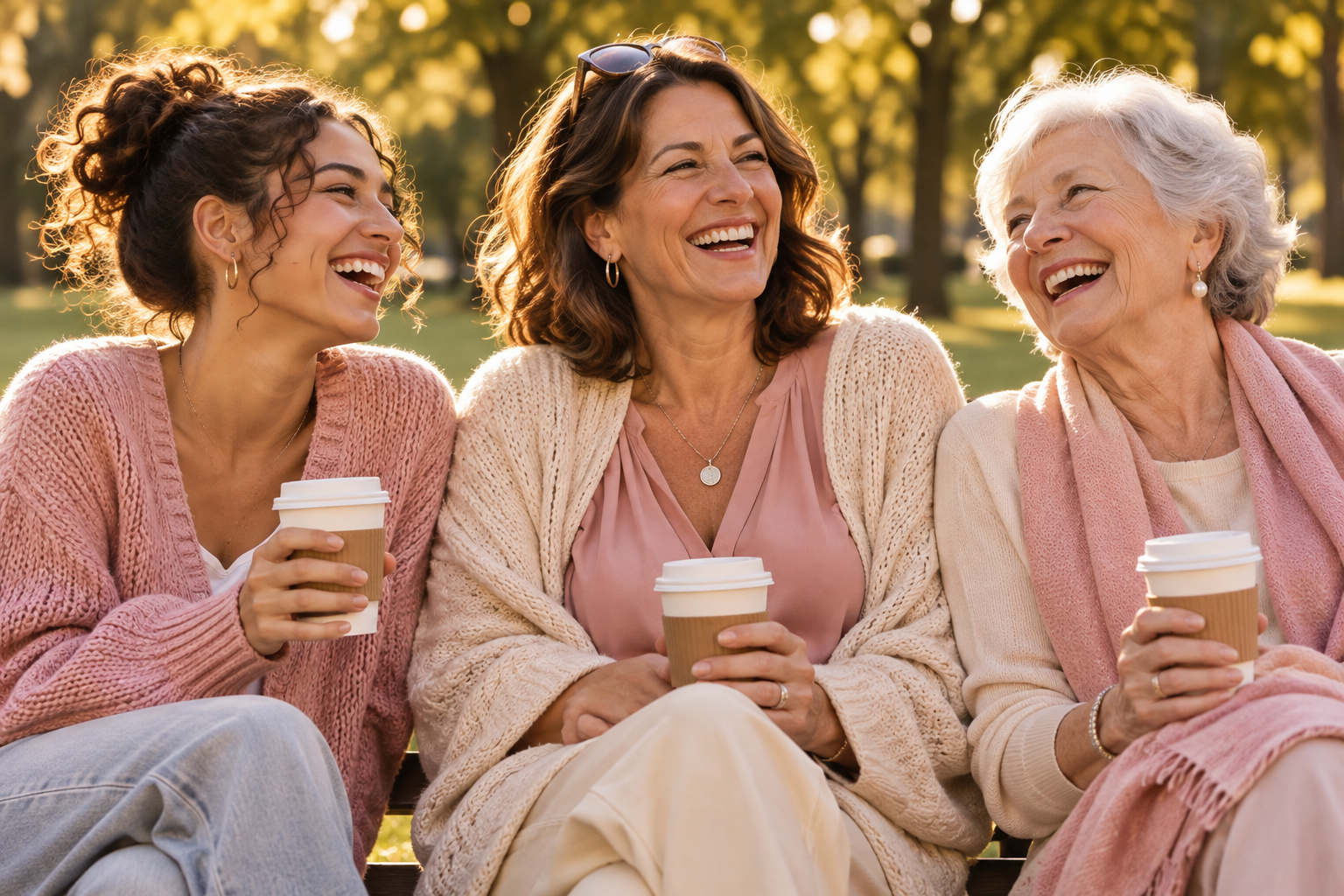
At 25, you’re wondering if you’re behind. At 45, you’re wondering when you last did something just for you. At 75, you’re wondering how to stay connected in a world that sometimes looks past you. Different decades, different struggles, but the same quiet question: how do I feel like myself?
At Pink in Progress, “finding your pink” means finding the version of you that feels strong, connected and like yourself, in whatever season you’re in. This post looks at what that can look like at three very different ages, what research says about each one and the feelings that tie all of us together.
We’re health coaches, not doctors. Screening guidelines and health advice here are general. Talk to your own provider about what’s right for you, especially if you have a family history or health condition. If you’re struggling emotionally, call or text 988 any time.
Same question, different decades
We picked 25, 45 and 75 because they represent three big chapters of a woman’s life: building, carrying and savoring. Of course, no age is a single experience. A 25-year-old might be a new mom, a 45-year-old might be newly single and a 75-year-old might be training for a 5K. Read these as patterns, not rules. Wherever you fall, you’ll probably see a little of yourself in all three, because most of us carry our younger selves with us and get glimpses of our older selves along the way.
What’s striking is how much overlaps. Women of every age tell us they want to feel strong, to have real friends, to feel useful and to stop feeling like they’re falling short. The details change. The heart of it doesn’t.
- Loneliest age groupIn multiple U.S. surveys25
- Of adults in their 40sAre “sandwiched” between generations45
- Of women 75 and olderLive alone75
- Ages that need connectionEvery single oneAll
Three ages at a glance
- 25BuildingThe big question
Who am I, and am I behind?
Health focusMaking friends after school, protecting bone and muscle, building habits that last
What helpsSaying yes to community, lifting weights, a regular checkup
- 45CarryingThe big question
How do I take care of everyone, including me?
Health focusPerimenopause, screenings, stress and sleep, holding on to strength
What helpsAsking for help, strength training, booking the mammogram
- 75SavoringThe big question
How do I stay connected, strong and myself?
Health focusBalance and falls, bone health, staying social, purpose
What helpsBalance and strength work, regular plans with people, saying yes to new things
Finding your pink at 25
Twenty-five can look exciting from the outside: first apartments, careers taking shape, new relationships. From the inside, it can feel uncertain and surprisingly lonely. The structure of school is gone, friends scatter to different cities and social media makes it easy to believe everyone else has it together.
What the research says
Young adults consistently report some of the highest rates of loneliness of any age group. In a 2024 Pew Research Center survey, nearly a quarter of Americans under 30 said they felt lonely or isolated all or most of the time, higher than any older group. A global Meta-Gallup survey found the same pattern, with adults ages 19 to 29 most likely to feel very or fairly lonely. Young women also report high levels of anxiety about the future.
Common struggles
- Making friends as an adult, without the built-in community of school.
- Comparison, especially with peers’ careers, relationships and bodies online.
- Money stress, from student loans, rent and entry-level pay.
- Figuring out who you are, apart from what your parents or school expected.
- Body changes as habits shift after college or after a first baby.
Health focus
Your 20s are a powerful time to invest in your future body. Most people reach peak bone mass around age 30, so weight-bearing exercise and enough calcium and vitamin D now pay off for decades. It’s also a great time to learn how to strength train, find movement you actually enjoy and set up regular checkups, including cervical cancer screening, which usually starts at 21.
What helps
- Say yes to community, even when it’s awkward. Join a run club, a class or a group like ours.
- Learn to lift. Building strength now is one of the best gifts you can give your 45- and 75-year-old self.
- Curate your feed. Unfollow accounts that make you feel behind.
- Remember it’s not a race. There’s no deadline for figuring life out.
Finding your pink at 45
Forty-five is often the most crowded chapter of a woman’s life. Many women are raising kids or teenagers, managing demanding careers, supporting aging parents and noticing their own bodies change, all at once.
What the research says
Pew Research Center found that more than half of Americans in their 40s are part of the “sandwich generation,” with a parent 65 or older plus a minor child or an adult child they’re supporting. Economist David Blanchflower’s research across 132 countries found that wellbeing tends to hit its low point in midlife, around age 47 in developed countries, before rising again.
Common struggles
- The mental load of managing everyone’s schedules, needs and emotions.
- Perimenopause, which can bring sleep changes, mood swings, hot flashes and irregular periods.
- Losing yourself in roles like mom, daughter, partner and employee.
- Friendships that faded during the busy years.
- Body changes, including shifts in weight, muscle and energy.
Health focus
Midlife is when screenings ramp up. The U.S. Preventive Services Task Force now recommends mammograms every other year starting at 40, and colorectal cancer screening starting at 45. It’s also a key time to protect muscle and bone as estrogen begins to drop, and to pay attention to blood pressure, blood sugar and sleep.
Our guide to perimenopause symptoms covers what to expect and when to talk to your doctor.
What helps
- Ask for help at home and at work. You don’t have to carry it all.
- Lift weights, even twice a week, to protect muscle and bone.
- Protect your sleep as much as you can.
- Book the screenings, and put your own appointments on the family calendar.
- Reconnect with friends and with the parts of you that got buried.
If you’re running on empty, our post on what to do when you’re too exhausted to work on yourself was written with you in mind.
Finding your pink at 75
At 75, many women have more time and more wisdom than ever before. They’ve also lived through a lot of loss. Some are newly widowed, some live far from family and some are caring for a spouse. Others are thriving: traveling, volunteering, taking classes and finally doing the things they put off for decades.
What the research says
Women live longer than men on average, and many spend their later years living alone. U.S. Census Bureau data from 2022 shows that 43% of women 75 and older lived alone. The National Academies of Sciences, Engineering, and Medicine found that about a quarter of Americans 65 and older living in the community are socially isolated, which is linked to higher risks of heart disease, depression and dementia.
But it’s not all hard news. Surveys find that loneliness is often lower in older adults than in young adults, and Pew Research Center found that most older women who live alone say they spend more time on their hobbies and interests as they age.
Common struggles
- Loss of a spouse, friends, siblings or independence.
- Staying connected when driving, mobility or hearing becomes harder.
- Feeling invisible in a culture that celebrates youth.
- Health changes, including balance, bone density and chronic conditions.
- Finding purpose after retirement or when children are grown.
Health focus
Balance, strength and bone health become top priorities. The USPSTF recommends osteoporosis screening for women 65 and older. Falls are a major concern, and strength and balance training can help reduce risk. Hearing and vision checks matter too, since they affect how connected you feel. After 74, the USPSTF says there isn’t enough evidence to recommend for or against routine mammograms, so it’s a conversation to have with your doctor.
What helps
- Move every day, with a focus on balance and strength. Tai chi, walking and light weights are great options.
- Keep a social calendar. Regular coffee dates, classes, faith groups or volunteering protect your health.
- Get your hearing checked. It’s easier to stay connected when you can follow the conversation.
- Say yes to new things. It’s never too late to learn, travel or make a new friend.
If you’ve lost a spouse, our widow support circle is a gentle place to connect with women who understand.
The happiness curve
One of the most hopeful findings for women in the middle of life is the so-called “happiness curve.” Economist David Blanchflower analyzed data from 132 countries and found that, on average, wellbeing follows a U-shape across life. It tends to dip in midlife and then rise again into our 60s and 70s.
Not everyone follows the curve, and researchers still debate exactly why it happens. But if you’re 45 and struggling, it’s comforting to know that many people find life gets lighter on the other side. And if you’re 75, you might already know that firsthand.
The feelings we share
When we talk with women of different ages, the same feelings come up again and again. Here are a few that seem to cross every generation:
Am I doing this right?
At 25 it’s about careers and relationships. At 45 it’s parenting and work. At 75 it’s aging well. The question stays the same.
I wish I had more friends.
Loneliness looks different at every age, but almost every woman feels it at some point.
I don’t recognize my body.
Whether it’s post-college changes, perimenopause or aging, our bodies keep surprising us.
I want to matter.
Purpose shifts across life, but the need to feel useful and seen doesn’t.
I’m tired.
Of hustling, of carrying everyone, of adapting. Rest is a need at every age.
I want to feel like myself again.
Every season asks us to rediscover who we are. That’s what finding your pink means.
Knowing these feelings are shared can make them feel a little lighter. You’re not the only one, at any age.
Health checks by age
A quick, general look at some of the key screenings recommended by the U.S. Preventive Services Task Force for women at average risk. Your provider may recommend a different schedule based on your history.
- 21–29Cervical cancer screening with a Pap test every 3 years.
- 30–65Cervical cancer screening every 3 to 5 years, depending on the test.
- 40–74Mammogram every 2 years.
- 45–75Colorectal cancer screening. Several test options are available.
- 65+Bone density screening for osteoporosis. Younger women at higher risk may need it sooner.
- All agesRegular blood pressure checks, plus screenings for depression, diabetes risk and others based on your health.
Strength at every age
If there’s one habit that serves women at 25, 45 and 75, it’s strength training. Building muscle and bone supports metabolism, mood, posture and independence, and it’s never too late to start.
- 🏋️At 25Build the bank
Lift weights and do weight-bearing exercise while you’re building peak bone mass.
- 💪At 45Protect what you have
Strength training helps offset muscle and bone loss as estrogen declines.
- 🧘At 75Stay steady
Strength and balance work can help prevent falls and keep you independent.
Federal physical activity guidelines recommend muscle-strengthening activities at least two days a week for adults of all ages, plus balance training for older adults. Start where you are, and get guidance if you’re new or have health conditions. Bodyweight moves, resistance bands, light dumbbells and water exercise all count, and a coach or physical therapist can help you pick the right starting point.
Body image across the decades
How we feel about our bodies tends to shift with every chapter, but it rarely disappears as a concern. At 25, the pressure often comes from social media and comparison. At 45, it can come from changes that feel sudden, like weight shifting with perimenopause or a body that has carried children. At 75, it may be about wrinkles, gray hair, mobility or simply feeling unseen.
A few shifts that help at any age:
- Focus on what your body does, not just how it looks. Carrying groceries, hugging your people, walking to the park.
- Move for strength and joy, not punishment.
- Notice the voice in your head, and ask whether you’d say the same thing to a friend.
- Spend time with women of other ages. It’s easier to see beauty in every season when you see it in others.
Purpose at every age
Purpose changes shape over a lifetime. At 25, it might come from building a career or a community. At 45, it might come from raising kids, leading at work or caring for parents. At 75, it might come from mentoring, volunteering, creating or being the person everyone calls for advice. Whatever form it takes, having something that matters to you is good for your mood and your health. If you’ve lost your sense of purpose in a transition, that’s worth naming and exploring, at any age.
Connection at every age
Loneliness doesn’t care how old you are. It shows up for the 25-year-old who just moved to a new city, the 45-year-old whose friendships faded during the busy years and the 75-year-old who’s lost her spouse. A few ideas that work at any age:
- Make it regular. A standing weekly walk or monthly dinner beats waiting for the perfect time.
- Join something. Classes, clubs, faith communities and volunteer groups make friendship easier.
- Reach out first. Most people are waiting for someone else to make the move.
- Go deeper, not wider. A few close friends often matter more than a big network.
If you’re in a friendship shift right now, our post on when your best friend becomes a mom covers how friendships change across life stages.
Friendships across generations
Some of the richest friendships happen across age gaps. A 25-year-old can get perspective and reassurance from a 75-year-old who’s been through it all. A 75-year-old can get energy, tech help and fresh ideas from someone younger. A 45-year-old can find both in the same week.
- Volunteer together. Community projects naturally mix ages.
- Join a mixed-age group, like a walking club, book club or one of our circles.
- Ask an older woman for advice, and really listen.
- Offer your skills to someone younger or older.
A note to each of you
To you at 25: You’re not behind. The people who seem to have it all figured out are mostly guessing too. Build your strength, protect your peace and keep showing up for friendships, even when it’s awkward.
To you at 45: You’re carrying so much. It’s okay to put some of it down. Your needs matter as much as everyone else’s. Book the appointment. Call the friend. Take the walk.
To you at 75: You’re not invisible to us. Your wisdom, humor and stories matter. Keep moving, keep learning and let people in. There’s still so much ahead.
Myths about age
- Myth #1What you might have heard
Your 20s are supposed to be the best years of your life.
What’s actually trueMany young adults report the highest rates of loneliness and anxiety of any age group. It’s okay if your 20s are hard.
- Myth #2What you might have heard
Midlife is all downhill.
What’s actually trueResearch on the “happiness curve” suggests wellbeing tends to dip in midlife and then rise again after.
- Myth #3What you might have heard
It’s too late to get strong after 60.
What’s actually trueStrength and balance can improve at any age with the right training, and they matter more than ever later in life.
- Myth #4What you might have heard
Older women are the loneliest.
What’s actually trueLoneliness is common later in life, but surveys find young adults often report it even more.
- Myth #5What you might have heard
Women of different ages don’t have much in common.
What’s actually trueThe details differ, but the core feelings, like wanting connection and purpose, are remarkably shared.
- Myth #6What you might have heard
You should have it figured out by now.
What’s actually trueThere’s no age when life is fully figured out. Every decade brings new questions.
Your turn
Wherever you are in life, try one of these this week:
- Name the season you’re in: building, carrying or savoring.
- Book one health check you’ve been putting off.
- Do one strength or balance exercise, even for five minutes.
- Reach out to a friend who’s a different age than you.
- Write yourself a note from the age you’ll be in 20 years.
Finding your pink doesn’t happen once. It’s something you do again and again, in every season of life. Whether you’re 25, 45, 75 or somewhere in between, there’s a version of you that feels strong, connected and like yourself. We’d love to help you find her.
Different generations. Different struggles. Same need to feel seen. You belong here at every age.
Sources
- Pew Research Center (2026): More than half of Americans in their 40s are sandwiched between an aging parent and their own children
- Greater Good Magazine, on Pew Research Center (2024): Who are the most lonely Americans?
- Gallup (2024): Loneliness in America rising, particularly among young people
- Meta-Gallup survey, via Scripps News: Nearly 1 in 4 adults across the world feel lonely
- Blanchflower, NBER Working Paper (2020): Is happiness U-shaped everywhere? Age and subjective well-being in 132 countries
- U.S. Census Bureau (2024): Living arrangements varied across age groups
- Pew Research Center (2025): A smaller share of older U.S. adults live alone today than in 1990
- Pew Research Center (2016): Smaller share of women ages 65 and older are living alone
- National Academies of Sciences, Engineering, and Medicine (2020): Social isolation and loneliness in older adults
- U.S. Preventive Services Task Force (2024): Breast cancer: screening
- U.S. Preventive Services Task Force (2021): Colorectal cancer: screening
- U.S. Preventive Services Task Force: Osteoporosis to prevent fractures: screening
- U.S. Preventive Services Task Force (2018): Cervical cancer: screening
- NIH Osteoporosis and Related Bone Diseases National Resource Center: Bone mass measurement and peak bone mass
- U.S. Department of Health and Human Services: Physical Activity Guidelines for Americans, 2nd edition
This article is for general information and isn’t medical advice. Talk with your doctor or midwife about what’s right for you.
- Women's health
- Aging
- Friendship
- Midlife
- Community
Find your strength. Find your girls.
Whether you’re 25, 45, 75 or somewhere in between, tell us where you are and what you’re looking for. We’ll reply within two business days.
Questions
Good questions.
What does finding your pink mean?
At Pink in Progress, finding your pink means finding the version of you that feels strong, connected and like yourself, whatever season of life you’re in.
What age group is the loneliest?
Several U.S. surveys, including from Pew Research Center and Gallup, find that young adults under 30 report the highest rates of loneliness. Older adults face higher risk of social isolation, especially if they live alone.
Is midlife really the unhappiest time?
Research by economist David Blanchflower across 132 countries found that wellbeing tends to follow a U-shape, dipping in midlife, around age 47 in developed countries, and rising again afterward. Individual experiences vary.
What is the sandwich generation?
The sandwich generation describes adults who have a parent age 65 or older and are raising a child under 18 or supporting an adult child. Pew Research Center found more than half of Americans in their 40s are in this situation.
What health screenings do women need by age?
For average-risk women, the USPSTF recommends cervical cancer screening from 21 to 65, mammograms every two years from 40 to 74, colorectal cancer screening from 45 to 75 and bone density screening from 65. Talk to your provider about your personal schedule.
Is it too late to start strength training at 75?
No. Strength and balance training can help at any age and may reduce the risk of falls. Start gently and get guidance if you’re new to exercise or have health conditions.
How can women of different ages connect?
Mixed-age activities like volunteering, walking clubs, book clubs and community circles make it easy to build friendships across generations.
How do I find community at any age?
Look for regular, repeating activities, like classes, clubs, faith communities or support circles, and reach out first. Consistency makes friendship easier at every age.
 Women’s health
 Friendship
 Friendship